Basal vs. Squamous Cell Carcinoma: Key Differences, Risks, and Treatments
 Jul, 27 2026
You find a new spot on your arm. It’s slightly pink, maybe a bit scaly. Is it just a sunburn that won’t fade? Or is it something more serious? For millions of people, this moment of uncertainty leads to a diagnosis of nonmelanoma skin cancer, specifically either basal cell carcinoma (BCC) or squamous cell carcinoma (SCC). These two conditions account for roughly 95% of all skin cancers worldwide. While they share common roots in sun damage, they behave very differently in the body. Understanding the distinction between them isn't just academic-it can change how urgently you need to act.
The short answer? Both are highly treatable if caught early. But squamous cell carcinoma is generally more aggressive and has a higher risk of spreading than basal cell carcinoma. Knowing what to look for, who is at risk, and how treatments differ can help you protect your health and peace of mind.
What Are Basal and Squamous Cell Carcinomas?
To understand these cancers, we first need to look at the structure of your skin. The epidermis, your skin's outer layer, consists of different types of cells. Basal cells sit at the bottom of the epidermis. They constantly divide to create new cells that eventually rise to the surface. As these cells move up, they flatten out and become squamous cells. When DNA damage-usually from ultraviolet (UV) radiation-causes these cells to grow uncontrollably, cancer develops.
- Basal Cell Carcinoma (BCC): This originates in the basal cells. It is the most common form of cancer in humans, accounting for about 80% of all skin cancer cases. BCC grows slowly and rarely spreads to other parts of the body (metastasizes). However, if left untreated, it can cause significant local tissue damage.
- Squamous Cell Carcinoma (SCC): This starts in the squamous cells found in the upper layers of the epidermis. SCC accounts for approximately 20% of nonmelanoma skin cancers. While still highly curable when detected early, SCC is more likely to spread than BCC and requires more urgent attention.
Both conditions are primarily driven by cumulative UV exposure. About 80% of cases occur on sun-exposed areas like the face, neck, ears, and hands. The average age of diagnosis is around 67 for BCC and 69 for SCC, with incidence rates skyrocketing after age 50.
Spotting the Signs: How They Look Different
Visual identification is the first line of defense. While both cancers can appear as sores that don’t heal, their typical presentations differ significantly. You should examine your skin monthly, paying close attention to any changes in size, shape, or color.
| Feature | Basal Cell Carcinoma (BCC) | Squamous Cell Carcinoma (SCC) |
|---|---|---|
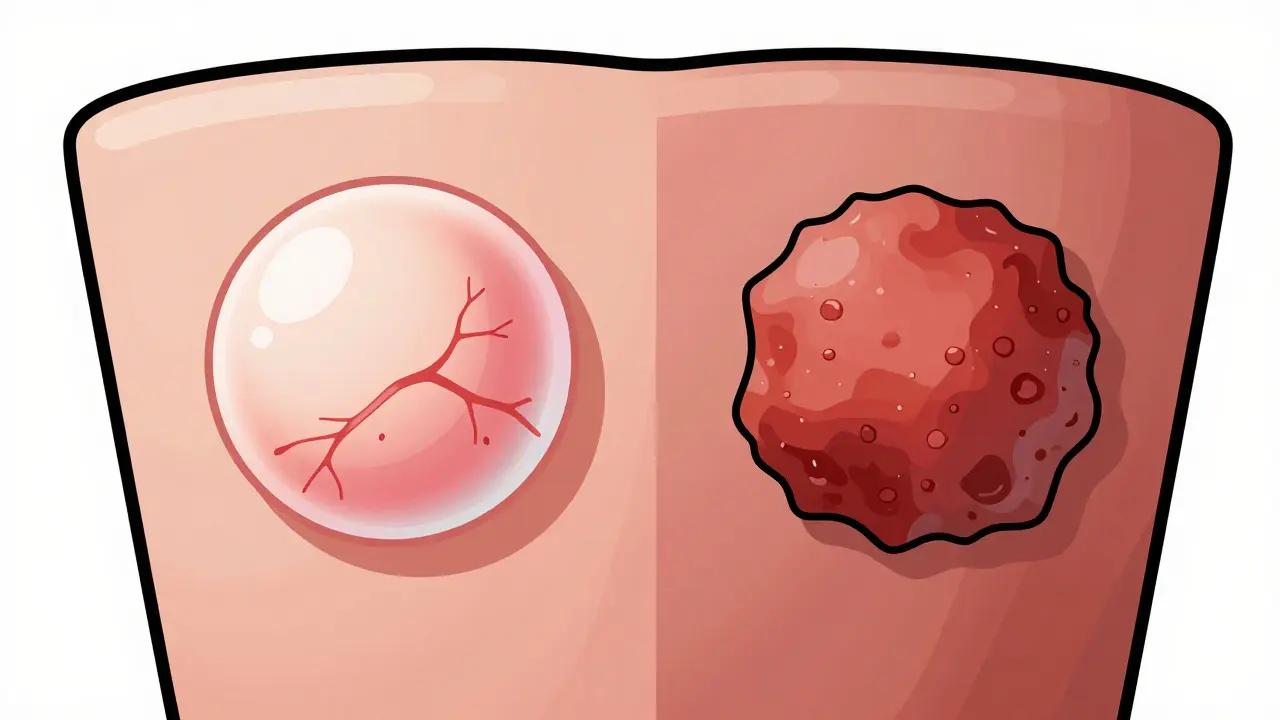
| Appearance | Pearly or waxy bump; shiny translucent patch; sore that bleeds and doesn't heal. | Firm red nodule; flat lesion with scaly crust; wart-like growth; open sore. |
| Texture | Smooth, pearly, often with visible blood vessels (telangiectasia). | Rough, scaly, crusted, or calloused. |
| Growth Speed | Slow (0.5-1.0 cm per year). | Faster (1.5-2.0 cm per year); can double in weeks if aggressive. |
| Bleeding | May bleed easily when bumped. | Often crusts over and bleeds repeatedly. |
| Pain | Usually painless unless ulcerated. | Can be tender or painful, especially if inflamed. |
If you see a pearly bump on your nose, think BCC. If you notice a rough, scaly patch on your forearm that feels like sandpaper, think SCC. Neither is an emergency room situation, but neither should wait. A dermatologist can often identify these visually, sometimes using dermoscopy for a closer look.
Risk Factors: Who Is Most Vulnerable?
Sun exposure is the primary culprit, but not everyone faces the same level of risk. Several factors increase your likelihood of developing either type of skin cancer.
- Skin Type: Fair-skinned individuals with light eyes and hair that burns easily are at highest risk. Melanin provides some natural protection against UV rays.
- History of Sunburns: Intense, intermittent sunburns (especially in childhood) are strongly linked to BCC. Cumulative, long-term sun exposure is more closely tied to SCC.
- Age: Risk increases dramatically after age 50. Eighty-five percent of cases occur in people over 50.
- Gender: BCC affects men and women relatively equally (55% male, 45% female). SCC shows a stronger male predominance (65% male), likely due to historical occupational sun exposure differences.
- Immunosuppression: Organ transplant recipients face a drastically elevated risk. Their risk of SCC is 250 times higher than the general population, while BCC risk is only 10 times higher.
- Geography: Living closer to the equator or in high-altitude areas increases UV exposure. In Australia, SCC makes up 30% of skin cancers compared to 15% in northern Europe.
If you fall into multiple high-risk categories, such as being an older, fair-skinned man with a history of outdoor work, your vigilance needs to be higher. Quarterly dermatological exams are recommended for high-risk patients.

Why Squamous Cell Carcinoma Is More Serious
This is the critical distinction that many patients miss. Both BCC and SCC have cure rates exceeding 90% when detected early. So why do doctors treat SCC with more urgency?
The answer lies in metastasis-the spread of cancer to other parts of the body. BCC rarely metastasizes, occurring in fewer than 0.1% of cases. Its danger is local: it eats away at nearby tissue, cartilage, and bone if ignored for years. SCC, however, metastasizes in approximately 2-5% of cases. In high-risk locations like the lips or ears, that rate jumps to up to 15%.
Once SCC spreads, the prognosis drops sharply. The 5-year survival rate for localized SCC is 95%, but it falls to 25-45% if metastasis occurs. Dr. John Zitelli, past president of the American College of Mohs Surgery, notes that while BCC is more common, SCC requires more urgent attention due to this metastatic potential. Additionally, SCC grows about three times faster than BCC. Aggressive subtypes can double in size within 4-6 weeks, leaving less time for detection before deeper invasion occurs.
Treatment Options: What to Expect
Treatment depends on the type, size, location, and depth of the tumor, as well as your overall health. Early detection simplifies treatment significantly.
Basal Cell Carcinoma Treatments
Because BCC grows slowly and rarely spreads, treatment options are varied and often less invasive for superficial lesions.
- Topical Medications: Creams like imiquimod or 5-fluorouracil can be effective for superficial BCC, achieving 60-70% clearance rates.
- Curettage and Electrodessication: The doctor scrapes away the cancer and uses heat to destroy remaining cells. Common for small, low-risk BCCs.
- Cryotherapy: Freezing the cancer cells with liquid nitrogen.
- Surgical Excision: Cutting out the tumor with a margin of healthy skin.
Squamous Cell Carcinoma Treatments
SCC often requires more aggressive approaches due to its potential for deeper invasion and recurrence.
- Mohs Micrographic Surgery: This is the gold standard for high-risk SCC and facial BCC. The surgeon removes thin layers of skin, examining each under a microscope until no cancer cells remain. It achieves 97% cure rates for primary SCC and spares maximum healthy tissue.
- Wide Local Excision: Standard surgery with wider margins (4-10 mm) compared to BCC (3-5 mm) to ensure complete removal.
- Radiation Therapy: Often used for elderly patients or those where surgery is difficult, particularly for SCC on the head and neck.
- Immunotherapy: For advanced, metastatic SCC, drugs like cemiplimab (Libtayo) target the immune system to fight cancer, showing response rates of 47% in metastatic cases.
On average, BCC treatment requires 1.2 procedures, while SCC requires 1.8 procedures due to the need for more extensive margins and follow-up. Patients with SCC also report needing more reconstructive surgery (45% vs. 28% for BCC) because the tumors often invade deeper tissues.

Prevention and Monitoring
Prevention is always better than cure. Since UV radiation is the main driver, sun protection is key. Daily use of broad-spectrum sunscreen reduces BCC risk by 40% and SCC risk by 50%. Wear protective clothing, hats, and sunglasses. Seek shade during peak sun hours (10 am to 4 pm).
For those already diagnosed, monitoring is crucial. Recurrence is possible. Seventy-three percent of recurrent SCC cases are detected within 12 months of prior treatment, compared to 18 months for BCC. This means SCC patients need more frequent follow-ups. High-risk patients should see a dermatologist every three months initially.
Perform self-exams monthly. Use the ABCDE rule (Asymmetry, Border, Color, Diameter, Evolving) typically associated with melanoma, but adapt it for nonmelanoma: look for anything new, changing, bleeding, or not healing. If a spot persists for more than two weeks, get it checked.
Living With a Diagnosis
A diagnosis of nonmelanoma skin cancer can be frightening, but it’s important to stay calm. The outlook is excellent for both BCC and SCC when treated promptly. Patient surveys indicate that while SCC patients experience higher anxiety about metastasis (85% vs. 42% for BCC), the vast majority achieve complete resolution with proper care. Ninety-two percent of BCC patients and 78% of SCC patients resolve completely with one treatment course.
Cosmetic concerns are valid, especially for facial lesions. Modern techniques like Mohs surgery prioritize tissue preservation to minimize scarring. Discuss aesthetic outcomes with your surgeon beforehand. Remember, treating the cancer effectively is the priority; reconstruction can address appearance later if needed.
Is basal cell carcinoma or squamous cell carcinoma worse?
Squamous cell carcinoma (SCC) is generally considered more serious than basal cell carcinoma (BCC) because it has a higher potential to spread (metastasize) to other parts of the body. While BCC rarely spreads (<0.1% of cases), SCC metastasizes in 2-5% of cases, with higher rates in high-risk areas like the lips and ears. SCC also grows faster and may require more aggressive treatment.
Can you cure nonmelanoma skin cancer without surgery?
Yes, in some cases. Superficial basal cell carcinomas can sometimes be treated with topical medications like imiquimod or 5-fluorouracil. Cryotherapy (freezing) and radiation therapy are also non-surgical options. However, surgical methods like excision or Mohs surgery remain the gold standard for most cases due to their high cure rates and ability to confirm complete removal via pathology.
How fast does squamous cell carcinoma grow?
SCC grows faster than BCC, averaging 1.5-2.0 cm per year. Aggressive subtypes can double in size within 4-6 weeks. This rapid growth is why prompt evaluation of new, growing, or changing skin lesions is essential.
Who is at highest risk for skin cancer?
People with fair skin, light eyes, and a history of sunburns are at higher risk. Age is a major factor, with 85% of cases occurring in people over 50. Men are more likely to develop SCC. Immunocompromised individuals, such as organ transplant recipients, face a dramatically increased risk, particularly for SCC.
What are the side effects of Mohs surgery?
Mohs surgery is highly effective but involves removing layers of skin, which can result in a larger wound than expected. Side effects include pain, swelling, bruising, and infection risk. The main concern is cosmetic, as the resulting scar depends on the size and location of the removed tissue. Reconstruction may be needed immediately or later to improve appearance.
Does insurance cover skin cancer treatment?
Most health insurance plans, including Medicare, cover medically necessary skin cancer treatments like excision, Mohs surgery, and radiation. Coverage details vary by plan, so check with your provider regarding copays, deductibles, and whether specific procedures or follow-up visits are included.
Can nonmelanoma skin cancer come back?
Yes, recurrence is possible, especially if the initial treatment didn't remove all cancer cells or if new sun damage occurs. SCC has a higher recurrence rate than BCC. Regular follow-up appointments with a dermatologist are crucial to catch any recurrence early. High-risk patients may need exams every 3-6 months.
What is the survival rate for metastatic squamous cell carcinoma?
If SCC metastasizes, the 5-year survival rate drops significantly to between 25% and 45%, depending on the extent of spread and patient health. This underscores the importance of early detection and treatment before the cancer spreads beyond the skin.