Generic Drug Availability: From Patent Expiration to Market Launch
 Jun, 18 2026
Picture this: A life-saving medication’s patent expires today. You’d expect the cheaper generic version to hit the pharmacy shelves tomorrow, right? Wrong. In reality, there is often a frustrating gap-sometimes lasting years-between that legal expiration date and the day you can actually buy the generic pill. Why does this happen? It isn’t just bureaucracy; it is a complex web of laws, lawsuits, and manufacturing hurdles designed to protect big pharma profits while trying to keep prices low for everyone else.
Understanding this timeline is crucial for patients, insurers, and policymakers who want affordable medicine. The journey from patent expiration is the moment when a brand-name drug's intellectual property protection ends, theoretically allowing competitors to produce identical versions to actual market launch involves navigating the Hatch-Waxman Act is a 1984 US law that created the Abbreviated New Drug Application (ANDA) pathway, balancing innovation incentives with generic competition. This guide breaks down exactly what happens in that gap, why it exists, and how recent changes are reshaping the landscape.
The Legal Framework: How Generics Get Approved
To understand the delay, we first need to look at the rules of the game. Before 1984, generic manufacturers had to repeat all the expensive clinical trials that brand-name companies did. That was too costly, so few generics were made. Then came the Drug Price Competition and Patent Term Restoration Act of 1984 is commonly known as the Hatch-Waxman Act, which established the modern framework for generic drug approval by allowing abbreviated applications based on bioequivalence rather than new clinical trials.
This act introduced the Abbreviated New Drug Application (ANDA) is a regulatory submission pathway that allows generic manufacturers to prove their drug is bioequivalent to an existing reference listed drug without repeating costly human clinical trials. Instead of proving safety and efficacy from scratch, generic makers just have to show their version works the same way in the body as the original. This sounds simple, but the FDA still has to review these applications carefully. According to the FTC’s 2020 study, the average time for the FDA to review and approve an ANDA is about 25 months. That’s over two years of just waiting for regulators to say "yes" before a single pill is sold.
But approval isn’t enough. Even if the FDA says the drug is safe, the company can’t sell it if they are infringing on active patents. This leads us to the biggest hurdle: the patent thicket.
The Patent Thicket: Layers of Protection
A standard pharmaceutical patent lasts 20 years from the filing date. However, developing a new drug takes 8 to 10 years of research and testing. So, by the time the drug hits the market, the company only has 10 to 12 years of exclusive sales left. To extend this monopoly, brand-name companies file multiple patents for different aspects of the drug.
These aren’t just one-off protections. They create a "thicket" of legal barriers:
- Active Ingredient Patents: Protect the core chemical molecule.
- Formulation Patents: Protect how the drug is delivered (e.g., extended-release capsules).
- Manufacturing Process Patents: Protect the specific method used to make the drug.
- Method-of-Use Patents: Protect specific medical conditions the drug treats.
Professor Robin Feldman of UC Hastings College of the Law found that brand-name manufacturers list an average of 14.2 patents per drug in the FDA Orange Book is an official publication listing approved drug products along with their patent and exclusivity information, serving as the primary reference for generic applicants to identify potential legal barriers. This creates massive uncertainty. Generic companies don’t know exactly when they can enter the market because there are so many overlapping dates to watch.
Regulatory Exclusivity vs. Patents
Even if there are no patents, the FDA grants periods of "exclusivity" that legally block generics. These are not patents, but they function similarly by preventing approval. Here is how the major types break down:
| Exclusivity Type | Duration | Purpose |
|---|---|---|
| New Chemical Entity (NCE) | 5 Years | Rewards companies for discovering entirely new drugs. |
| New Clinical Investigation | 3 Years | Incentivizes studies on new uses or formulations. |
| Orphan Drug Exclusivity (ODE) | 7 Years | Encourages development for rare diseases with small markets. |
| Pediatric Exclusivity | 6 Months | Adds time to existing protections for child-specific studies. |
For example, an orphan drug might have its main patent expire, but if it still has Orphan Drug Exclusivity, no generic can be approved for seven years from the date the brand got its marketing approval. This layered system means that "patent expiration" is rarely the true start line for generics.
The Paragraph IV Certification Race
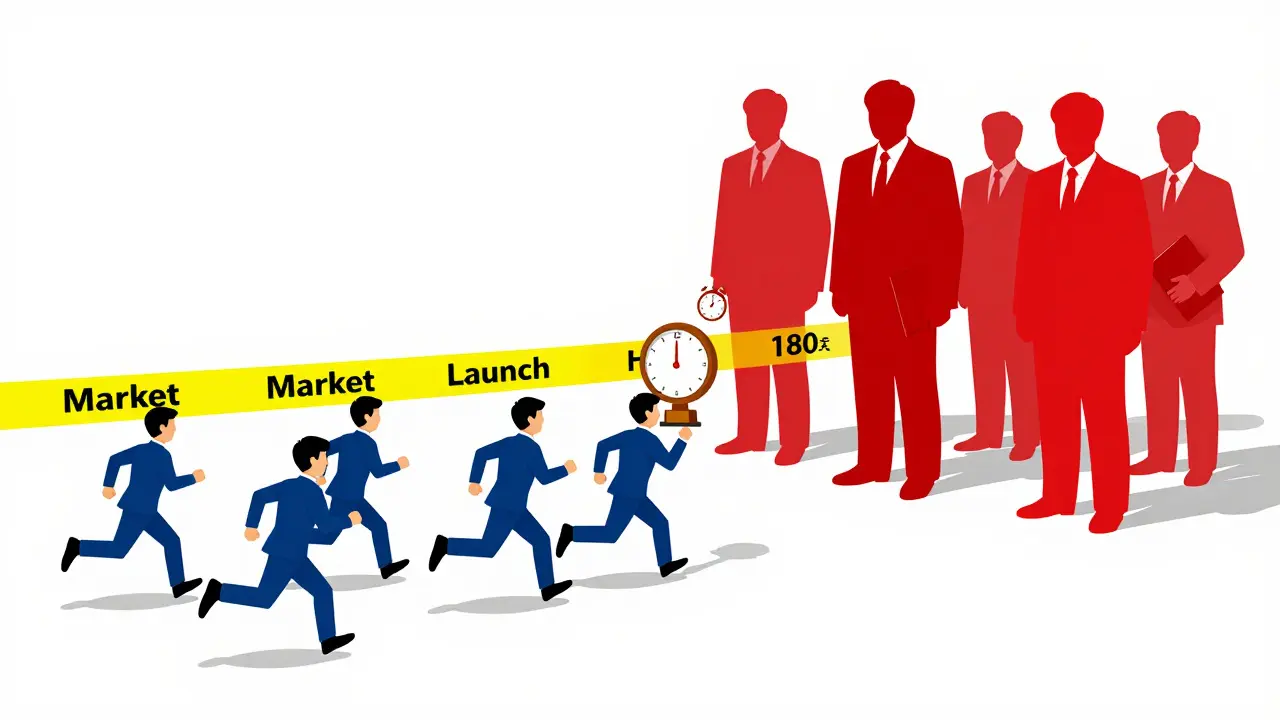
So, how do generics get around these patents? They challenge them. Under the Hatch-Waxman Act, a generic manufacturer can file a Paragraph IV Certification is a legal declaration by a generic applicant stating that a patent listed in the Orange Book is invalid, unenforceable, or will not be infringed by the generic product. This is essentially saying, "Your patent is weak, and we are going to sue to prove it." When a brand-name company receives this notice, they have 45 days to sue. If they do, the FDA triggers a 30-month stay. This pauses the approval clock for 30 months while the courts decide the case. It’s a strategic move that gives the brand-name company breathing room to negotiate settlements or win in court. The winner of this race gets a huge prize: 180-day exclusivity. The first generic company to successfully challenge the patent gets to be the only generic seller for six months. This creates a fierce competition among generic makers. They spend millions on legal fees and development just to be the first filer. According to the FTC, 87% of successful Paragraph IV challenges result in generic entry within that 180-day window. But if the first filer fails to launch quickly-due to manufacturing issues or further lawsuits-they can lose that exclusivity. In 2022, 22% of first generic applicants forfeited their exclusivity due to delays.
Why the Gap Persists: Litigation and Settlements
You might think the 30-month stay is the main bottleneck. Surprisingly, it’s not. Research published in PMC in 2021 showed that generic launches occurred, on average, 3.2 years *after* the 30-month stay expired. Why? Because litigation drags on.
The average time between a patent infringement lawsuit and a final court of appeals decision is nearly 3 years and 4 months. During this time, the generic sits in limbo. Brand-name companies often use this time to settle. Sometimes, these are "reverse payment" settlements, where the brand pays the generic company to stay away from the market. While the Supreme Court ruled in 2021 (*Amarin Pharma v. Helsinn Healthcare*) that secret settlements violate antitrust laws, these deals still happen openly. The FTC estimates that patent litigation settlements cost consumers approximately $3.5 billion annually by delaying cheaper options.
Additionally, "patent evergreening" is a growing tactic. A 2024 Brookings Institution study found that 68% of brand-name drugs receive at least one new patent within 18 months of the original expiration. Companies tweak the formulation slightly-maybe changing the color of the coating or the release mechanism-and file a new patent. This resets the clock for generics, forcing them to start the legal battle all over again.
Differences by Drug Type: Small Molecules vs. Biologics
Not all drugs face the same timeline. The type of medicine matters significantly.
Small Molecule Drugs: These are traditional pills and capsules. They typically see generic entry within 1.5 years of patent expiration. The chemistry is well-understood, and bioequivalence is easier to prove. Cardiovascular drugs, however, face longer delays (averaging 3.4 years) due to complex patent thickets.
Biologics: These are large, complex molecules made from living organisms (like insulin or cancer therapies). They are much harder to copy. The Biologics Price Competition and Innovation Act (BPCIA) is a 2010 law part of the Affordable Care Act that created a separate, more complex pathway for approving biosimilars, resulting in longer delays compared to small molecule generics governs these. Complex biologics face an average delay of 4.7 years after patent expiration. The science is newer, the manufacturing is trickier, and the regulatory scrutiny is higher. As of 2026, biosimilars capture about 28% of the market for reference biologics, but the Congressional Budget Office forecasts this could rise to 45% by 2030.
Economic Impact and Market Consolidation
Why does this timing matter? Money. Generic drugs accounted for 92% of all prescriptions filled in the US in 2023, but only 16% of total drug spending. They save the healthcare system $373 billion annually. When generic entry is delayed, those savings vanish. The Congressional Budget Office estimated that a one-year delay in generic entry for a top 10 drug costs Medicare $1.2 billion every year.
The market itself is also changing. It is becoming more consolidated. Teva, Viatris, and Sandoz control 45% of the $70 billion US generic market. With fewer players, the incentive to fight hard for that 180-day exclusivity is even greater. High-revenue drugs (those making over $1 billion a year) face an average of 17.3 patent challenges per product. This "patent thicket effect" delays generic entry by an average of 1.8 years compared to lower-revenue drugs.
Future Outlook: AI and Regulatory Shifts
Is there hope for faster access? Yes, technology and policy are shifting. The FDA’s 2024 strategic plan highlights the adoption of artificial intelligence in bioequivalence testing. AI could reduce generic development timelines by 25% by predicting how drugs behave in the body without needing as many physical tests.
Regulatory reforms are also helping. The Orange Book Transparency Act of 2020 is legislation requiring more precise and timely patent listing information in the FDA Orange Book, which reduced patent listing disputes by 32% in its first year of implementation has already cut down on some legal confusion. And GDUFA II, implemented in 2023, aims to speed up reviews for complex generics. However, as of Q2 2024, only 62% of complex generic applications met the new 24-month review target.
FDA Commissioner Robert Califf noted in February 2024 that despite improvements, the median time from patent expiration to generic availability remains 18 months. It’s a significant barrier, but the tools to break it down are getting sharper.
What is the average time from patent expiration to generic drug availability?
On average, it takes about 18 to 21 months from the date of patent expiration for a generic drug to become available on the market. However, this varies widely by therapeutic class and the complexity of the patent thicket. For small molecule drugs, it can be as short as 1.5 years, while biologics may take up to 4.7 years.
What is a Paragraph IV certification?
A Paragraph IV certification is a legal statement filed by a generic drug manufacturer asserting that a patent listed in the FDA Orange Book is invalid, unenforceable, or will not be infringed by their generic product. Filing this triggers a 30-month stay on FDA approval if the brand-name company sues for patent infringement.
Why do brand-name companies file multiple patents for one drug?
Brand-name companies file multiple patents (a "patent thicket") covering the active ingredient, formulation, manufacturing process, and method of use to extend their market exclusivity beyond the initial 20-year patent term. This makes it legally difficult and risky for generic manufacturers to enter the market early.
What is the 180-day exclusivity period for generics?
The 180-day exclusivity period is a reward granted to the first generic manufacturer to successfully challenge a brand-name drug's patents via a Paragraph IV certification. This company gets to be the sole generic supplier for six months, incentivizing rapid legal challenges and market entry.
How do biologics differ from small molecule drugs in terms of generic entry?
Biologics are complex molecules made from living organisms and are governed by the BPCIA pathway, which is more stringent than the ANDA pathway for small molecules. Consequently, biosimilars face longer delays, averaging 4.7 years post-patent expiration, compared to 1.5 years for typical small molecule drugs.
What is the economic impact of delayed generic entry?
Delayed generic entry significantly increases healthcare costs. The Congressional Budget Office estimates that a one-year delay in generic entry for a top 10 drug costs Medicare $1.2 billion annually. Overall, timely generic competition saves the US healthcare system hundreds of billions of dollars each year.
What is "patent evergreening"?
Patent evergreening is a strategy where brand-name manufacturers obtain new patents for minor changes to a drug (such as a new formulation or delivery method) shortly before the original patent expires. This extends market exclusivity and forces generic competitors to face new legal hurdles.
How does the Hatch-Waxman Act balance innovation and competition?
The Hatch-Waxman Act balances interests by granting brand-name companies patent term restoration to compensate for development time, while creating the ANDA pathway that allows generics to bypass costly clinical trials. It also provides incentives (180-day exclusivity) for generics to challenge weak patents early.