Hormone Replacement Therapy: Benefits, Risks, and Monitoring Guide
 Aug, 17 2026
Hot flashes that wake you at 3 a.m. Vaginal dryness making intimacy painful. Bones feeling fragile after a minor fall. If you are navigating menopause, Hormone Replacement Therapy (HRT) is a medical treatment that replenishes declining levels of estrogen and sometimes progesterone to alleviate symptoms and prevent certain health conditions. For decades, this treatment has been the most effective way to manage these changes, yet it remains one of the most misunderstood topics in women's healthcare. You might have heard horror stories from the early 2000s or conflicting advice from social media. The reality is more nuanced: when started at the right time and monitored correctly, HRT offers significant relief with manageable risks.
This guide cuts through the noise. We will look at how HRT actually works, who benefits most, what the real risks are based on recent data, and exactly how your doctor should monitor your progress. By the end, you will have the specific facts needed to have a confident conversation with your healthcare provider.
The Core Benefits: More Than Just Hot Flashes
While stopping hot flashes is the most common reason for starting HRT, the benefits extend further into long-term health. According to the North American Menopause Society (NAMS), the primary value proposition is effective relief of vasomotor symptoms, but there are other critical advantages.
- Vasomotor Symptom Relief: HRT reduces hot flashes and night sweats by 80-90%, significantly outperforming non-hormonal alternatives like SSRIs, which typically reduce symptoms by only 50-60%.
- Bone Health Protection: A major study known as the Women's Health Initiative (WHI) found that HRT reduces fracture risk by 34% compared to placebo. This makes it highly effective for short-term osteoporosis prevention.
- Cardiovascular Timing Benefit: If started before age 60 or within 10 years of menopause onset, HRT is associated with a 32% reduction in coronary heart disease risk. Starting later offers no such benefit and may carry higher risks.
- Quality of Life: Clinical reports indicate that 78% of participants in early studies reported significant improvement in overall well-being within just three months of starting treatment.
The "timing hypothesis" is key here. Your body responds differently to estrogen depending on when you introduce it. Early initiation maximizes the protective effects on the heart and bones, while late initiation focuses primarily on symptom management.
Understanding the Types and Delivery Methods
Not all HRT is created equal. The type of hormone and how it enters your body determine both effectiveness and side effect profiles. There are two main categories based on your anatomy:
- Estrogen Therapy (ET): Used for women who have had a hysterectomy (no uterus). It contains only estrogen.
- Estrogen-Progestogen Therapy (EPT): Used for women with an intact uterus. Progestin is added to protect the lining of the uterus (endometrium) from overgrowth, which can lead to cancer.
Delivery method matters just as much as the hormone itself. Here is how the common methods compare:
| Method | Common Forms | Key Advantage | Risk Profile |
|---|---|---|---|
| Oral | Pills (e.g., Premarin, Estrace) | Convenient, precise dosing | Higher risk of blood clots; passes through liver |
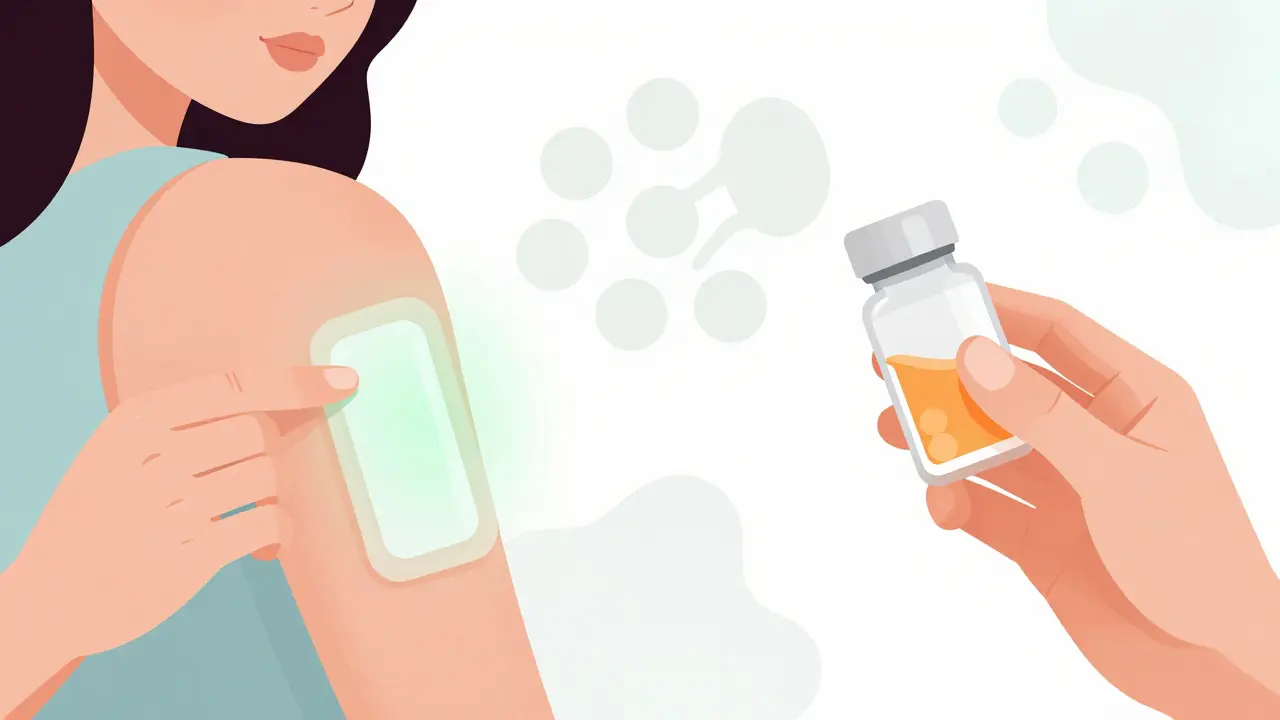
| Transdermal | Patches, Gels (e.g., EstroGel) | Lowers clot risk; bypasses liver | Skin irritation possible; requires daily application |
| Vaginal | Rings, Creams, Tablets | Targets local symptoms (dryness); minimal systemic absorption | Best for mild symptoms; not for bone protection |
Recent data highlights a significant safety advantage for transdermal options. A 2018 systematic review found that transdermal estrogen carries a 1.5 to 2-fold lower risk of venous thromboembolism (blood clots) compared to oral estrogen. Specifically, the absolute risk of deep vein thrombosis is approximately 1.3 per 1,000 women-years for transdermal use versus 3.7 per 1,000 for oral use. For many patients, especially those with a history of migraines or higher clotting risk, this difference is decisive.
Realistic Risk Assessment: What the Data Says
Fear often drives decisions about HRT, but fear based on outdated data leads to poor health outcomes. The landscape changed dramatically after the WHI study results were published in 2002, which revealed previously unrecognized risks. However, subsequent analyses and the FDA's 2022 labeling updates have clarified the picture.
Here are the specific risks to discuss with your doctor:
- Breast Cancer: The WHI study found a 26% increased relative risk of invasive breast cancer with combined EPT use over 5.6 years. However, in absolute terms, this translates to about 8 additional cases per 10,000 women-years. For most women, the baseline risk remains low, but family history plays a crucial role.
- Stroke and Clots: Oral HRT slightly increases stroke risk, particularly in women over 60. Transdermal HRT mitigates this significantly, showing a 30-50% lower risk of stroke and blood clots compared to oral administration.
- Endometrial Cancer: This is a risk only if estrogen is taken without progestin in women with a uterus. Proper EPT formulation eliminates this specific concern.
It is also worth noting the controversy around "bioidentical" hormones. While marketed as safer, the Endocrine Society states there is insufficient evidence that compounded bioidenticals are superior to prescription versions. Prescription HRT is regulated by the FDA, ensuring consistent purity and dosage, whereas compounded products vary by pharmacy.
Who Should Consider HRT? And Who Should Avoid It?
HRT is not a one-size-fits-all solution. The decision depends heavily on your individual health profile. Generally, HRT is recommended for women with moderate-to-severe vasomotor symptoms who are under age 60 or within 10 years of menopause onset.
However, certain conditions make HRT a poor choice or require extreme caution. Contraindications include:
- History of breast cancer
- Active cardiovascular disease (heart attack, stroke)
- History of venous thromboembolism (DVT or PE)
- Unexplained vaginal bleeding
- Active liver disease
If you fall into any of these categories, non-hormonal treatments like gabapentin, clonidine, or specific SSRIs might be better initial steps. Your doctor will weigh these factors against your symptom severity to create a personalized plan.
The Monitoring Protocol: Keeping Things Safe
Starting HRT is just the beginning. Regular monitoring ensures the therapy continues to work and that no new risks emerge. The Endocrine Society recommends using the lowest effective dose for the shortest duration necessary, typically starting with low-dose transdermal estradiol or equivalent oral doses.
Your monitoring schedule should look like this:
- Baseline (Before Starting): Mammography, clinical breast exam, pelvic exam, blood pressure measurement, and BMI calculation. This establishes your normal values.
- 3-Month Follow-up: Assess symptom improvement and side effects. This is a critical checkpoint to adjust dosage if needed.
- Annual Check-ups: Repeat blood pressure checks, weight monitoring, breast exams, and discussion of any new concerns. Mammograms continue according to standard screening guidelines (usually every 1-2 years).
A common challenge during the first six months is irregular bleeding, occurring in 30-50% of users. This is usually temporary and resolves as your body adjusts. However, if bleeding persists beyond six months, your doctor should perform an endometrial evaluation to rule out underlying issues.

Navigating Side Effects and Discontinuation
Many women stop HRT not because it doesn't work, but because of side effects or anxiety. Understanding what is normal helps you stay on track.
Common side effects include:
- Breast Tenderness: Reported by about 17% of users. Often subsides after a few weeks.
- Nausea: More common with oral pills (28%) than transdermal patches (12%). Switching delivery methods can solve this.
- Mood Changes: Some women report mood swings initially. Adjusting the type of progestin used in EPT can often help stabilize mood.
Discontinuation rates are high-around 35% within the first year. The top reasons are fear of breast cancer (cited by 48% of those who stopped) and vaginal bleeding (22%). If you are considering quitting, talk to your doctor first. They can help distinguish between true adverse reactions and temporary adjustments, potentially saving you from unnecessary symptom return.
Future Directions and Personalized Care
The field of HRT is evolving rapidly. Recent developments focus on personalization. For instance, pharmacogenomics research suggests that variants in the CYP1B1 gene predict how well your body metabolizes estradiol, allowing for more tailored dosing. Additionally, new formulations like tissue-selective estrogen complexes (TSECs) aim to provide the benefits of estrogen for bones and symptoms while reducing impact on the uterus and breasts.
As guidelines become clearer and providers better educated, we expect appropriate HRT use to increase. The goal is simple: ensure that women who need relief get it safely, without being paralyzed by outdated fears.
Is HRT safe for women over 60?
It depends. For women starting HRT after age 60 or more than 10 years post-menopause, the cardiovascular benefits diminish, and the risk of blood clots and stroke may increase. However, if the primary goal is managing severe hot flashes or preventing fractures, HRT can still be beneficial. The decision must be made carefully with a doctor, weighing the specific risks against the symptom burden.
Do I need progestin if I have had a hysterectomy?
Generally, no. If you have had a total hysterectomy (removal of the uterus and cervix), you do not need progestin because there is no uterine lining to protect. You can use Estrogen Therapy (ET) alone. However, if you had a partial hysterectomy where the uterus was left in place, you still need progestin.
What is the difference between bioidentical and synthetic HRT?
Bioidentical hormones are molecularly identical to those produced by the human body. Synthetic hormones are man-made but mimic the action of natural hormones. While some claim bioidenticals are safer, major medical bodies like the Endocrine Society note that prescription bioidenticals (like estradiol) are well-studied and safe. Compounded bioidenticals lack rigorous regulation and consistent quality control, so they are not necessarily safer or more effective.
How long should I take HRT?
There is no hard cutoff. The general guideline is to use the lowest effective dose for the shortest duration necessary to manage symptoms. Many women take HRT for 5-10 years. After that, you and your doctor can reassess whether you still need it. Some women stop and restart if symptoms return, while others continue indefinitely if they tolerate it well and have no contraindications.
Can HRT cause weight gain?
HRT itself does not directly cause weight gain. Any weight changes are likely due to aging, metabolic slowdown, or lifestyle factors rather than the medication. In fact, some studies suggest HRT may help maintain muscle mass and bone density, which supports healthy metabolism. If you notice sudden swelling or fluid retention, discuss it with your doctor, as this could be a sign of an adverse reaction.