Penicillin Allergy Testing: How to Remove the Label and Avoid Side Effects
 Aug, 3 2026
Penicillin Allergy Risk & Cost Estimator
Enter your details to see your estimated allergy risk category and potential annual cost savings.
Your Estimated Risk Level
Financial Impact Analysis
- Current Annual Cost: $0
- Potential De-labeled Cost: $0
- Annual Savings: $0
Recommended Next Steps
1. Review History
Write down details of your original reaction (timing, symptoms).
2. Consult Doctor
Ask about antibiotic stewardship programs or allergist referrals.
3. Get Tested
Undergo skin testing and oral challenge if deemed appropriate.
4. Update Records
Ensure your electronic medical record is updated upon passing.
You might be one of the ten people in the United States who carry a "penicillin allergy" label on their medical record. For most of us, that sticker feels like a safety net. It tells doctors what to avoid so we don’t end up in an emergency room. But here is the catch: about 90% of those labels are wrong. You probably aren’t allergic at all. And because of that mistaken tag, you are likely taking stronger, more expensive, and riskier antibiotics than you need.
Keeping a false penicillin allergy label doesn't just limit your options; it actively harms your health. Patients with these labels face a higher risk of surgical site infections, treatment failures, and serious gut issues like Clostridioides difficile (C. diff) infection. The good news? There is a proven way to clear this label. Through a process called penicillin allergy testing, which involves a series of clinical evaluations including skin tests and oral challenges to determine if a patient can safely tolerate penicillin-class antibiotics, you can get "de-labeled." This simple step restores access to safer, cheaper, and more effective medicines.
The Hidden Cost of a False Label
Why does this matter so much? Penicillin and its relatives, known as beta-lactam antibiotics, are the gold standard for treating many common infections. They are cheap, effective, and generally safe. When you tell your doctor you’re allergic, they have to pivot. They often prescribe alternatives like fluoroquinolones or clindamycin.
These alternative drugs are not just different; they are worse in several key ways. First, they cost more. A course of amoxicillin costs around $34.50, while alternative antibiotics can run you nearly $100 per course. That’s a 63% price hike for no reason if you aren’t actually allergic. Second, they are less effective. Studies show that patients with penicillin allergy labels have a 30% higher rate of treatment failure for common infections. Third, they are harder on your body. Using these broad-spectrum alternatives increases your risk of developing a C. difficile infection by 2.5 times. C. diff is a nasty bacterial infection that causes severe diarrhea and can be life-threatening.
So, why do we keep these labels? Often, it’s due to confusion from childhood. A mild rash, a stomach bug, or even a viral illness coinciding with antibiotic use gets recorded as an "allergy." Once it’s in the electronic medical record, it travels with you forever unless someone takes the time to investigate. This is where antibiotic stewardship comes in. Stewardship programs are hospital initiatives designed to ensure antibiotics are used correctly. Removing false allergy labels is a cornerstone of these programs because it reduces the overuse of powerful, last-resort antibiotics.
Who Should Get Tested?
Not everyone needs a full workup, but almost everyone with a penicillin allergy label should consider getting evaluated. The Centers for Disease Control and Prevention (CDC) and the Infectious Diseases Society of America (IDSA) recommend that any patient with a history of penicillin allergy undergo risk stratification. This means a doctor looks at your specific history to decide the next steps.
Here is how they break it down:
- Low Risk: You had a reaction years ago, it was a delayed rash (appearing more than 72 hours after starting the drug), or you were told you were allergic because a family member was. These cases are rarely true IgE-mediated allergies.
- Moderate Risk: You had hives, itching, or swelling within six hours of taking the medication. This suggests an immune response, but it might not be severe enough to warrant lifelong avoidance.
- High Risk: You experienced anaphylaxis (difficulty breathing, throat closing, drop in blood pressure) or had a reaction very recently (within the last 10 years).
If you fall into the low-risk category, you might not even need a skin test. Your doctor might proceed directly to a "graded challenge," where you take small, increasing amounts of the drug under observation. If you have moderate or high-risk symptoms, formal penicillin skin testing (PST) is usually required first.
How the Testing Process Works
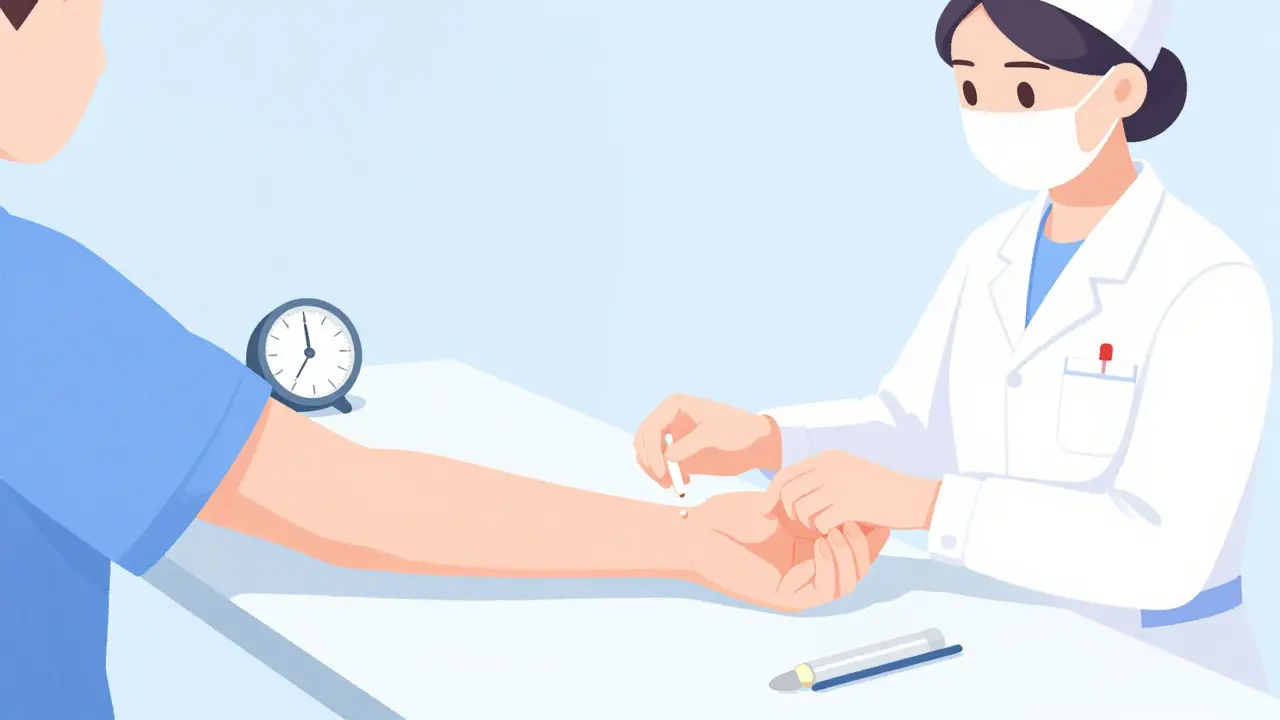
Many people fear the word "skin test," imagining painful injections or dangerous exposures. In reality, the process is quick, minimally invasive, and highly accurate when done correctly. The goal is to see if your immune system reacts to the specific parts of the penicillin molecule that cause immediate allergic reactions.
The standard protocol takes about 45 to 60 minutes. It typically involves two main steps:
- Skin Prick Test: A nurse or allergist places a tiny drop of penicillin reagent on your forearm or back and gently pricks the skin. They wait 15-20 minutes to see if a raised, itchy bump (wheal) appears. This tests for surface-level sensitivity.
- Intradermal Test: If the prick test is negative, they inject a very small amount of the reagent just under the skin. This checks for deeper immune responses. Again, they wait 15-20 minutes for results.
The reagents used include the "major determinant" (penicilloyl-polylysine, often sold as Pre-Pen) and "minor determinants" (like benzylpenicillin). In the U.S., Pre-Pen is the only FDA-approved skin test antigen for this purpose. If both skin tests are negative, it’s a great sign, but it’s not the final answer. Because skin tests have a sensitivity of only about 30-35%, a negative result doesn't guarantee safety on its own. Therefore, the next step is crucial.
The Oral Challenge: After negative skin tests, you will take an oral dose of amoxicillin (usually 250 mg) in a controlled setting. You stay for about an hour of observation. If you feel fine-no hives, no breathing issues, no vomiting-you pass. At this point, your risk of having a future IgE-mediated anaphylactic reaction drops to near zero. It becomes equivalent to someone who has never been labeled allergic.
When Testing Isn't the Answer
It is important to note that penicillin allergy testing is not for everyone. Specifically, it is designed to detect immediate IgE-mediated reactions (the kind that happen within an hour). It does not reliably predict delayed hypersensitivity reactions.
If your past reaction involved severe skin conditions like Stevens-Johnson syndrome, toxic epidermal necrolysis, or DRESS (drug rash with eosinophilia and systemic symptoms), you should not undergo standard skin testing. These are rare but serious conditions caused by a different part of the immune system. If you have a history of these, you must maintain your allergy label and avoid all beta-lactam antibiotics. Always discuss your specific reaction history with an allergist before proceeding.
The Future of Allergy De-labeling
The landscape of penicillin allergy care is changing rapidly. As of 2023, 68% of large U.S. hospitals have implemented formal de-labeling protocols, up from just 22% in 2018. This shift is driven by data showing that removing these labels saves money and lives. Hospitals save an average of $60.70 per antibiotic course and reduce patient length of stay by nearly a day.
New tools are also on the horizon. The FDA is currently evaluating a comprehensive skin test kit that includes major determinants, minor determinants, and amoxicillin. Early studies involving 455 patients showed this kit has a 98% negative predictive value. If approved, this could eliminate the need for the separate oral challenge step, making the entire process faster and easier for patients.
Additionally, training is expanding beyond allergists. Pharmacists and nurses in academic medical centers are now performing nearly half of all penicillin allergy assessments. This democratization of expertise means you might not need a specialist referral to get tested; your primary care provider or hospital pharmacist may be able to help.
| Feature | Penicillin-Class (e.g., Amoxicillin) | Alternatives (e.g., Fluoroquinolones) |
|---|---|---|
| Average Cost Per Course | $34.50 | $95.20 |
| Treatment Failure Rate | Baseline | 30% Higher |
| C. Diff Risk | Low | 2.5x Higher |
| Surgical Site Infection Risk | Baseline | 50% Higher |
| Availability | Widely Available | Reserved for Resistant Cases |
Steps to Take Today
If you have a penicillin allergy label, don’t just accept it as fact. Here is how to start the process of getting de-labeled:
- Review Your History: Think back to the original reaction. Was it a rash? Did it happen immediately? How old were you? Write down these details.
- Talk to Your Doctor: Mention that you want to explore penicillin allergy testing. Ask if they have an antibiotic stewardship program or a partnership with an allergist.
- Undergo Evaluation: Be prepared for a skin test and possibly an oral challenge. It’s a half-day commitment that can change your medical care for decades.
- Update Your Records: If you pass, ensure your electronic medical record is updated. Ask for a formal note stating you "tolerated the challenge" so the allergy is removed from your profile.
Removing a false penicillin allergy label is one of the most impactful things you can do for your long-term health. It protects you from unnecessary side effects, saves you money, and helps combat the broader crisis of antibiotic resistance. Don’t let a mistake from the past dictate your treatment today.
Is penicillin skin testing painful?
Most patients describe the sensation as similar to a mosquito bite or a tiny pinch. The prick test uses a shallow needle, and the intradermal test uses a very fine needle to place fluid just under the skin. Discomfort is minimal and brief.
Can I get tested if my reaction was years ago?
Yes. In fact, the longer it has been since your reaction, the less likely you are to still be allergic. Most IgE-mediated allergies wane over time. If it has been more than 10 years, your chances of passing the test are very high.
What happens if I fail the test?
If you react during the skin test or oral challenge, the process stops immediately. You are treated for the reaction (usually with antihistamines or epinephrine if severe). You will then keep your penicillin allergy label and use alternative antibiotics, knowing for certain that the label is accurate.
Does insurance cover penicillin allergy testing?
Coverage varies by plan, but many insurers recognize the value of antibiotic stewardship and cover the testing, especially if ordered by a specialist. It is worth calling your provider to check benefits for "allergy evaluation" or "drug desensitization" codes.
Are cephalosporins safe if I'm allergic to penicillin?
Often, yes. Cephalosporins are related to penicillins but have different chemical structures. Cross-reactivity is lower than previously thought, especially with newer generations of cephalosporins. An allergist can help determine if you can safely take these alternatives if penicillin is ruled out.