Choosing Antiemetics for Medication-Induced Nausea: A Practical Guide
 Jan, 28 2026
Post-Surgical Nausea Risk Calculator
How Risky Is Your Surgery?
This tool uses the Apfel PONV risk score to determine your likelihood of nausea after surgery. Based on four key factors, we'll recommend the right antiemetic strategy for you.
When you're taking medicine for pain, cancer, or even after surgery, nausea can hit hard - and it's often not the medicine itself that's the problem, but how your body reacts to it. Up to 70% of post-surgical nausea cases come from medications like opioids or anesthesia. That’s not just uncomfortable; it can delay recovery, increase hospital stays, and even make people avoid needed treatments. The good news? There are smart, proven ways to stop it - if you pick the right antiemetic for the right situation.
What Are Antiemetics, Really?
Antiemetics aren’t just "nausea pills." They’re targeted drugs that block specific signals in your brain and gut that trigger vomiting. Think of them like interrupting a faulty alarm system. Your body has a "trigger zone" near the brainstem that gets confused by certain drugs and sends false alarms: "Something’s toxic - vomit now!" Antiemetics quiet that alarm. There are seven main types, each with a different job:- 5-HT3 antagonists (ondansetron, granisetron): Block serotonin, the main trigger after chemo and surgery.
- Dopamine antagonists (droperidol, metoclopramide): Stop dopamine from stirring up nausea, especially useful with opioids.
- Corticosteroids (dexamethasone): Work slowly but boost other drugs - often used in combos.
- Antihistamines (promethazine): Better for motion sickness than drug-induced nausea.
- Anticholinergics (scopolamine patch): Useful for travel, not so much for meds.
- Sedatives (diphenhydramine, olanzapine): Calm the brain’s nausea center; good for tough cases.
- Opioid antagonists (nalmefene): Rarely used, mostly experimental.
Which One Works Best for Post-Surgery Nausea?
If you’ve had surgery, you’ve probably heard of ondansetron. It’s popular - and for good reason. In studies, it stops nausea in 65-75% of cases, compared to just 45-55% with placebo. But here’s the catch: it’s not always the best choice. Droperidol, a dopamine blocker, has been quietly outperforming ondansetron in real-world settings. In one trial, 14.5% of patients on droperidol had vomiting after surgery, while 26.7% on tropisetron (another 5-HT3 blocker) did. Droperidol also costs under $0.50 per dose - way cheaper than ondansetron’s $1.25. And here’s what many anesthesiologists are saying: for opioid-tolerant patients or those with high risk, droperidol 0.625 mg IV works better than 4 mg of ondansetron. It doesn’t cause as much dizziness or headache. Plus, it kicks in fast - within 15 minutes.The Power of Combining Drugs
One drug isn’t always enough. The most effective approach? Mixing two with different mechanisms. The gold standard combo for high-risk patients: droperidol + dexamethasone. Dexamethasone takes 4-5 hours to work, so it’s not for rescue. But if you give it before surgery, it boosts the effect of droperidol by 20-30%. In one 2023 quality study, combining 4 mg dexamethasone with 4 mg ondansetron cut rescue meds by 32% in opioid-induced nausea. Why does this work? Because nausea has multiple pathways. Blocking just one leaves the others wide open. Combine them, and you shut down the whole system.
Know Your Risk - The Apfel Score
You don’t need to guess who’s at risk. There’s a simple tool called the Apfel PONV risk score. It uses four easy-to-check factors:- Female sex (2.2x higher risk)
- Non-smoker (1.9x higher risk)
- History of motion sickness or past PONV (3.1x higher risk)
- Will get opioids after surgery (1.5x higher risk)
- 0-1 risk factors: Skip prophylaxis. Just have ondansetron ready if nausea hits.
- 2 risk factors: Give one antiemetic - droperidol 0.625 mg or ondansetron 4 mg.
- 3-4 risk factors: Use two - droperidol + dexamethasone.
What About Chemotherapy Nausea?
Chemotherapy is a different beast. It’s more intense, longer-lasting, and hits multiple pathways. Here, 5-HT3 blockers like ondansetron are still first-line - but now they’re often paired with NK-1 antagonists like rolapitant. New combo drugs like Akynzeo (netupitant + palonosetron) have shown 75% complete response rates - meaning no vomiting and no need for rescue meds - compared to 63% with ondansetron plus dexamethasone. For highly emetogenic chemo, this is a game-changer. But for most patients, generic ondansetron still works fine. The big-ticket combos? They’re for the toughest cases - or when standard drugs fail.Side Effects You Can’t Ignore
Every drug has trade-offs. Droperidol has a black box warning for QT prolongation - but only at doses over 1.25 mg. At the low doses used for nausea (0.625 mg), it’s as safe as aspirin in healthy people. Ondansetron? Common side effects: headache (reported by 32% of users) and dizziness. Rare but serious: QT prolongation in people with heart conditions or those on other QT-prolonging drugs. Metoclopramide? It can cause akathisia - a terrifying feeling of inner restlessness - in up to 8% of elderly patients. That’s why many clinics now use olanzapine 2.5-5 mg instead for older adults. Dexamethasone? Safe in single doses. But if you’re diabetic or have high blood pressure, watch your numbers.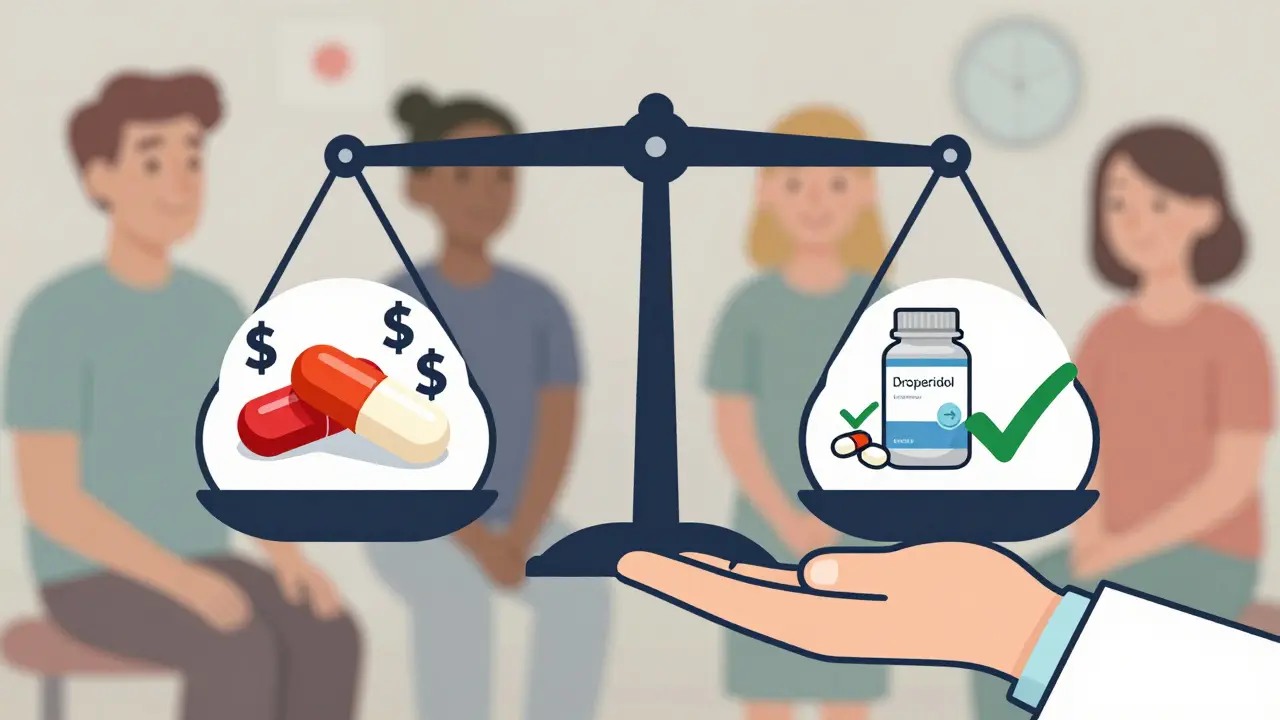
Cost Matters - A Lot
A single dose of Akynzeo can cost $350. A dose of generic ondansetron? $1.25. Droperidol? $0.50. Dexamethasone? $0.25. In a world where hospitals are under pressure to cut costs, using the right drug isn’t just about effectiveness - it’s about sustainability. Most patients don’t need the fancy new drugs. They need the proven, cheap ones - given at the right time, to the right person.What’s New and What’s Next
In 2024, the FDA approved intranasal ondansetron (Zuplenz) - great for patients who can’t swallow pills or are vomiting. Bioavailability? 89% - almost as good as IV. Future tools? Genetic testing. Some people metabolize ondansetron slowly because of CYP2D6 gene variants. They get more side effects. Others clear it too fast - and it doesn’t work. Personalized dosing is coming. The biggest shift? Moving away from "one-size-fits-all" to risk-stratified, precision antiemetic therapy. No more giving everyone ondansetron. No more guessing. Just matching the drug to the patient’s risk, the drug causing the nausea, and the timing.What to Do Right Now
If you’re a patient:- Ask: "Am I at risk for nausea after this procedure?"
- Ask: "What antiemetic will you give me - and why?"
- Don’t assume ondansetron is the best - ask about droperidol or dexamethasone.
- If you’ve had bad nausea before, tell your doctor.
- Use the Apfel score. Every time.
- For moderate risk: start with droperidol 0.625 mg.
- For high risk: droperidol + dexamethasone.
- Hold off on expensive combos unless standard drugs fail.
- Watch for metoclopramide side effects in the elderly.
Bryan Fracchia
January 28, 2026 AT 23:26Man, I wish I’d known this stuff when I had surgery last year. Ondansetron made me dizzy as hell, and they just shrugged like it was normal. Droperidol at half a milligram? That’s wild. Why aren’t we doing this everywhere?
Lance Long
January 29, 2026 AT 15:04LET ME TELL YOU ABOUT THE TIME I GOT DROPERIDOL AFTER MY KNEE SURGERY - NO HEADACHE, NO DIZZINESS, JUST SILENCE FROM MY STOMACH. IT WAS LIKE MY BODY FINALLY TOOK A BREATH. WHY IS THIS NOT STANDARD?!?!
Timothy Davis
January 30, 2026 AT 01:49Interesting, but you’re ignoring the meta-analysis from JAMA 2022 that showed no significant difference in PONV reduction between droperidol and ondansetron when adjusted for BMI and anesthesia type. Also, droperidol’s QT risk is still statistically higher in patients over 65, even at low doses. Your cost argument is valid, but safety trumps savings when you’re talking about cardiac events.
fiona vaz
January 31, 2026 AT 10:38Thank you for writing this. I’ve been telling my patients for years that ondansetron isn’t magic - and that dexamethasone is a quiet superhero. I use the Apfel score every time. It cuts down on waste and makes people feel heard. Simple tools > expensive ones.
Sue Latham
February 1, 2026 AT 14:44Oh sweetie, you really think droperidol is the answer? Honey, that’s the drug they used to use before they realized it could make people hallucinate. And now you’re pushing it like it’s organic kale? 😅
John Rose
February 3, 2026 AT 04:45This is one of the clearest summaries I’ve read on antiemetics. The distinction between mechanism-based treatment and "default to ondansetron" is critical. I’m sharing this with my med students tomorrow. Thank you for the data-driven approach.
Lexi Karuzis
February 3, 2026 AT 13:17Wait… so you’re saying the pharmaceutical companies are hiding droperidol because it’s cheap?!?! And dexamethasone? That’s a steroid - they’ve been lying about steroids for DECADES! They’re poisoning us with expensive drugs to keep us dependent! I’ve seen the emails - the FDA is in on it!!
Brittany Fiddes
February 4, 2026 AT 05:36Oh please. You Americans think you’ve invented medicine because you’ve got a spreadsheet. In the NHS, we’ve been using droperidol for 30 years - no drama, no $$$, just results. You’re still stuck on branded generics while the rest of the world got smart. Typical.
Colin Pierce
February 6, 2026 AT 04:04My grandma had chemo last year and we tried everything. Ondansetron made her worse. Then we tried olanzapine - 2.5 mg at night. She slept, didn’t vomit, and actually ate. I didn’t even know that was an option until I read this. Thank you for the real talk.
Mark Alan
February 7, 2026 AT 19:21THIS IS WHY WE NEED TO STOP PAYING FOR BRAND NAMES!! 💪 Droperidol = $0.50. Ondansetron = $1.25. Akynzeo = $350. 😳 We’re being SCAMMED. 🚨 Let’s burn the pharmacy contracts!! 🗣️🔥
Amber Daugs
February 9, 2026 AT 18:05It’s so irresponsible to suggest people skip ondansetron. What if they’re allergic? What if they have a history of anxiety? You’re acting like this is just a math problem - but people aren’t data points. You’re putting lives at risk with your "cost-effective" nonsense.
Ambrose Curtis
February 10, 2026 AT 21:01bro i just had surgery last week and they gave me ondansetron and i felt like a zombie for 2 days. then i asked for droperidol and they were like "oh we don’t use that" - like it’s some forbidden spell. why? it’s cheaper and works better. this system is broken. also i think the doc was scared of the black box warning - but they didn’t even explain it to me. dumb.
Linda O'neil
February 11, 2026 AT 22:23You’re right - this is the kind of info that changes lives. I’m a nurse, and I’ve seen so many patients suffer needlessly because we default to the same drug. I’m printing this out for my unit tomorrow. Let’s make this the new standard.
Robert Cardoso
February 12, 2026 AT 06:25The Apfel score is flawed because it doesn’t account for genetic polymorphisms in CYP2D6 metabolism, which directly affects ondansetron efficacy. You’re promoting a 1990s algorithm while ignoring pharmacogenomics. Also, droperidol’s QT risk is not negligible - the FDA warning exists for a reason. This is anecdotal medicine dressed as evidence.
James Dwyer
February 13, 2026 AT 14:15Just wanted to say - this gave me hope. I’ve been terrified of every surgery since my last one. Now I know what to ask for. Thank you for writing this like a human, not a textbook.