Contraceptive Patch, Ring, and IUD: Safety and Risks Compared
 Apr, 20 2026
Key Takeaways
- IUDs are the most effective and safest for those at risk of blood clots.
- The Patch and Ring are convenient but carry higher cardiovascular risks due to estrogen.
- Copper IUDs are the only non-hormonal option among these three, though they can increase menstrual cramping.
- LARCs (Long-Acting Reversible Contraceptives) like IUDs have significantly lower failure rates than short-acting methods.
The Basics: How They Work
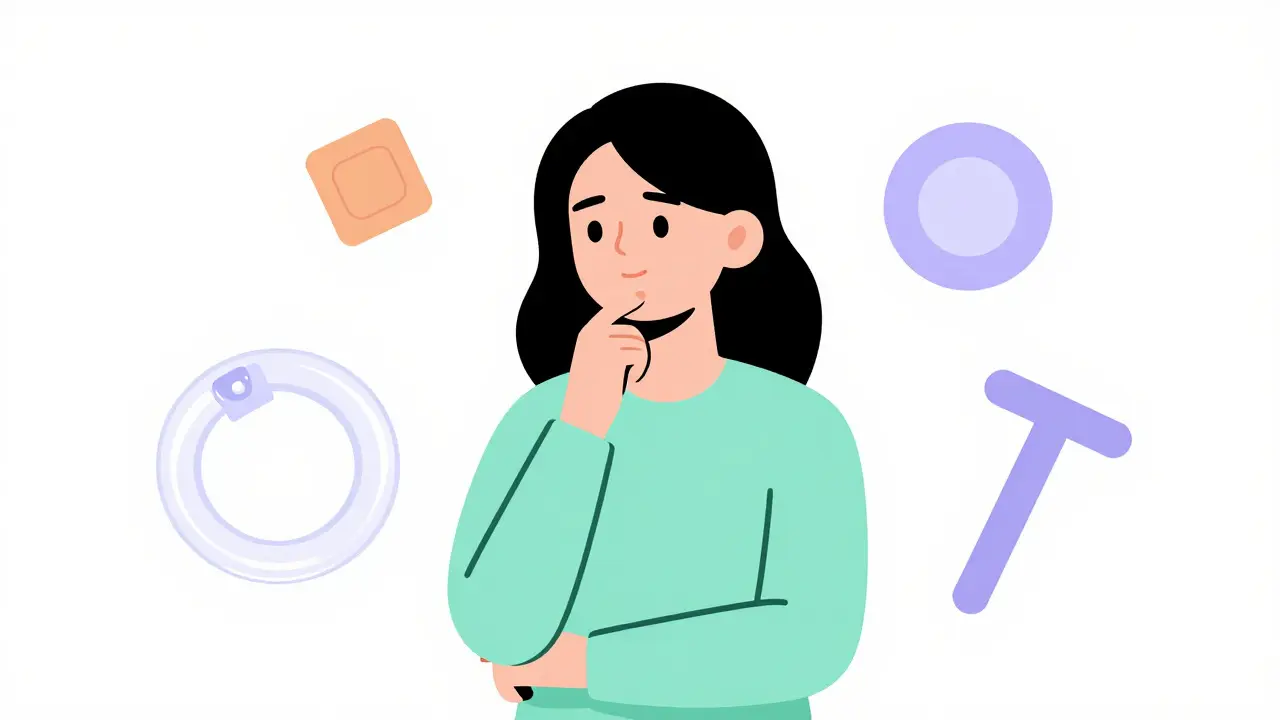
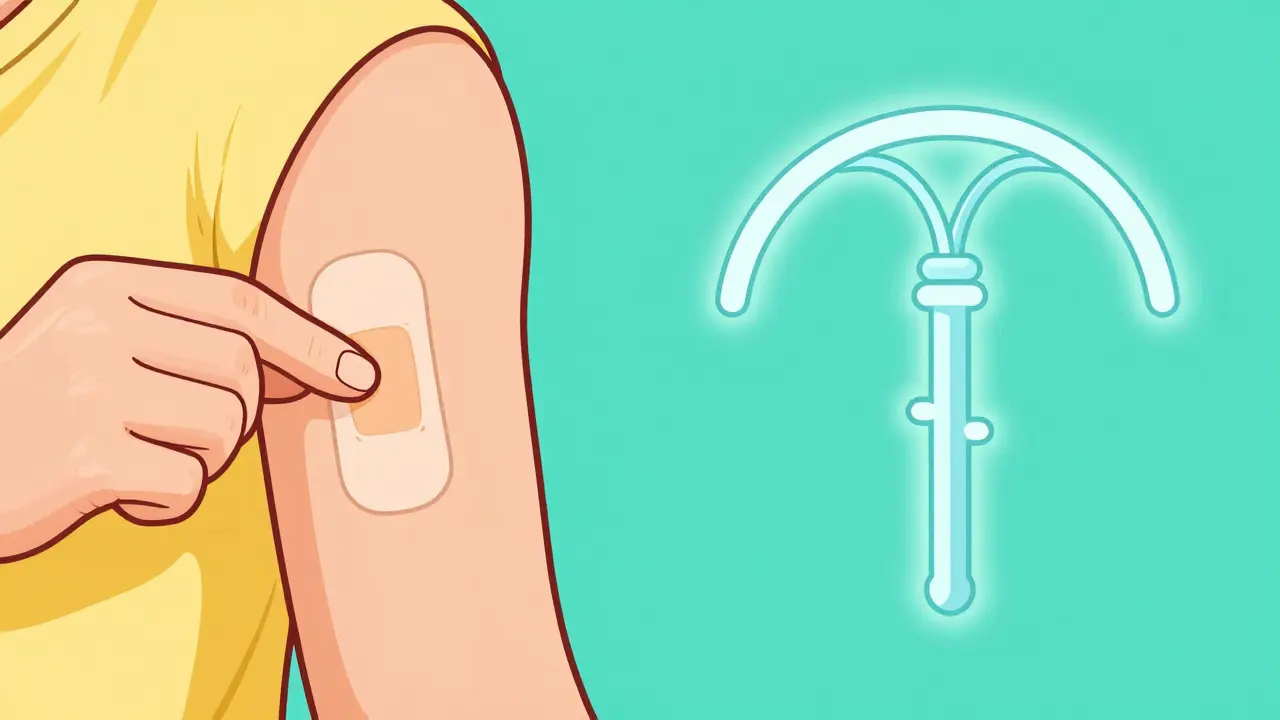
Before weighing the risks, it's helpful to understand what these devices actually do. The contraceptive patch (such as Xulane) is a small piece of adhesive plastic that sticks to your skin. It releases norelgestromin and ethinyl estradiol directly into your bloodstream. You wear one for three weeks and then take a week off.
The vaginal ring (NuvaRing) is a flexible, clear plastic ring you insert yourself. It releases etonogestrel and ethinyl estradiol. Like the patch, it follows a three-weeks-on, one-week-off cycle.
Then there are the IUDs (Intrauterine Devices). These are T-shaped devices inserted into the uterus by a healthcare provider. There are two main types: hormonal IUDs (like Mirena or Kyleena) that release levonorgestrel, and the non-hormonal copper IUD (Paragard) that uses copper ions to stop sperm from reaching the egg.
Comparing the Safety Profiles
The biggest safety divide here is between methods that contain estrogen and those that don't. The patch and the ring are "combined" methods, meaning they use both estrogen and progestin. This combination is effective, but it comes with a specific set of risks, most notably an increased risk of venous thrombosis (blood clots in the legs or lungs). According to a 2022 JAMA review, estrogen-containing methods can increase these events to between 7 and 10 per 10,000 women-years.
IUDs, on the other hand, avoid this particular risk. Because they are either progestin-only or completely hormone-free, they don't carry the same cardiovascular warnings. This makes them a first-line recommendation for women who have a history of high blood pressure or those who experience migraines with aura, as estrogen can exacerbate these conditions.
| Feature | Contraceptive Patch | Vaginal Ring | Hormonal IUD | Copper IUD |
|---|---|---|---|---|
| Hormones Used | Estrogen & Progestin | Estrogen & Progestin | Progestin Only | None |
| Typical Efficacy | ~91% | ~91% | >99% | >99% |
| Blood Clot Risk | Higher | Higher | Very Low | No Risk |
| Duration | Weekly Change | Monthly Change | 3-8 Years | 10-12 Years |
| Insertion | Self-applied | Self-inserted | Clinical Procedure | Clinical Procedure |
Evaluating the Risks and Side Effects
No contraceptive is without its downsides. For the patch, skin irritation is a common complaint, with some users reporting redness or itching where the adhesive meets the skin. There is also the practical risk of the patch peeling off; research shows about 1.8% of users experience complete detachment, which can compromise effectiveness.
The vaginal ring is generally well-tolerated, but some people find it uncomfortable during intercourse, or it may accidentally slip out. While it has a lower rate of breakthrough bleeding than some oral pills, it's not a guarantee of a regular cycle for everyone.
IUD risks are different because they involve a physical device inside the uterus. There is a small chance of expulsion (the body pushing the IUD out), which happens in 2-10% of cases. More rarely, uterine perforation can occur during insertion (0.1-0.6%).
Then there is the "period problem." Copper IUDs are famous for making periods heavier and crampier, which can be a dealbreaker for some. Hormonal IUDs do the opposite; they often make periods lighter or cause them to disappear entirely (amenorrhea), which many users actually prefer.
Who Should Avoid Which Method?
If you're trying to narrow down your list, look at your health markers first. You should generally avoid the patch and the ring if you:
- Are over 35 and smoke.
- Have severe hypertension (high blood pressure).
- Suffer from migraines with aura.
- Have a history of blood clots or stroke.
If these apply, an IUD is a much safer bet. Conversely, if you have certain uterine abnormalities or a current pelvic infection, an IUD might not be the right choice. It's also worth noting that for those seeking emergency contraception, the copper IUD is incredibly effective if inserted within 120 hours of unprotected sex, reducing pregnancy risk to just 0.1%.

The Lifestyle Factor: Convenience vs. Effort
Think about your daily habits. Do you forget to take a pill? The patch and ring remove the daily requirement, but you still have to remember to change them every week or month. This "user-dependent" nature is why their typical-use effectiveness is lower (around 91%) compared to IUDs.
IUDs are "set it and forget it." Once it's in, you don't have to think about birth control for 3 to 12 years. This convenience is a huge part of why IUD usage has surged over the last two decades. According to the Guttmacher Institute, IUD use grew from 6% to 14% among contraceptive users between 2006 and 2019.
Cost also plays a role. While the upfront cost of an IUD can be high (up to $1,300 without insurance), it's often cheaper over several years than paying for a monthly ring or weekly patches. However, the initial insertion can be painful-comparable to very strong menstrual cramps-which is something to prepare for mentally.
Which is safer: the patch or the ring?
Both use a combination of estrogen and progestin, so they share similar cardiovascular risks. However, some data suggests the patch may deliver a slightly higher dose of estrogen to the bloodstream than the ring, potentially increasing the risk of blood clots slightly more than the ring does. You should consult a doctor to see which is safer based on your blood pressure and smoking status.
Can I switch from a hormonal IUD to the patch immediately?
It is generally advised to avoid switching to a patch until after a hormonal IUD has been removed to prevent overlapping hormone exposure. Because different methods have different "activation" times, you may need a backup method (like condoms) for the first 7 days after starting the patch.
Does the copper IUD cause more pain than hormonal IUDs?
While the insertion process is similar for both, the copper IUD often leads to heavier periods and more intense cramping during your monthly cycle. Hormonal IUDs typically reduce menstrual flow and cramping over time, making them a more comfortable long-term option for people with naturally heavy periods.
What happens if my contraceptive patch peels off?
If the patch completely detaches for more than 24 hours, you should apply a new one immediately. Depending on where you are in your cycle, you may need to use backup contraception for 7 days to ensure you remain protected against pregnancy.
Are IUDs permanent?
No, IUDs are Long-Acting Reversible Contraceptives (LARCs). This means they last for several years, but a doctor can remove them at any time, and your fertility typically returns to its baseline immediately after removal.
Next Steps: Making Your Decision
If you are prone to forgetting things or want the highest possible protection, an IUD is likely your best move. If you prefer to have total control over when you are using hormones and don't have cardiovascular risk factors, the ring or patch offer a flexible alternative.
If you're currently using a method and feeling side effects-like the severe migraines some users report with the ring-don't just stick it out. Switching to a progestin-only method like a hormonal IUD often resolves these issues. Always schedule a consultation with your provider to review your blood pressure and medical history before making a switch.
Aaron McGrath
April 22, 2026 AT 10:47Listen up! If you're not optimizing for maximum efficacy with a LARC, you're basically just gambling with your life cycle. Total failure in strategy if you're still relying on user-dependent methods when the ROI on a hormonal IUD is literally off the charts in terms of peace of mind. Get the clinical procedure done and stop playing the odds with 91% typical-use garbage! Crush those goals and secure your future!
Tanya Rogers
April 23, 2026 AT 03:00One finds it quaint that we still prioritize convenience over a comprehensive ontological analysis of how exogenous hormones disrupt the natural equilibrium of the human psyche. The tendency to gravitate toward "set and forget" solutions reflects a broader societal decay where immediate ease is conflated with actual progress. To suggest that a higher efficacy rate equates to a "better" choice is a logical fallacy of the most pedestrian variety, as it ignores the qualitative experience of the individual in favor of quantitative clinical data. True autonomy requires a willingness to endure the burden of daily maintenance if it means preserving one's biological authenticity. The irony of medicalizing the womb to simplify a lifestyle is truly profound.
Olushola Adedoyin
April 24, 2026 AT 22:56Plastic rings and chemical patches? No way! They want to put trackers in the rings to see where we go! And the IUDs? They're just metal traps for your soul! 😱 It's a giant trick to keep us sleepy and numb while the big pharma lords laugh in their golden towers! Watch your back, people, these things are spooky!
Charlotte Boychuk
April 26, 2026 AT 16:12I totally get where some people are coming from with the fear of the copper IUD cramps. I had one for a while and it was a bit of a wild ride, like a stormy sea in my uterus every month. But honestly, being hormone-free felt like a breath of fresh air for my mood. It's all about finding that sweet spot that works for your own vibe.
Lesley Wimbush
April 27, 2026 AT 14:43Honey, the patch is just so... tacky. I mean, literally. Who wants a piece of plastic stuck to their hip like a budget band-aid? It's just not a vibe for anyone with a shred of elegance. I'm simply far too refined to deal with adhesive residue on my skin, but I suppose it's fine for the masses who don't care about their aesthetic.
Cynthia Didion
April 28, 2026 AT 18:54American medicine is the gold standard. These options are exactly why our healthcare leads the world. Deal with it.
Venkatesh Venky
April 30, 2026 AT 12:26LARC options are the real MVP here. Let's all just support each other in finding what works best for our bodies. Positive vibes only!