Dry Eye Treatments: Cyclosporine, Lifitegrast, and Plugs Explained
 Feb, 23 2026
When your eyes feel gritty, burn, or water uncontrollably - even though they’re dry - you’re not imagining it. Dry eye disease affects over 16 million Americans, and for many, over-the-counter drops just don’t cut it. If you’ve been told you need more than artificial tears, you’ve likely heard about cyclosporine, lifitegrast, or punctal plugs. These aren’t quick fixes. They’re targeted treatments that work differently, at different speeds, and with different trade-offs. Here’s what actually happens when you use them - based on real data, not marketing.
Cyclosporine: The Long Game for Inflammation
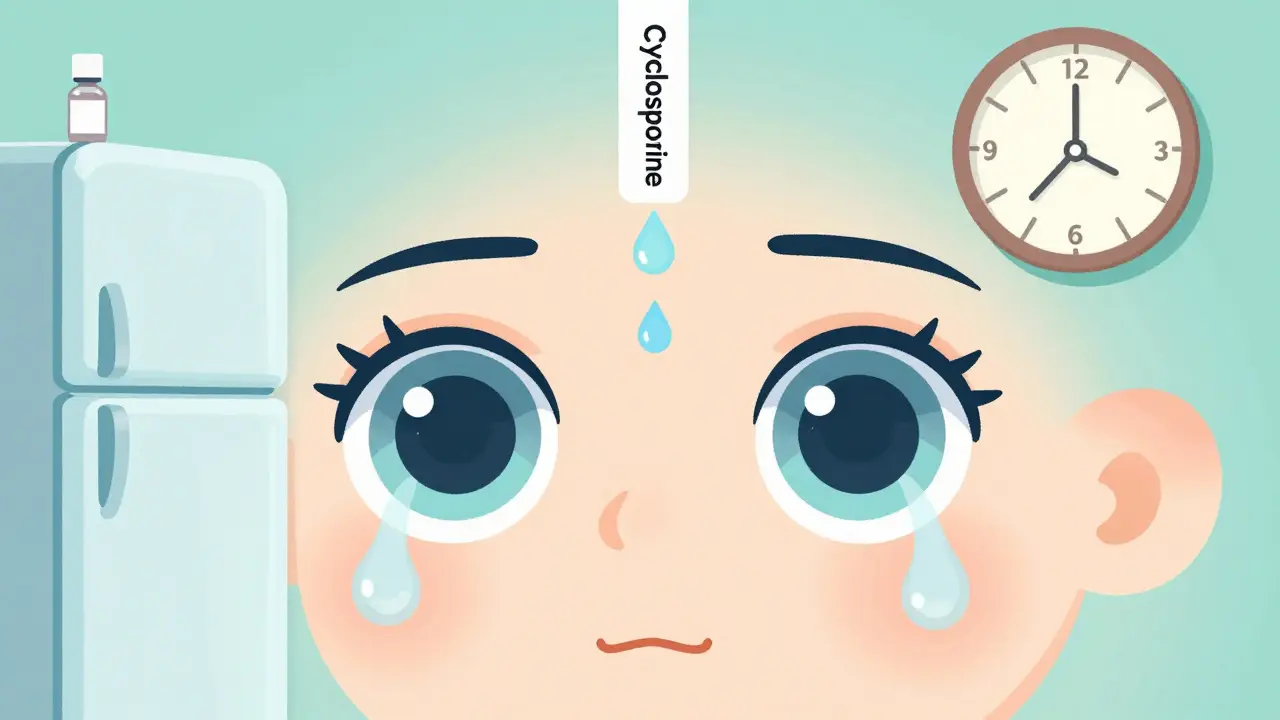
Cyclosporine, sold as Restasis and Cequa, isn’t a lubricant. It’s an immune system modulator. Dry eye isn’t just about lacking tears - it’s often about inflammation killing your tear-producing glands. Cyclosporine blocks the inflammatory signal, letting those glands heal over time. That’s why it takes 3 to 6 months to feel real improvement.
It’s applied twice daily, 12 hours apart. You must remove contacts before use and wait 15 minutes before putting them back in. Many users report a burning sensation at first - about 73% do. The trick? Keep it refrigerated. Cold drops sting less. A 2023 JAMA Ophthalmology trial with 834 people showed 71.6% had significant improvement in corneal staining after just 4 weeks - far better than placebo. But here’s the catch: 68% of patients quit before the 3-month mark because of discomfort or slow results. That’s why doctors now offer training sessions to teach proper use - 85% of ophthalmologists do.
Restasis MultiDose uses a special gel (DuraSite) to help the medicine stick around longer. Cequa, a newer version, uses nanomicelles to improve absorption. Both are 0.05% or 0.1% strength. Generic versions of the single-use vials are now available, cutting the cost from $590 to around $300 for a 30-day supply. Still, adherence drops to just 41% after six months. The payoff? If you stick with it, your eyes stop feeling like sandpaper. Long-term studies show it’s the most effective at repairing the surface of the eye.
Lifitegrast: Fast Relief, But With a Metallic Taste
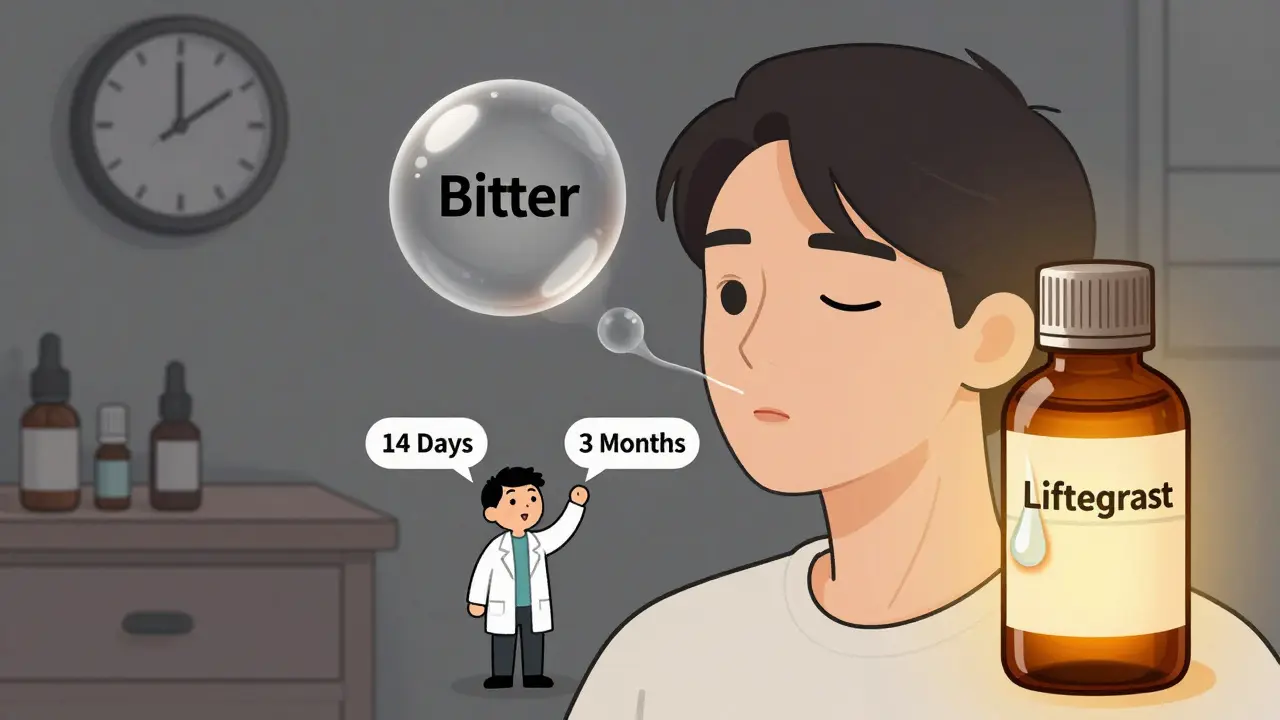
If you need relief now, lifitegrast (Xiidra) might be your best bet. Approved in 2016, it works differently - by blocking a protein called LFA-1 that triggers inflammation between immune cells and eye tissue. It doesn’t rebuild glands like cyclosporine. Instead, it quiets the inflammation fast.
Studies show 47.4% of users had a noticeable drop in dryness symptoms within just 14 days, compared to 37.7% on placebo. That’s why it’s often chosen for people who can’t wait months for results. But there’s a downside: 18% of users stop taking it because of a strong metallic or bitter taste. It’s not dangerous - just deeply unpleasant. Many patients solve this by using it right before bed. Some even report the taste fades after a few weeks.
It’s also twice daily, and you can’t wear contacts during application. Cost is similar to cyclosporine - around $620 a month - but Takeda offers a $0 co-pay coupon for the first month. A 2022 AHRQ review found lifitegrast gave faster symptom relief than cyclosporine, but cyclosporine won on long-term healing. That’s why doctors often suggest trying lifitegrast first if you’re in pain and need quick relief, then switching to cyclosporine if symptoms linger.
Punctal Plugs: The Physical Block
Punctal plugs are tiny devices inserted into the tear ducts - the small openings in your eyelids where tears normally drain away. By blocking those drains, more of your natural tears stay on the eye. It’s mechanical, not chemical. No inflammation reduction. No gland repair. Just conservation.
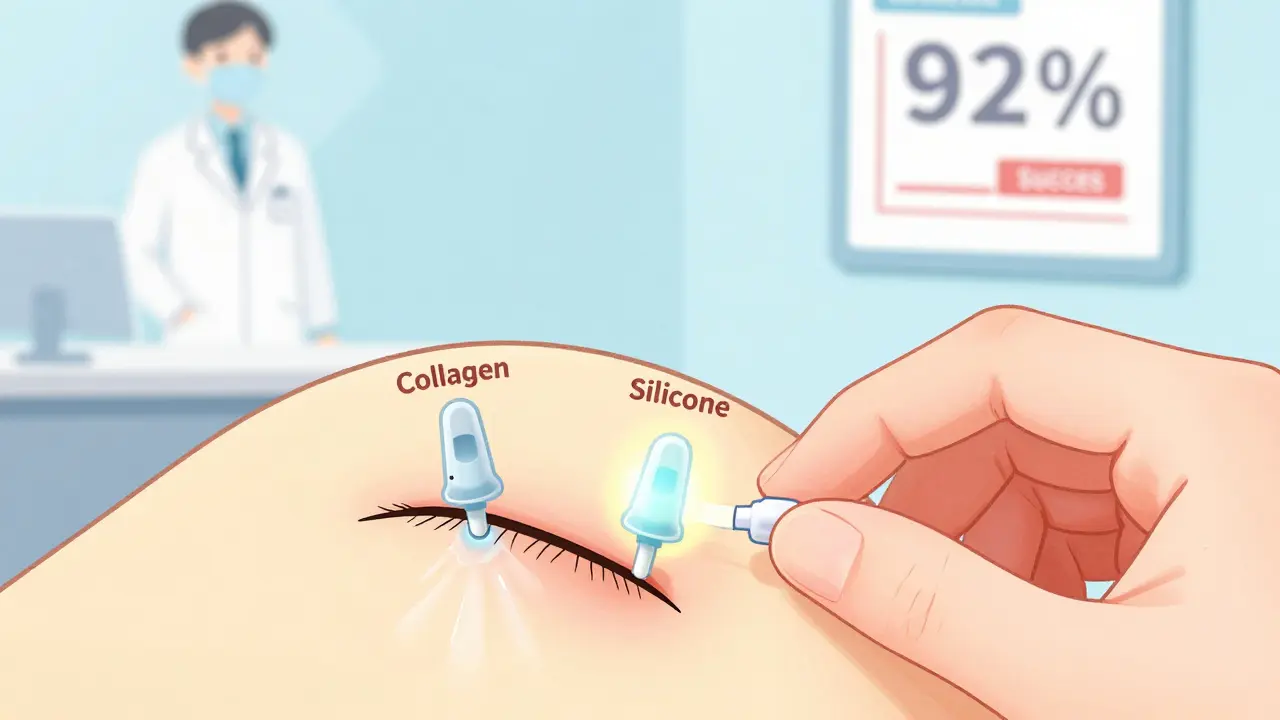
There are two types: collagen (temporary, dissolves in 3-10 days) and silicone (permanent). Collagen plugs are used to test if you’ll benefit before committing. Silicone plugs last years unless they fall out or cause irritation. Insertion is quick - 5 to 10 minutes - done in the doctor’s office. Success rate on first try? 92%.
People who benefit most have low tear production - a Schirmer’s test score under 10mm. In real-world use, 58% of users report satisfaction. Some say, “My eyes stopped watering constantly - finally, normal.” But 28% report plugs falling out (extrusion), especially collagen ones. A 2023 study found 23% of temporary plugs were gone within two weeks. A Cochrane Review found plugs improve tear volume slightly but don’t reliably improve how dry your eyes feel. That’s why they’re best used as an add-on, not a standalone fix.
How They Compare: Speed, Cost, and Side Effects
| Treatment | How It Works | Time to Relief | Common Side Effects | Monthly Cost (Avg.) | Best For |
|---|---|---|---|---|---|
| Cyclosporine | Reduces inflammation to restore tear production | 3-6 months | Burning, stinging (73%), blurred vision | $300-$590 | Chronic, moderate-severe dry eye; long-term healing |
| Lifitegrast | Blocks inflammatory signals between cells | 1-2 weeks | Metallic taste (42%), eye irritation | $620 | Patients needing fast symptom relief |
| Punctal Plugs | Physically blocks tear drainage | Immediate | Discomfort, extrusion (28%), infection risk | $150-$300 (per procedure) | Low tear production; adjunct to meds |
What Experts Recommend - And Why
The American Optometric Association’s 2022 guidelines say: Start with cyclosporine for moderate to severe dry eye. Why? It has the strongest long-term data. But if you can’t tolerate the burning or need faster results, lifitegrast is the next step. Punctal plugs? They’re not first-line. Use them when meds alone aren’t enough - especially if your eyes are constantly draining tears.
Dr. Reza Dana from Harvard calls cyclosporine the “gold standard” - not because it’s perfect, but because it’s been studied for over 20 years. Dr. Stephanie Marioneaux says lifitegrast’s taste issue is underreported in trials. Real-world data shows nearly half of users find it unbearable. And Dr. Anat Galor warns that 26.7% of patients in cyclosporine trials quit due to side effects - meaning we might be overestimating how well people tolerate it.
The smartest approach? Combine them. The 2023 Dry Eye Workshop II report says 78% of experts recommend cyclosporine + punctal plugs for severe cases. It’s like fixing the leak (plugs) and rebuilding the faucet (cyclosporine) at the same time. Some new experimental plugs even release cyclosporine slowly - called Cyclplug - and early results show 40% better outcomes than regular plugs.
What to Expect - And How to Stick With It
Here’s the truth: dry eye treatments don’t work if you stop. Cyclosporine fails because people quit too soon. Lifitegrast fails because the taste makes them quit. Plugs fail because they fall out or get ignored.
Real tips from patients:
- Store cyclosporine in the fridge - it reduces burning by 60%.
- Use lifitegrast right before bed - the taste fades while you sleep.
- Ask your doctor for collagen plugs first - test if you benefit before permanent ones.
- Use a pill organizer for your drops - twice-daily dosing is easy to forget.
- Check if your insurance covers patient assistance programs - Restasis covers 78% of insured patients.
Don’t give up after a week. Give it 30 days. Then 60. Dry eye isn’t cured - it’s managed. And the best treatment is the one you’ll actually use.
What’s Next?
The dry eye market is shifting fast. A once-daily version of lifitegrast (Vevye) is in Phase 3 trials and could hit shelves in late 2024. Generic versions of cyclosporine are already cutting costs. And new drugs like rebamipide (approved in Japan) are under FDA review - they may offer better results with fewer side effects.
For now, the three options - cyclosporine, lifitegrast, and plugs - remain the backbone of prescription dry eye care. Choose based on your timeline, your tolerance for side effects, and whether you need healing or just relief. Talk to your eye doctor. Don’t just accept the first suggestion. Ask: Which one fits my life?
How long does it take for cyclosporine to work for dry eye?
Cyclosporine typically takes 3 to 6 months to show full effect. Some patients notice minor improvement after 4 weeks, but real relief - like reduced burning and less need for artificial tears - usually comes after consistent use for at least 90 days. Stopping early is the most common reason it seems ineffective.
Does lifitegrast really cause a metallic taste?
Yes. About 42% of users report a persistent metallic or bitter taste after using lifitegrast. It’s not dangerous, but it’s strong enough that 18% of patients stop taking it. Many find relief by using it right before bedtime - the taste fades while sleeping. Some also rinse their mouth with water after use.
Are punctal plugs permanent?
It depends on the type. Silicone plugs are designed to be permanent and can last years. Collagen plugs dissolve naturally in 3 to 10 days and are used to test if you’ll benefit. Permanent plugs can be removed if they cause irritation or fall out - which happens in about 28% of cases, especially with temporary ones.
Can I use cyclosporine and lifitegrast together?
Yes - and many doctors recommend it. Both target inflammation, but through different pathways. Using them together can improve outcomes more than either alone. However, they’re usually not started at the same time. Most patients begin with one, wait to assess response, then add the other if needed.
Is there a cheaper alternative to Restasis or Xiidra?
Yes. Generic cyclosporine (0.05%) is now available as single-use vials and costs about half the price of brand-name Restasis. For lifitegrast, no generic exists yet (expected in 2026), but Takeda offers a $0 co-pay coupon for the first month. Also, combining punctal plugs with a cheaper artificial tear can reduce how often you need expensive drops.
Do I need to stop wearing contacts with these treatments?
Yes. You must remove contact lenses before applying cyclosporine or lifitegrast. Wait at least 15 minutes after applying either medication before reinserting lenses. This prevents the medicine from being absorbed by the lens and reduces irritation. Some patients switch to daily disposables during treatment to make this easier.
Natanya Green
February 23, 2026 AT 17:43Okay but like… I tried cyclosporine?? And it burned so bad I cried?? Like, not dramatic-cry, actual-tears-rolling-down-my-face-cry?? And then the bottle exploded in my fridge?? (Long story. Don’t ask.) Anyway, I switched to lifitegrast and now my mouth tastes like a battery that got drunk at a metal concert?? But?? I can SEE again?? So?? Worth it??
Steven Pam
February 25, 2026 AT 09:30Love this breakdown. Seriously. I was about to give up until I found out about refrigerating the drops. Game-changer. Also, using a pill organizer for my twice-daily drops? Genius. I set alarms labeled 'EYE TIME' and now I feel like a superhero. No more sandpaper eyes. Just… normal. Also, plugs? I tried collagen ones first-worked like magic. No need to go permanent yet. You don’t need to suffer to heal.
Brandice Valentino
February 27, 2026 AT 01:23Okay but like… why is everyone so obsessed with cyclosporine?? Like… it’s just a repackaged immunosuppressant?? I mean… if you’re gonna go full sci-fi with your eyeballs, why not just try a biologic?? Also, I heard the new rebamipide is like… 3x better?? Why are we still talking about 20-year-old tech?? #OverIt
Larry Zerpa
February 27, 2026 AT 06:0671.6% improvement in corneal staining? That’s statistically significant, sure. But what’s the clinical relevance? Corneal staining doesn’t equal symptom relief. 68% quit cyclosporine because it’s unbearable. That’s not adherence failure-it’s a treatment failure. And let’s not pretend the metallic taste of lifitegrast is just ‘unpleasant.’ It’s a sensory assault. This whole field is built on placebo-driven marketing and patient suffering. The real gold standard? Hydration. And not wearing contacts. But nobody wants to hear that.
Gwen Vincent
February 28, 2026 AT 16:52Thank you for this. I’ve had dry eye for 8 years and this is the first time I’ve seen someone explain it without sounding like a pharmaceutical ad. I started with cyclosporine, hated the burn, switched to lifitegrast, hated the taste, then tried plugs and… wow. It’s not perfect, but it’s the first thing that made me feel like my eyes weren’t betraying me. I’m not cured, but I’m not crying every morning anymore. That’s enough.
Nandini Wagh
February 28, 2026 AT 20:15Lol. You Americans spend $600 a month on eye drops while I’m using coconut oil and a warm spoon. But hey, if you wanna pay for the privilege of tasting metal and crying in the mirror? Go for it. At least you’ve got insurance. I don’t. My eyes just… adapt. Like everything else. #ThirdWorldProblems
Holley T
March 2, 2026 AT 11:50Everyone’s talking about cyclosporine and lifitegrast like they’re the end-all-be-all, but nobody’s addressing the elephant in the room: screen time. I’ve been using these meds for 6 months. I reduced my screen exposure by 70%, started blinking consciously, and now I’m on only one drop a day. The drugs? They helped. But the real fix? Changing how I live. I used to think dry eye was a medical issue. Now I know it’s a behavioral one. We’re treating symptoms while ignoring the cause. And honestly? The fact that we’re still debating whether to use plugs or drugs instead of saying, ‘Maybe stop staring at your phone for 14 hours a day,’ is a tragedy.
Christopher Brown
March 3, 2026 AT 14:10Just use saline. That’s it. No drugs. No plugs. No nonsense. If your eyes are dry, you’re dehydrated. Drink water. Stop being weak.