Generic Manufacturer Profitability: How Business Models Drive Sustainable Healthcare
 Mar, 23 2026
When you pick up a prescription at the pharmacy, chances are it’s a generic drug. In the U.S., generic drugs make up 90% of all prescriptions filled. But here’s the catch: while they save patients and insurers billions every year, many companies making them are barely breaking even-or losing money. How is that possible? And more importantly, how are some manufacturers still surviving-and even growing-in this tough environment?
The Cost of Cheap Medicine
Generic drugs were designed to be affordable. After a brand-name drug’s patent expires, any qualified manufacturer can produce an identical version. The idea was simple: more competition = lower prices = better access. And it worked. In 2022 alone, generics and biosimilars saved the U.S. healthcare system over $408 billion. But the flip side? Profit margins have collapsed.Just a decade ago, generic manufacturers enjoyed gross margins of 50-60%. Today, for the simplest pills-like metformin or lisinopril-margins are often below 30%. Some companies are operating at negative margins. Teva, once a giant in the space, reported a $174.6 million loss in 2025 despite $3.8 billion in revenue. That’s a -4.6% profit margin. Meanwhile, smaller players like Mylan (now part of Viatris) managed a modest 4.3% margin. Why such a gap? It’s not about size. It’s about strategy.
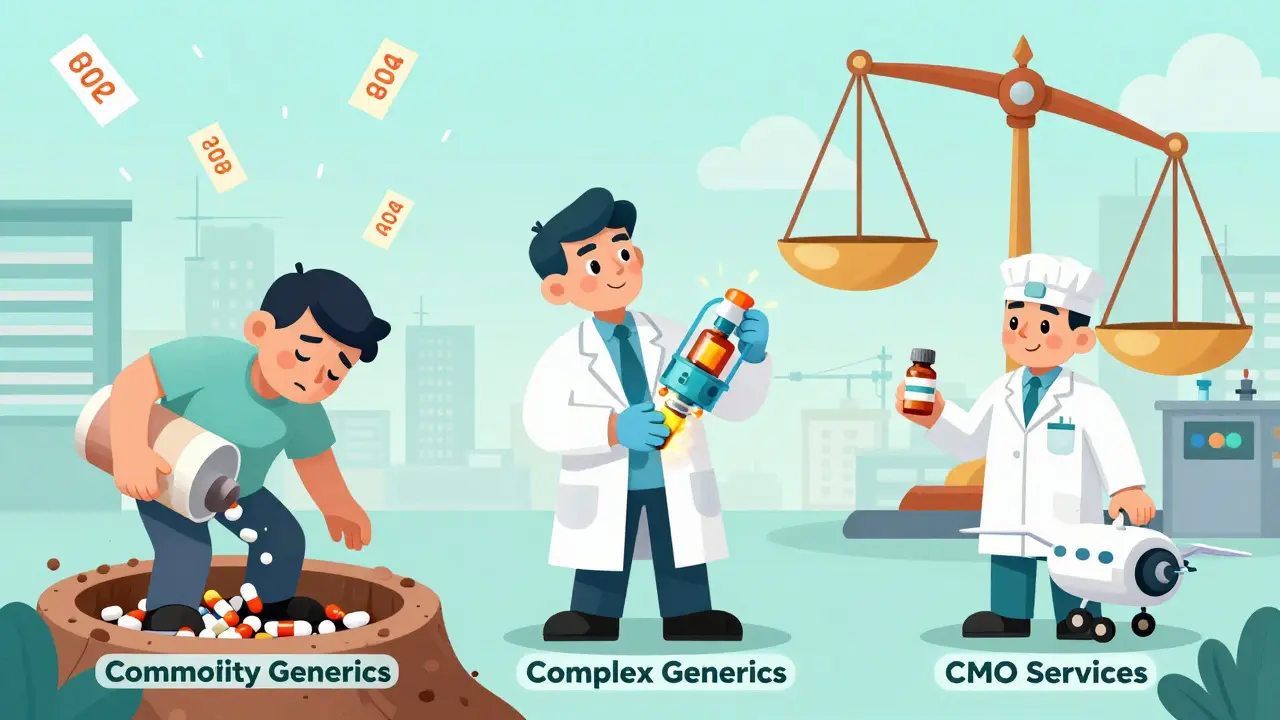
Three Business Models, One Industry
Not all generic manufacturers are the same. Today, there are three clear paths forward-and only two of them lead to sustainability.1. Commodity Generics - This is the old model: produce high-volume, low-complexity drugs with dozens of competitors. Think aspirin, ibuprofen, or amoxicillin. The problem? Prices keep dropping. When 15 companies can make the same 10mg tablet, the only way to win is to undercut everyone else. That leads to race-to-the-bottom pricing. Many companies have exited this space entirely. The FDA estimates it costs $2.6 million just to get one of these drugs approved. For a product that might sell for $0.02 per pill? The math rarely adds up.
2. Complex Generics - This is where the real opportunity lies. These aren’t simple pills. They’re inhalers, injectables, topical gels, or combination products that are hard to formulate or manufacture. Think of a generic version of EpiPen or a sustained-release patch. These require advanced technology, specialized equipment, and deep regulatory expertise. Because fewer companies can make them, competition is limited-and margins climb to 40-60%. Companies like Teva and Viatris are now pouring R&D into these areas. In 2024, Teva increased its R&D spending by 5% to $998 million, focusing on complex generics for neurological and immune disorders. These aren’t just generics anymore. They’re specialty products with real barriers to entry.
3. Contract Manufacturing Organizations (CMOs) - Some manufacturers are stepping back from selling their own brands and instead becoming factories for others. These CMOs produce drugs for branded companies, startups, or even other generic firms. The global CMO market for generics is projected to grow from $56.5 billion in 2025 to $90.95 billion by 2030. Why? Because it’s more predictable. No marketing. No pricing battles. Just manufacturing under contract. Egis Pharmaceuticals launched its own CMO division in late 2023 to serve partners worldwide. This model turns manufacturing into a service-and services have more stable demand than commodities.
Why Some Companies Fail-and Others Survive
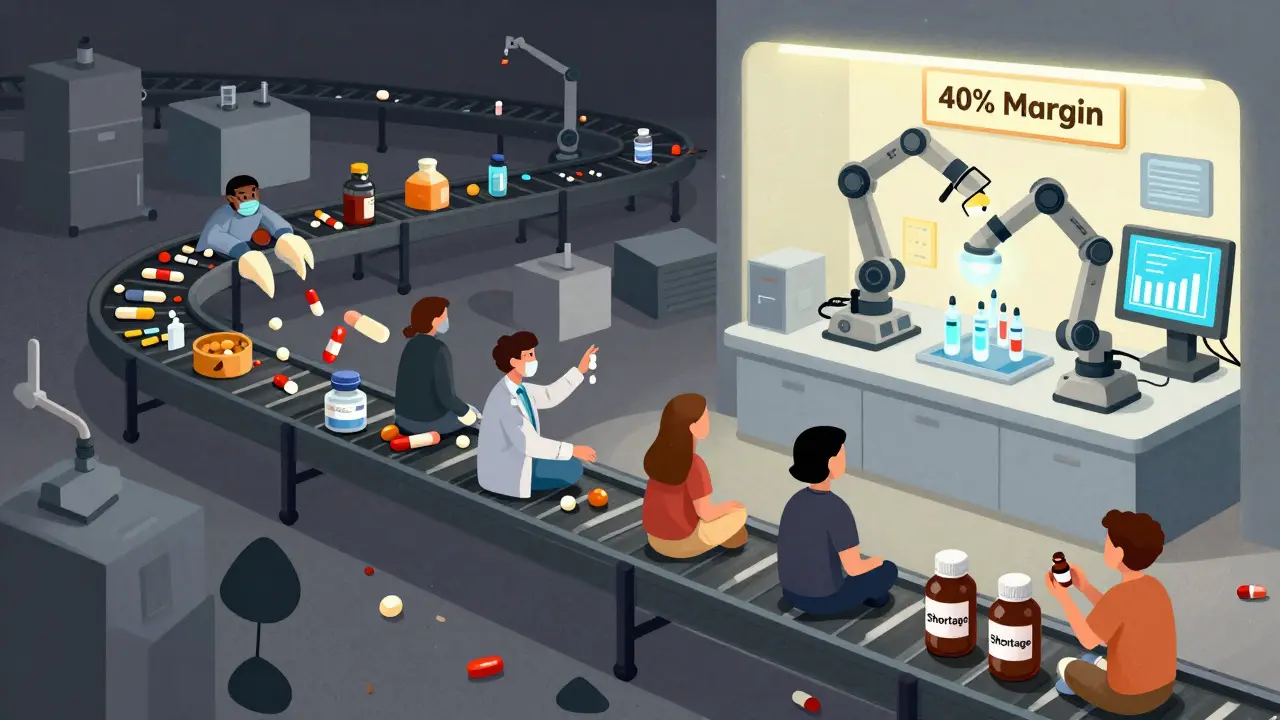
The industry isn’t just under pressure from price cuts. It’s also battling systemic issues.First, there’s the cost of entry. Building a facility that meets FDA’s current Good Manufacturing Practices (cGMP) standards can cost over $100 million. Add in the 18-24 months it takes to get approved and secure formulary placement, and you’ve got a high-risk, long-payback game. McKinsey found that over 65% of new entrants focused only on commodity generics fail within three years.
Then there’s the issue of supply chain chaos. Raw materials for active pharmaceutical ingredients (APIs) can swing wildly in price. A shortage in India or China can shut down production for months. And let’s not forget the pharmacy benefit managers (PBMs)-the middlemen who negotiate drug prices for insurers. In the U.S., PBMs often demand deeper discounts than any manufacturer can afford, especially for generics. Meanwhile, brand companies sometimes pay generic makers to delay launching their versions-a practice called “pay for delay.” A 2025 study estimated that banning this alone could save $45 billion over ten years.
But here’s the thing: the problem isn’t just greed or bad management. It’s a market failure. As Dr. Aaron Kesselheim from Harvard put it, “The relentless price competition in generics has created a market failure where essential medicines face shortages because manufacturers cannot profitably produce them.” We’re seeing real shortages of antibiotics, heart medications, and even insulin generics-not because no one can make them, but because no one can make them and still pay the bills.
Regional Differences Matter
Profitability isn’t the same everywhere. In North America, especially the U.S., the system is stacked against manufacturers. PBMs, insurance rebates, and bulk purchasing drive prices down to unsustainable levels. In Europe, pricing is more regulated, and reimbursement models are often tied to therapeutic value-not just cost. That means margins stay healthier. In emerging markets like India and Brazil, demand is growing fast, but currency instability and regulatory unpredictability make long-term planning risky. So while the U.S. generic market is shrinking, global demand is rising. By 2033, the total generics market is expected to hit $600 billion.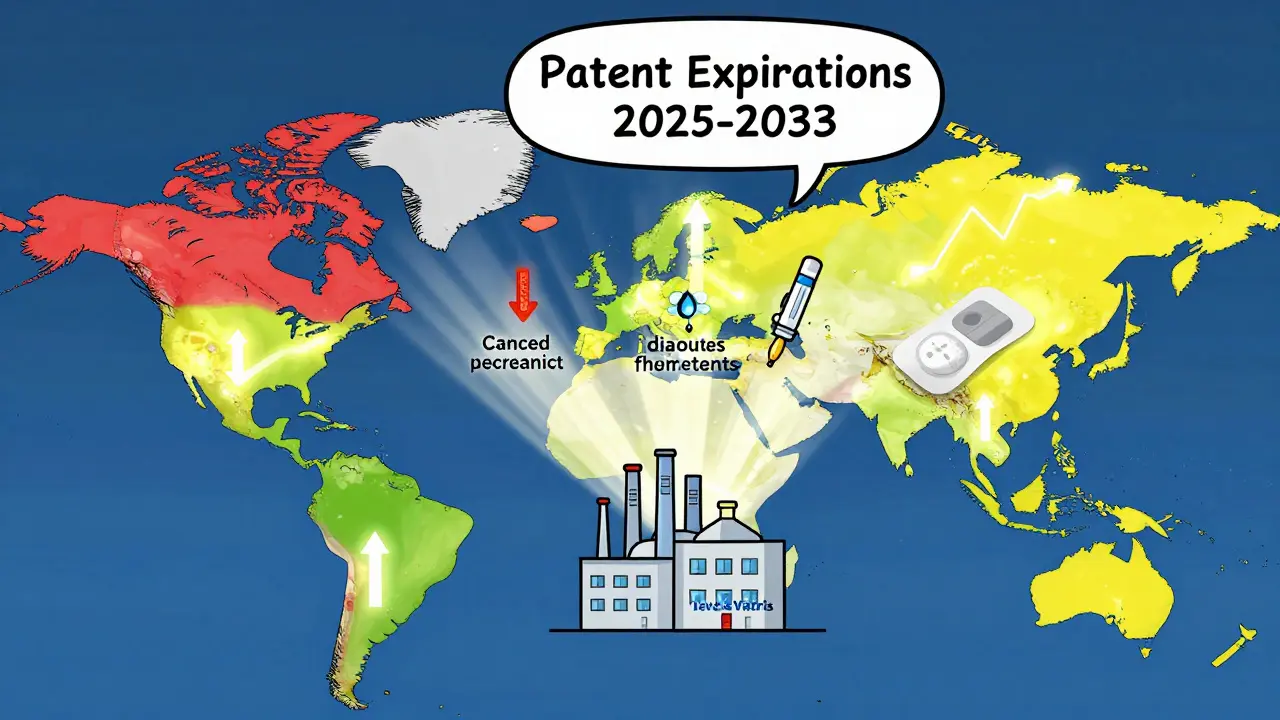
The Path Forward
The future of generic manufacturing isn’t about making more cheap pills. It’s about making smarter ones.Companies that survive will be those who:
- Shift from commodity to complex generics
- Invest in R&D for hard-to-make formulations
- Partner with or become contract manufacturers
- Expand into international markets with better pricing
- Use automation and AI to reduce production costs
Teva’s pivot shows what’s possible. After years of losses, they grew revenue 4% in 2024-not by selling more aspirin, but by pushing higher-margin specialty generics like Austedo XR and lenalidomide. Viatris, after merging and shedding non-core assets, is now focused on core generics and biosimilars with better margins. Both are betting on quality, complexity, and reliability-not just low cost.
And let’s not forget the bigger picture. Generics aren’t just a business. They’re a public health tool. Without them, millions couldn’t afford life-saving drugs. The challenge isn’t whether we need generics-it’s whether we’re willing to structure a system that lets manufacturers survive while keeping drugs affordable. That means policy changes, fairer PBM practices, and incentives for innovation in complex formulations.
What’s Next?
Between 2025 and 2033, over 50 major brand drugs will lose patent protection-including blockbuster treatments for cancer, diabetes, and autoimmune diseases. That’s a $100+ billion opportunity. But only manufacturers who’ve moved beyond the old model will be ready to capture it.The days of mass-producing simple pills for pennies are over. The future belongs to those who can make the hard stuff-and do it reliably, safely, and profitably. If we want affordable medicine to keep flowing, we need to stop treating generic manufacturers like disposable suppliers. They’re the backbone of the system. And right now, that backbone is cracking.
Why are generic drug prices so low?
Generic drug prices are low because multiple manufacturers can produce the same drug after the original patent expires. This creates intense competition, forcing companies to slash prices to win contracts with pharmacies and insurers. Pharmacy benefit managers (PBMs) further drive down prices by negotiating bulk discounts. As a result, some generic drugs sell for less than $0.05 per pill-even though manufacturing and regulatory costs remain high.
What are complex generics?
Complex generics are generic versions of drugs that are difficult to manufacture because of their formulation, delivery method, or stability requirements. Examples include inhalers, injectables, transdermal patches, and combination products. These require advanced technology, specialized equipment, and deep regulatory expertise. Because fewer companies can produce them, competition is limited, allowing for higher profit margins-often 40-60%-compared to 10-20% for simple pills.
Can generic manufacturers make money anymore?
Yes-but only if they change their business model. Companies stuck in the commodity generics space are struggling or going out of business. Those shifting to complex generics, contract manufacturing, or international markets are seeing growth. Teva and Viatris are examples: they’ve cut low-margin products and invested in harder-to-make drugs and manufacturing services. Profitability now depends on expertise, not volume.
Why are there shortages of generic drugs?
Shortages happen when manufacturers can’t profitably produce a drug. If the price is too low to cover manufacturing, regulatory, and supply chain costs, companies stop making it. This is especially common for older, low-cost generics with dozens of competitors. A 2024 Harvard study linked these shortages directly to unsustainable pricing pressures. When no one can make money, production stops-and patients go without.
How does contract manufacturing help generic companies?
Contract manufacturing lets companies earn steady revenue by producing drugs for others-instead of selling under their own brand. This removes the risks of pricing battles and marketing costs. It also allows them to use their facilities more efficiently. As the contract manufacturing segment grows to nearly $91 billion by 2030, companies like Egis and Catalent are turning manufacturing into a service business, which offers more predictable margins than selling generic pills directly.
Raphael Schwartz
March 24, 2026 AT 21:23Stephen Alabi
March 25, 2026 AT 23:34Agbogla Bischof
March 26, 2026 AT 10:32Pat Fur
March 26, 2026 AT 12:45Anil Arekar
March 26, 2026 AT 19:22Elaine Parra
March 28, 2026 AT 18:35Natasha Rodríguez Lara
March 30, 2026 AT 16:58peter vencken
March 30, 2026 AT 17:37Linda Foster
April 1, 2026 AT 01:54Kenneth Jones
April 2, 2026 AT 10:37Mihir Patel
April 3, 2026 AT 22:16Kevin Y.
April 4, 2026 AT 23:57Rachele Tycksen
April 5, 2026 AT 08:47Grace Kusta Nasralla
April 5, 2026 AT 10:03Korn Deno
April 5, 2026 AT 15:22