Generic vs Brand Drug Prices: Complete Comparison Guide
 Feb, 7 2026
When you pick up a prescription, do you ever wonder why two pills that do the exact same thing cost so differently? One might be $4. Another, $80. That’s not a mistake. It’s the difference between a generic drug and a brand-name drug. And understanding this isn’t just about saving money-it’s about making smarter, safer choices for your health.
What Exactly Is a Generic Drug?
A generic drug isn’t a copy. It’s the same medicine. Same active ingredient. Same dosage. Same way it works in your body. The FDA requires generics to match brand-name drugs in strength, quality, purity, and how fast they’re absorbed. That’s not a suggestion-it’s the law. If a generic doesn’t deliver the same amount of medicine at the same speed as the brand, it doesn’t get approved.Think of it like this: if you buy a smartphone from Apple or a phone from a lesser-known brand that uses the same processor, battery, and camera, it’s not a fake. It’s just built without the logo, marketing, or patent fees. That’s what generics are. They’re the same medicine, stripped down to the essentials.
The U.S. system for approving generics started in 1984 with the Hatch-Waxman Act. Before that, companies had to repeat expensive clinical trials just to prove a drug worked. Now, they only need to prove it works the same way. That cut development costs by 80-90%. Those savings get passed on.
Why Do Brand-Name Drugs Cost So Much?
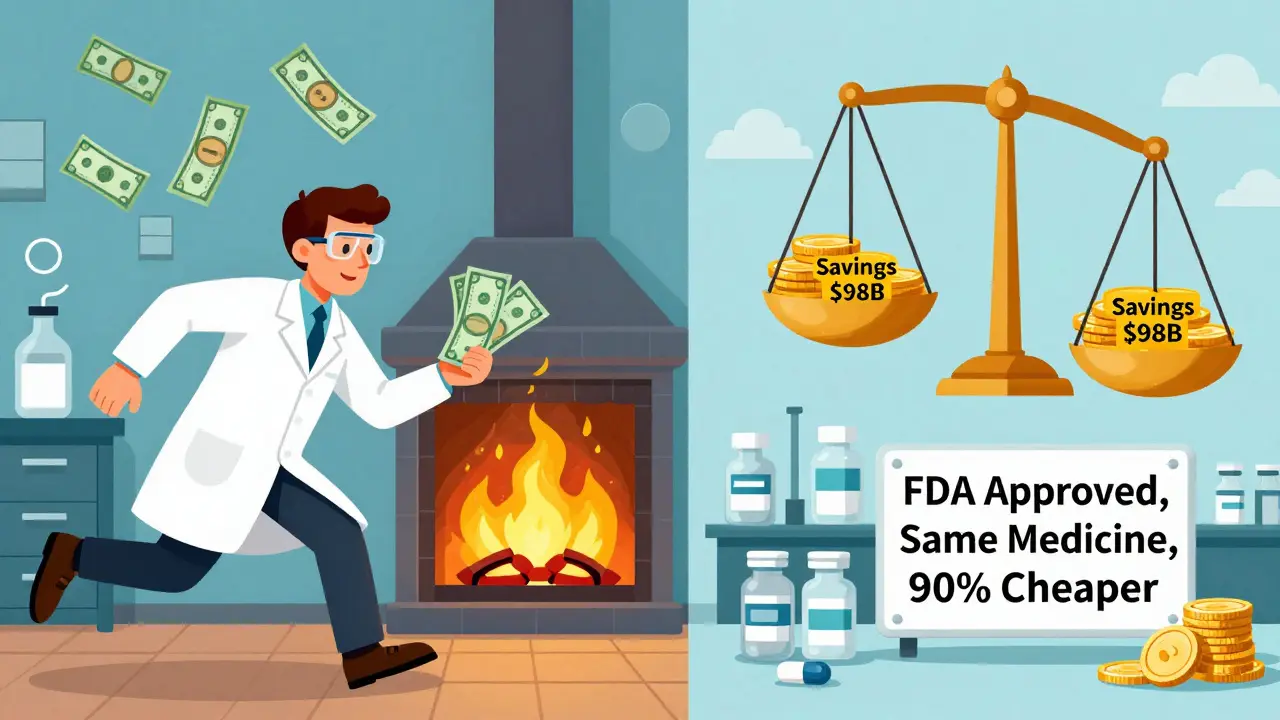
Brand-name drugs come with a price tag that includes more than just the medicine. They pay for the original research, clinical trials, marketing, patents, and corporate overhead. A single new drug can cost $2.6 billion to develop, according to studies from the Tufts Center for Drug Development. That’s why companies charge high prices during the patent period-usually 10 to 12 years-before generics enter the market.Once the patent expires, generic manufacturers can step in. And when they do, prices don’t just drop-they collapse. The FDA estimates generics cost 79-85% less than their brand-name equivalents. In 2024, 90% of all prescriptions filled in the U.S. were generics, but they made up only 12% of total prescription spending. That’s a $98 billion savings compared to $700 billion spent on brand drugs.
How Much Do Generic Drugs Actually Save?
Let’s get real about numbers. A 2017 analysis by the U.S. Assistant Secretary for Planning and Evaluation found that when one generic enters the market, prices fall to about 90% of the original brand price. With three to four competitors, prices drop to 60-70%. With five or more, they fall below 50%-sometimes as low as 20% of the original cost.Take Nexavar, a cancer drug made by Bayer. When the first generic version launched in 2022, Bayer cut its list price by 50%-not because it was forced to, but because it knew the market was changing. Merck did the same with Januvia, dropping prices by 42.4% before the new Medicare price cap kicks in. These aren’t charity moves. They’re strategic.
Meanwhile, generic prices keep falling. Between 2019 and 2024, total spending on generics in the U.S. dropped by $6.4 billion-even as more prescriptions were filled. Why? Because competition drives prices down. One generic? Maybe 30% off. Five generics? You could be paying 80% less.
Do Generics Work as Well as Brand Drugs?
Yes. And the science backs it up.The FDA doesn’t just approve generics based on price. They require bioequivalence: the generic must deliver the same amount of active ingredient into your bloodstream within 80-125% of the brand’s performance. That’s a tight window. It’s not “close enough.” It’s medically identical.
Multiple studies-including one from the University of Chicago in 2025-show no difference in effectiveness between generics and brand-name drugs for conditions like high blood pressure, depression, seizures, and diabetes. The American Medical Association, the FDA, and even the World Health Organization all agree: generics are safe and effective.
So why do 62% of Americans say they still trust brand-name drugs more? Because of perception, not science. A 2025 Tebra survey found that 84% of people believe generics are just as effective. But 63% choose them only because they can’t afford the brand. That gap between belief and behavior is where the real problem lies.
What About the Price Difference in Real Life?
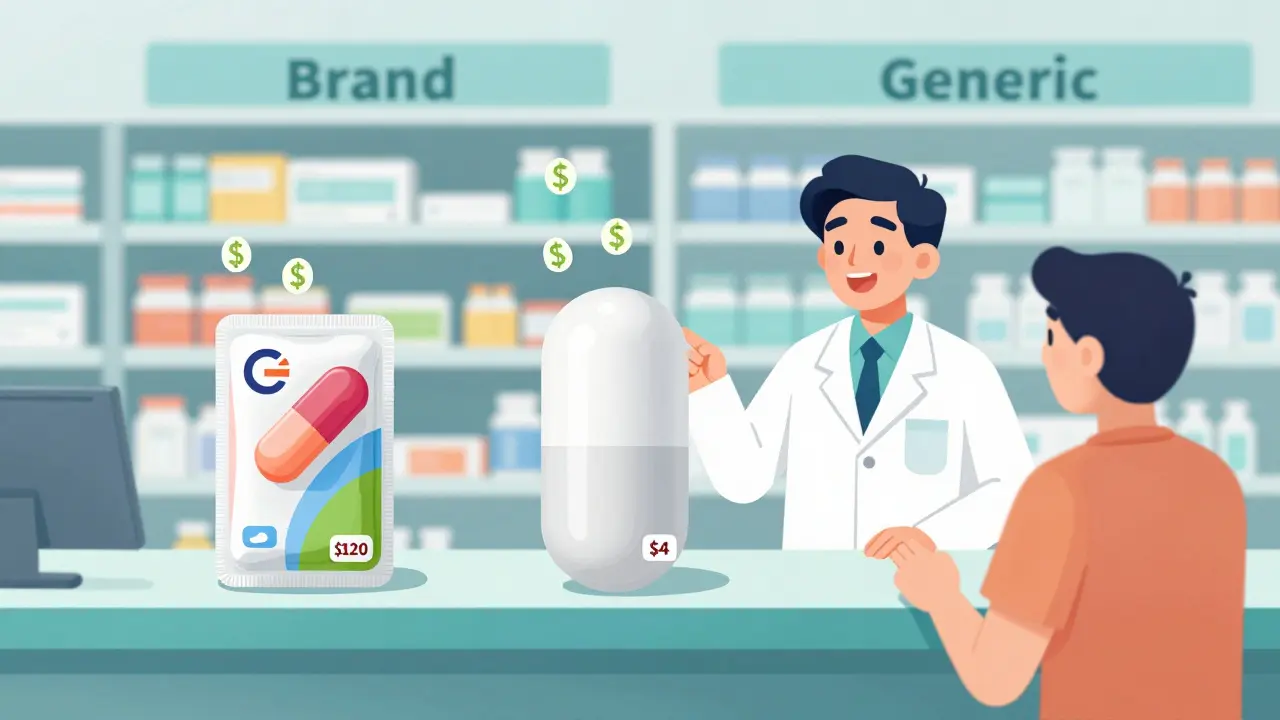
Here’s what you might actually pay at the pharmacy counter in 2026:- Generic Lisinopril (blood pressure): $4 for a 30-day supply
- Brand-name Zestril: $120 for the same
- Generic Metformin (diabetes): $5 for 30 tablets
- Brand-name Glucophage: $150
- Generic Atorvastatin (cholesterol): $10 for 30 pills
- Brand-name Lipitor: $300
These aren’t outliers. They’re the norm. And the gap keeps widening. In 2016, generics made up 87% of prescriptions but cost 27% of total spending. By 2024, they were 90% of prescriptions but only 12% of spending. That’s a 55% drop in cost share over eight years.
Even more surprising? Brand-name drug prices have been falling, too. DrugChannels reported that in 2024, brand-name list prices dropped for the seventh straight year. Why? Because manufacturers know they’re losing market share. They’re lowering prices to stay competitive-sometimes before the generic even hits shelves.
Why Don’t More People Choose Generics?
It’s not about safety. It’s about trust, misinformation, and inertia.Some people remember stories from the 90s-when generics had inconsistent quality or packaging. But those days are gone. Today’s generics are made in the same FDA-inspected factories as brand drugs. Sometimes, they’re made by the same company.
Ever notice how your brand-name drug comes in a colorful pill with a logo? The generic is usually white or blue and says “10 mg.” That looks cheaper. It feels cheaper. But it’s not. The FDA requires the same purity, stability, and shelf life. No exceptions.
Pharmacists can switch you to a generic without asking-unless your doctor says “dispense as written.” But many patients don’t even know they’re being offered a cheaper option. Ask. Always ask.
What About Biosimilars and Newer Drugs?
Biosimilars are the next frontier. They’re not generics-they’re not exact copies, because they’re made from living cells, not chemicals. But they’re designed to be just as safe and effective as expensive biologic drugs like Humira or Enbrel. And they’re starting to cut prices too. In 2025, the first biosimilars for Humira hit the market, cutting the cost from $2,000 per month to under $300.For newer drugs still under patent-like Ozempic or Mounjaro-generics aren’t available yet. But when they are, expect the same pattern: prices crash by 80% or more. That’s not speculation. It’s history.
How to Save More on Your Prescriptions
Here’s what you can do right now:- Ask your doctor if a generic is available for your prescription. If they say no, ask why.
- Check your pharmacy’s discount programs. Many offer generics for $4-$10, even without insurance.
- Use mail-order pharmacies. They often have lower prices than local stores.
- Compare prices. A generic might cost $8 at CVS and $3 at Walmart. Always check.
- Ask about patient assistance programs. Some brand-name manufacturers offer free or low-cost meds if you qualify.
The system is designed to save you money. You just have to use it.
What’s Next? The Bigger Picture
The U.S. healthcare system has a strange but effective balance. Brand-name drugs fund innovation. Generics make care affordable. Together, they’ve helped the U.S. achieve 18% lower public-sector prescription prices than peer countries like Canada, Germany, and the UK-despite higher brand-name list prices.That’s because 90% of prescriptions are generics. The system works. But only if people use it.
Don’t let myths stop you. Don’t let a brand name fool you into thinking it’s better. Your health doesn’t care about the logo. It cares about the active ingredient. And that’s exactly the same.
Are generic drugs really as effective as brand-name drugs?
Yes. The FDA requires generic drugs to have the same active ingredient, strength, dosage form, and route of administration as the brand-name version. They must also deliver the medicine into your bloodstream at the same rate and amount. Studies show no difference in effectiveness for conditions like high blood pressure, diabetes, depression, and cholesterol. The American Medical Association and FDA both confirm generics are safe and effective.
Why are generic drugs so much cheaper?
Generic drugs don’t need to repeat expensive clinical trials. Once a brand-name drug’s patent expires, other manufacturers can produce the same medicine using the existing safety data. This cuts development costs by 80-90%. They also don’t spend money on marketing, advertising, or brand-building. Those savings get passed to consumers. In 2024, generics cost 79-85% less than brand-name versions on average.
Can I trust the quality of generic drugs?
Absolutely. The FDA inspects manufacturing facilities for both brand and generic drugs using the same strict standards. Many generics are made in the same factories as brand-name drugs. The FDA also monitors adverse events and recalls-just like with brand drugs. If a generic drug fails to meet standards, it’s pulled from the market. There’s no lower quality bar.
Why do some doctors prescribe brand-name drugs instead of generics?
Sometimes, it’s habit. Other times, there’s a specific reason-like a patient having an unusual reaction to a filler in a generic version (very rare). But in most cases, there’s no medical reason. If your doctor doesn’t explain why, ask. Most will switch to a generic if you ask and if it’s appropriate. You have the right to request a generic unless the prescription says "dispense as written."
Do generic drugs take longer to work?
No. The FDA requires generics to be bioequivalent, meaning they must reach the same level of active ingredient in your bloodstream within the same time frame as the brand-name drug. Any difference in absorption must be within 80-125% of the brand’s performance. That’s a tight, scientifically proven range. If a generic worked slower, it wouldn’t be approved.
Are there times when I should stick with a brand-name drug?
Very rarely. For most medications, generics are a safe, effective, and cheaper choice. But for drugs with a narrow therapeutic index-like warfarin, levothyroxine, or some seizure medications-some doctors prefer to keep patients on one brand to avoid even tiny variations. Even then, switching is often possible with careful monitoring. Always talk to your doctor or pharmacist before switching.
Can I switch from a brand to a generic mid-treatment?
Yes, in most cases. For the vast majority of medications, switching from brand to generic is safe and effective. Your pharmacist can make the switch unless your doctor specifically says "dispense as written." If you’re concerned, talk to your doctor first. They can help you monitor for any changes, though most people notice no difference at all.
Why do generic drugs look different from brand-name drugs?
By law, generics can’t look identical to brand-name drugs. That’s to avoid trademark infringement. So they may have different colors, shapes, or markings. But the active ingredient, strength, and effectiveness are identical. The differences are only in inactive ingredients like dyes or fillers-which don’t affect how the drug works.
John McDonald
February 9, 2026 AT 00:54Man, I used to swear by brand-name meds until I switched to generic lisinopril last year. Same pill, same results, $115 cheaper. My bank account thanked me. No side effects, no weird reactions. Just straight-up savings.
Turns out, the FDA doesn’t mess around. If it says 'bioequivalent,' it means it. Stop overpaying for a logo.
Jonah Mann
February 9, 2026 AT 20:45soo.. like.. i just found out my pharma just switched me to generic atorvastatin without telling me?? i was gonna freak out but then i checked the label and it was literally the same dosage.. and i saved like 90%??
why dont they just TELL people this?? i mean, i'm not dumb but i thought generics were 'second rate' or something??
THANGAVEL PARASAKTHI
February 11, 2026 AT 17:30From India, I can confirm this 100%. We've been using generics for decades. My dad takes 5 meds daily-all generics. Cost? Less than $10/month total.
Brand drugs? They're for people who don't know better-or for marketing. The science doesn't care about packaging. Active ingredient is king. Period.
And yes, same factories. I've seen the reports. FDA checks them all. No difference. Just price difference.
Tatiana Barbosa
February 13, 2026 AT 12:36I work in pharmacy and I’ll tell you this: 90% of patients don’t even know they’re being offered a generic. Pharmacists are supposed to ask if you want the generic-but most don’t push it. Why? Time. Pressure. System design.
But when you DO ask? You save hundreds. I had a patient switch from Lipitor to atorvastatin and cried because she hadn’t realized she was paying $300/month for 10 years.
Don’t be shy. Ask. Always. It’s your right.
Ken Cooper
February 14, 2026 AT 15:19Wait, so… you’re telling me my mom’s $150/month seizure med? The one with the weird shape and the bright blue color? It’s the same as the generic that looks like a plain white oval??
And the FDA says they’re identical??
And my doctor never mentioned this??
I’m gonna call her right now. This is insane. I feel like I’ve been scammed my whole life.
Sam Dickison
February 14, 2026 AT 21:20Biosimilars are the real game-changer. Humira was $2,000/month. Now? $280. That’s not a discount. That’s a revolution.
Biologics are complex-made from living cells, not chemicals-but biosimilars are engineered to be functionally identical. No, they’re not generics. But they’re close enough that the savings are massive.
And yes, they’re covered by insurance now. Ask your doc. It’s not magic. It’s science.
Joshua Smith
February 15, 2026 AT 11:41My cousin was on a brand-name antidepressant for years. Switched to generic. Same dose. Same side effects. Same results. Cost? $5 vs $280.
She didn’t notice a thing. Not even a hiccup.
And now she’s helping her mom switch too. It’s wild how much fear is built around this. It’s not about safety. It’s about branding.
Jessica Klaar
February 16, 2026 AT 08:01My grandma used to say, 'If it doesn’t have a name on it, it’s not real.'
She was 82. We sat down, showed her the FDA documents, the manufacturing reports, the fact that the same factory makes both.
She switched to generic metformin. Saved $140 a month.
Now she tells everyone: 'It’s the same damn medicine. Stop paying for the box.'
It’s not about trust. It’s about being taught to trust the wrong thing.
glenn mendoza
February 16, 2026 AT 13:10It is imperative to recognize that the structural economic incentives embedded within the pharmaceutical supply chain are deliberately engineered to maximize profit during the patent exclusivity window. Once generic competition emerges, the market dynamics shift precipitously, resulting in a non-linear price deflationary spiral. The consumer, however, remains largely unaware of this mechanism due to insufficient public health literacy regarding regulatory equivalence standards. Consequently, behavioral inertia persists despite overwhelming empirical evidence supporting therapeutic equivalence. A coordinated public education initiative, grounded in transparent data dissemination, is not merely advisable-it is a public health imperative.