GLP-1 GI Side Effects: Meal Planning and Dose Titration Tips
 Feb, 7 2026
GLP-1 Dose Titration Calculator
Personalized Dose Guidance
This calculator helps determine your optimal dose progression based on symptoms and meal habits. Follow the Endocrine Society recommendations for safe titration.
Recommended Actions
When you start a GLP-1 receptor agonist like Ozempic, Wegovy, or Trulicity, the goal is clear: better blood sugar control, weight loss, and long-term health benefits. But for many, the first few weeks feel like a battle with your own stomach. Nausea. Vomiting. Diarrhea. Constipation. These aren’t rare side effects-they’re common. In fact, 40 to 70% of people on these medications experience gastrointestinal (GI) issues, and up to a quarter quit because of them. The good news? You don’t have to be one of them. With smart meal planning and a patient approach to dosing, most of these side effects can be reduced-or even avoided.
Why GLP-1 Medications Cause GI Problems
GLP-1 drugs work by slowing down how fast your stomach empties. That’s why they help you feel full longer and lose weight. But that same effect can make food sit in your stomach too long, triggering nausea and bloating. These drugs also affect the part of your brain that controls vomiting, which is why some people feel sick even when their stomach is empty. The more you take, the stronger this effect becomes. That’s why the first few weeks of treatment are the hardest.How Dose Titration Makes or Breaks Your Experience
Most GLP-1 medications don’t start at full dose. They ramp up slowly. But here’s the catch: many patients follow the calendar, not their body. If you’re told to increase your dose every week, but you’re still throwing up twice a day, pushing forward won’t help. It’ll make things worse. Real-world data shows that people who wait until symptoms fully settle before increasing their dose cut their risk of quitting by more than half. The Endocrine Society recommends holding off on the next dose increase if nausea lasts more than 7 days. If vomiting happens more than twice a week, pause the medication for 7 to 10 days. Restart at the previous dose. Then try again. This isn’t failing-it’s strategy. For example, semaglutide (Wegovy) is approved to reach 2.4 mg over 16 to 20 weeks. But if you’re struggling, stretch that timeline to 24 weeks. Studies show this reduces discontinuation by 37%. Some clinics now use a symptom-based titration score: if your nausea hits a 4 out of 10, you hold. No exceptions.Meal Planning That Actually Works
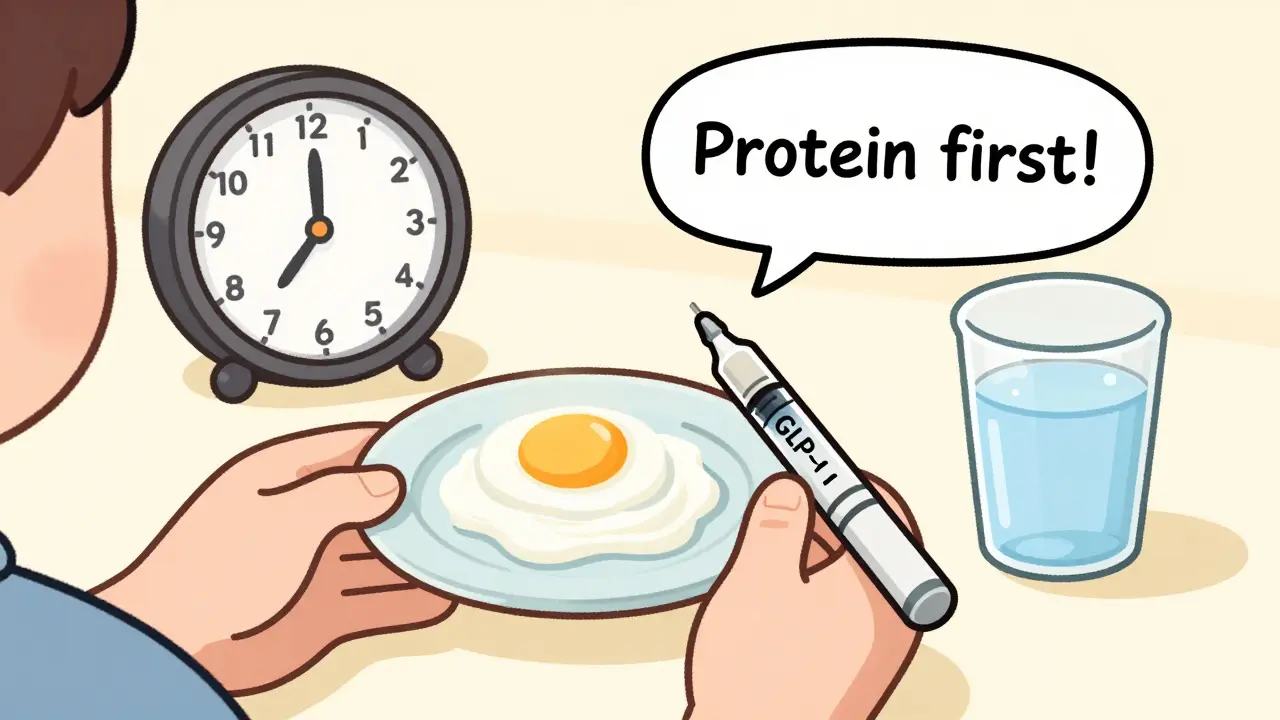
What you eat matters more than you think. Eating the same meals you did before starting GLP-1 will almost guarantee discomfort. You need to retrain your stomach to handle smaller, simpler meals.- Start your day with protein. Eat 20 to 25 grams within 30 minutes of waking. A boiled egg, a scoop of whey in water, or a small Greek yogurt. This helps stabilize your blood sugar and reduces morning nausea.
- Keep meals small. Aim for 300 to 400 calories per meal. That’s about the size of your palm, not your plate. Overeating is the #1 trigger for vomiting.
- Focus on protein. Get 25 to 30 grams per meal. Protein digests slower and is easier on the stomach than carbs or fat.
- Limit fat and sugar. Keep fat under 15g per meal. Avoid more than 20g of simple carbs (like white bread, juice, or candy) at once. High-fat meals delay stomach emptying even more.
- Drink water between meals, not with them. Limit fluids to 120 to 180 ml (4 to 6 oz) during meals. Drinking too much liquid pushes food through too fast or swells your stomach. Avoid soda, sparkling water, and alcohol entirely during titration.
- Space meals out. Eat every 3 to 4 hours. Don’t snack. Don’t eat late. Stop eating at least 3 hours before bed.
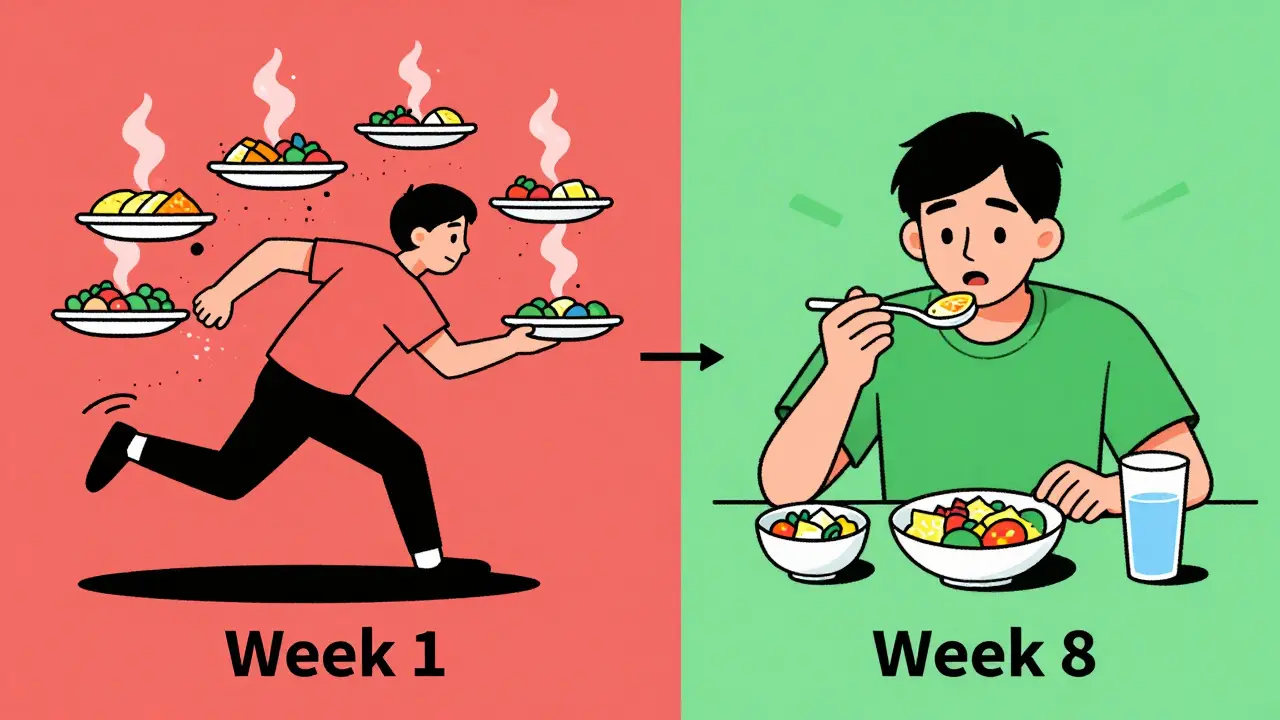
One patient on Reddit, after months of vomiting, switched to eating 5 small meals a day: a protein shake at 7 a.m., a hard-boiled egg and cucumber at 10 a.m., a chicken salad at 1 p.m., a handful of almonds at 4 p.m., and a low-fat yogurt at 7 p.m. Within 10 days, her nausea dropped from daily to once a week.
Timing Matters Too
When you take your dose can change how bad your side effects feel. For once-weekly medications like Ozempic or Trulicity, taking it in the morning-right after waking up-is better than at night. Why? Your body’s natural rhythm slows digestion overnight. Taking the drug before bed means your stomach is already sluggish. Take it in the morning, and your body has the whole day to adjust. Some patients swear by waiting 2 hours after their injection before eating. One Mayo Clinic video comment got 25,000 likes: “I ate 2 hours after my shot. Nausea went from severe to mild in 3 days.” It’s not magic. It’s giving your body time to absorb the drug before food hits.What to Do When Symptoms Hit
If you feel sick:- For mild nausea: Stick to clear liquids for 24 hours-water, broth, ginger tea. Then try bland foods like toast, rice, or bananas.
- For vomiting: Stop the medication for 7 to 10 days. Restart at the last dose you tolerated. Don’t skip ahead.
- For constipation: Increase fiber slowly. Add 1 tablespoon of ground flaxseed to your morning shake. Drink 2 liters of water daily. Movement helps too-walk 10 minutes after meals.
- For diarrhea: Avoid dairy, caffeine, and spicy foods. Try a probiotic with at least 10 billion CFUs. Loperamide (Imodium) is okay short-term if dehydration is a risk.
The American Gastroenterological Association recommends the BRAT diet (bananas, rice, applesauce, toast) for 2 to 3 days during flare-ups. After that, slowly reintroduce protein and complex carbs. Don’t rush.

What Not to Do
- Don’t try to eat “normally.” If you’re used to 800-calorie meals, you’re setting yourself up for failure. Your stomach isn’t ready.
- Don’t skip meals to avoid nausea. Skipping meals makes your blood sugar crash, which can make nausea worse.
- Don’t take it with food. Taking GLP-1 with a meal increases the chance of vomiting. Take it on an empty stomach, with water only.
- Don’t compare yourself to others. Some people tolerate high doses quickly. Others need months. Neither is wrong.
Real Support Is Out There
Novo Nordisk now offers free dietitian access with Wegovy. Eli Lilly’s Mounjaro includes biweekly nurse check-ins. These aren’t marketing gimmicks-they’re clinical tools. Patients using these programs have 15-20% higher adherence rates. If your provider doesn’t offer support, ask for a referral to a registered dietitian who specializes in metabolic health. They can build you a custom meal plan based on your symptoms, not a generic template.The Bigger Picture
GLP-1 drugs are changing lives. Over 10 million Americans are on them now. But for every person who sticks with it, two others quit-not because the drug doesn’t work, but because they weren’t taught how to manage the side effects. The science is clear: slow titration + smart eating = better outcomes. You don’t need to suffer to succeed. You just need to listen to your body.The FDA confirmed in early 2024 that the benefits of these drugs far outweigh the risks-for people who manage them properly. Cardiovascular protection, weight loss, and improved insulin sensitivity are real. But they only happen if you stay on the medication. And you’ll stay on it if you know how to eat, when to wait, and when to pause.
How long do GLP-1 GI side effects last?
For most people, nausea peaks around week 4 and starts improving by week 8. By week 56, only about 5.5% still report regular nausea. Vomiting and diarrhea usually fade within 6 to 12 weeks if you follow proper titration and meal guidelines. Constipation may last longer but responds well to hydration and fiber.
Can I take GLP-1 with food?
No. Taking GLP-1 medications with food increases the risk of vomiting and nausea. Always take them on an empty stomach with a full glass of water. Wait at least 30 to 60 minutes before eating your first meal. This gives the drug time to absorb without food interfering.
Should I stop my GLP-1 if I vomit?
If you vomit more than twice in a week, hold your dose for 7 to 10 days. Restart at your previous dose-don’t jump ahead. Stopping completely is rarely necessary. Most people can return to the medication successfully after a short break and adjusted eating habits.
Is it normal to feel sick for months on GLP-1?
No. While some discomfort is common early on, ongoing nausea or vomiting beyond 12 weeks usually means your dose is too high for your body right now. Either your titration was too fast, or your meals are too large. Talk to your provider about slowing down or adjusting your eating plan. Persistent symptoms aren’t normal-they’re a sign to pause and re-evaluate.
Do I need to avoid all fats on GLP-1?
No. Healthy fats like avocado, olive oil, and nuts are fine in small amounts. The key is keeping total fat under 15g per meal. High-fat meals slow digestion too much and worsen nausea. Stick to moderate amounts and spread them across meals, not load them into one.
Ariel Edmisten
February 8, 2026 AT 09:30Start with protein first thing. Simple. Works. No magic, just biology.
Fixed my nausea in 3 days.
Niel Amstrong Stein
February 8, 2026 AT 18:15bro i took my ozempic at midnight after a burrito and now i’m crying in the bathroom like a sad anime character 🥲
learned the hard way: empty stomach. always.
also ginger tea is my new best friend. not a joke. i even bought a fancy teapot.
now i take it at 7am, wait 2 hours, eat 2 eggs and a banana. life changed.
also stop comparing yourself to that guy on reddit who did 2.4mg in 8 weeks. he’s not real. or he’s a robot. either way, don’t be him.
Joey Gianvincenzi
February 10, 2026 AT 07:31The assertion that patients should stretch titration timelines is not merely anecdotal-it is supported by robust clinical evidence as outlined by the Endocrine Society and corroborated by peer-reviewed longitudinal studies published in The Journal of Clinical Endocrinology & Metabolism. To suggest that symptom-based titration is a 'strategy' is a gross understatement; it is the standard of care. Failure to adhere to these guidelines constitutes a deviation from evidence-based practice and may result in preventable therapeutic discontinuation, increased healthcare utilization, and compromised metabolic outcomes. This is not a suggestion. It is a clinical imperative.
Amit Jain
February 11, 2026 AT 03:53all this talk about 'meal planning' and 'titration' is just rich people nonsense.
in india we just eat roti and dal and take our shot and it's fine.
you guys overcomplicate everything.
my cousin in delhi took wegovy for 3 months, ate biryani every day, never stopped, lost 20kg.
you don't need a dietitian. you need a backbone.
stop being soft.
also why is everyone on here talking like they're in a nutrition PhD? just eat less and move more. that's it.
Sarah B
February 12, 2026 AT 22:23Stop coddling people. If you can't handle a little nausea you shouldn't be on this med. I threw up once and kept going. Lost 40lbs. Done. No drama. No dietitian. Just grit.
Savannah Edwards
February 14, 2026 AT 15:50I’ve been on semaglutide for 11 months now and I want to say this gently: the meal timing and protein-first advice changed everything for me. I used to eat a huge breakfast-pancakes, bacon, orange juice. Total disaster. My stomach felt like it was holding a brick. Then I started doing exactly what the post said: 20g protein within 30 minutes of waking, no liquids with meals, 300-calorie meals spaced out. I also started walking 10 minutes after each meal. It sounds tiny but it’s huge. I went from vomiting twice a week to almost zero. I still have the occasional bloated feeling, especially if I eat too fast or have a glass of wine (which I now avoid), but it’s manageable. What helped me most was realizing this isn’t about willpower-it’s about retraining your body. It’s like learning to walk again after an injury. You don’t rush. You don’t force. You just show up, gently, every day. And if you’re struggling? You’re not broken. Your body is just asking you to slow down. And that’s okay. It’s not weakness. It’s wisdom.
Gouris Patnaik
February 14, 2026 AT 17:08you people treat GLP-1 like it’s a magic wand and not a pharmacological intervention that alters gut-brain signaling. the fact you’re so obsessed with 'meal plans' and 'titration schedules' proves you’ve outsourced your autonomy to Big Pharma and their dietitian bots.
real health isn’t about eating 25g of protein at 7am.
real health is rejecting the idea that your body needs corporate-approved meal templates to function.
my body knows what it needs. i eat when i’m hungry. i stop when i’m full. i don’t time my shots with a stopwatch.
and yes, i still lost weight. without a spreadsheet.
you’re not sick. you’re just addicted to control.
Heather Burrows
February 15, 2026 AT 19:50I read this whole thing and just felt… tired.
So many rules.
So many calories.
So many 'shoulds' and 'musts'.
What happened to just… living?
Why does taking a medication now require a full-time job as a nutritionist, a timing specialist, and a symptom tracker?
I’m not against the science.
I’m against the performance of health.
Some people just need to rest. Not optimize.
And that’s okay too.