Heart Disease Risk Factors: Age, Family History, Smoking, and What You Can Actually Do
 Dec, 15 2025
Heart disease isn’t just something that happens to older people. It’s the #1 killer worldwide, and 80% of premature cases can be prevented. That’s not a guess-it’s from the American Heart Association. So if you’re wondering whether your habits, your age, or your family tree could put you at risk, you’re asking the right question. The good news? You don’t need to be a doctor to understand what matters.
Age Isn’t Just a Number-It’s a Real Risk
Men over 45 and women over 55 start seeing their heart disease risk climb noticeably. But it’s not just about getting older. Each decade adds about 2-3% more risk, independent of anything else. By age 70, nearly 7 in 10 men and 6 in 10 women will develop some form of cardiovascular disease. That’s not fate-it’s biology. As you age, your arteries stiffen, your heart muscle works harder, and plaque builds up slowly over time. The Framingham Heart Study found that at age 40, your lifetime risk is already half. By 70? It’s over 60%. That’s why checking your blood pressure and cholesterol regularly after 40 isn’t optional. It’s your baseline.Family History: Your Genetic Blueprint
If a parent or sibling had a heart attack before age 55 (for men) or 65 (for women), your risk jumps by 60-75%. That’s not a small bump-it’s a red flag. The INTERHEART study confirmed this. And it’s not just about one relative. If two or more close family members had early heart disease, your risk multiplies. Genetics play a big role-up to 60% of your heart disease risk comes from inherited factors. One specific gene variant, called 9p21, can add 20-30% more risk per copy. Then there’s familial hypercholesterolemia, a hidden condition affecting 1 in 250 people. Untreated, it can raise heart attack risk by 13 to 20 times. Men with it often have heart attacks before 50. Women by 60. If your family has a pattern of early heart trouble, don’t wait for symptoms. Get tested for cholesterol and ask about genetic screening.Smoking: The Single Most Preventable Cause
Smoking doesn’t just hurt your lungs. It wrecks your heart. Current smokers are 2 to 4 times more likely to develop coronary heart disease than non-smokers. Even smoking just 1 to 5 cigarettes a day? That still raises your risk by 50%. That’s from a 2020 JAMA Internal Medicine study. Smoking damages blood vessel walls, makes blood stickier, raises blood pressure, and lowers good cholesterol. In the U.S., smoking causes about 1 in every 4 heart disease deaths. The scary part? You don’t have to be a daily pack-a-day smoker to be at risk. Secondhand smoke is just as dangerous. The good news? Quitting works. Within one year, your risk drops by half. After 15 years, it’s nearly the same as someone who never smoked. No other single change gives you that kind of return.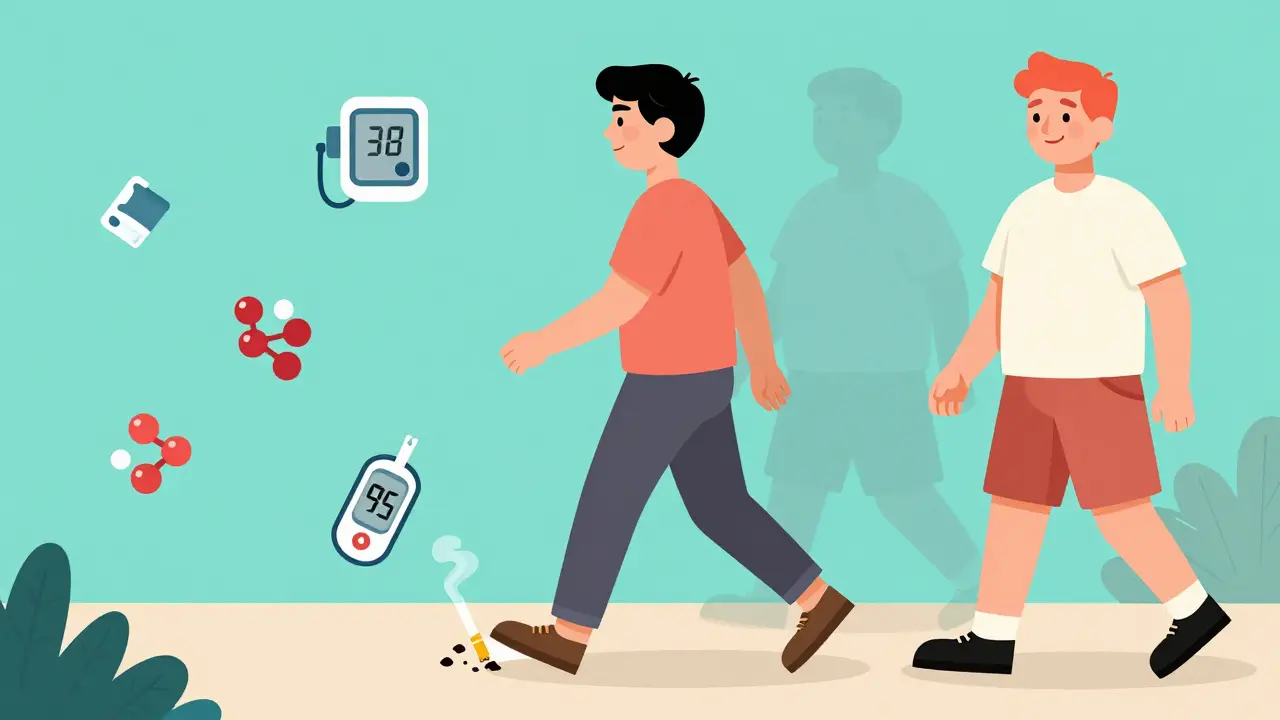
What You Can Change: The Big Four
You can’t change your age or your family history. But you can change these four things-and they make the biggest difference:- Blood pressure: About 47% of U.S. adults have high blood pressure. When it’s uncontrolled, your heart disease risk triples to quadruples. Target under 120/80. The SPRINT trial showed that lowering systolic pressure to under 120 (instead of 140) cuts heart events by 25%.
- Cholesterol: Nearly 1 in 3 Americans have LDL (bad) cholesterol too high. That’s 94 million people. High LDL raises your risk by 50%. Statins aren’t a cure-all, but high-intensity ones (like atorvastatin or rosuvastatin) can cut risk by 25-35% in people with existing heart disease.
- Blood sugar: Diabetes doesn’t just mean insulin shots. It means your heart is under constant stress. People with diabetes are 2 to 4 times more likely to die from heart disease. Sixty-eight percent of those over 65 with diabetes will have heart disease as their cause of death.
- Weight and activity: Being overweight increases strain on your heart. But even losing 5-10% of your body weight cuts blood pressure, improves cholesterol, and lowers diabetes risk. Just 150 minutes of brisk walking a week reduces heart disease risk by 30%.
It’s Not Just One Thing-It’s the Combo
Risk factors don’t add up-they multiply. Having high blood pressure and diabetes together? That raises your heart disease risk by 8 to 10 times compared to having neither. That’s the power of synergy. Two modifiable risks can turn a moderate threat into a crisis. That’s why the American Heart Association says fixing just three-smoking, high blood pressure, and inactivity-could prevent nearly half of all heart disease deaths in the U.S. It’s not about doing everything perfectly. It’s about tackling the biggest threats first.Tools to Know Your Real Risk
You can’t guess your risk. You need numbers. The American College of Cardiology and American Heart Association use the Pooled Cohort Equations to calculate your 10-year risk. It takes your age, sex, race, cholesterol, blood pressure, diabetes status, and smoking habits. The result? Low, borderline, intermediate, or high risk. High risk means 20% or more chance of a heart attack or stroke in the next decade. That’s when doctors recommend statins, even if your cholesterol looks okay. There’s also the Reynolds Risk Score, which adds family history and a simple blood test (CRP) to spot hidden inflammation. These tools aren’t perfect-but they’re better than hoping.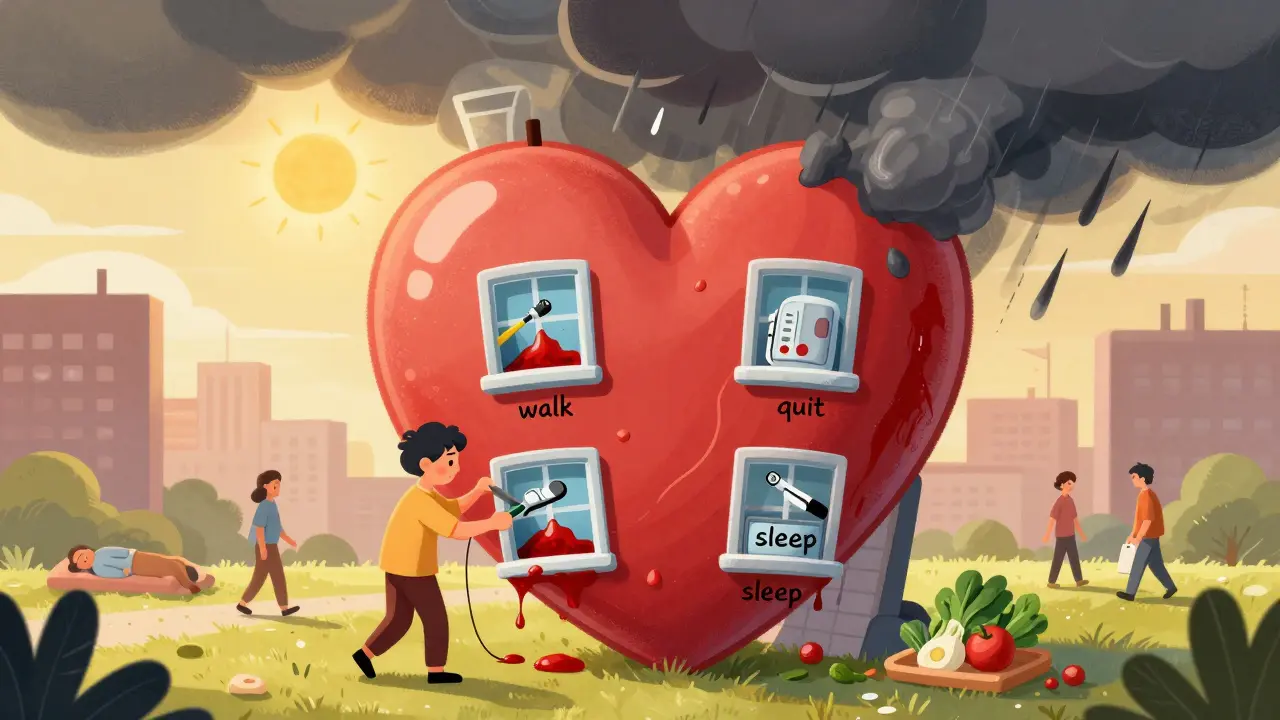
What No One Tells You: Stress, Sleep, and Society
Heart disease isn’t just about what’s in your body. It’s about where you live, how much stress you carry, and whether you get enough sleep. People in the lowest income brackets have 2 to 3 times higher heart disease death rates than those in the highest. Chronic stress raises cortisol, which spikes blood pressure and inflammation. Poor sleep-less than 6 hours a night-increases risk by 20%. Air pollution? It’s now officially recognized as a risk factor. Just a 10 μg/m³ increase in fine particles (PM2.5) raises heart disease death risk by 10-15%. These aren’t side notes-they’re part of the picture. You can’t control pollution, but you can control your environment: reduce noise, protect your sleep, and find ways to lower daily stress.What Works in Real Life
A 48-year-old man in Wisconsin had high blood pressure, obesity, smoked, and had a father who had a heart attack at 52. His 10-year risk? 18.2%. That’s high. He quit smoking, lost 35 pounds, started walking daily, and took his meds. In 18 months, his risk dropped to 6.3%. That’s not magic. That’s consistent action. People who succeed don’t go on a diet. They change one habit at a time. They track their blood pressure at home. They use apps to log meals. They ask their doctor for a referral to a dietitian or a smoking cessation program. And they don’t wait for a scare to start.What to Do Now
You don’t need to overhaul your life tomorrow. Start here:- Know your numbers: Get your blood pressure, cholesterol, and fasting blood sugar checked. Don’t skip this.
- Ask: “Do I have a family history of early heart disease?” If yes, get tested for cholesterol and consider genetic screening.
- If you smoke, quit. Use nicotine patches, counseling, or apps. Don’t try to do it alone.
- Walk 30 minutes a day, five days a week. That’s it. No gym needed.
- Reduce processed food. Swap soda for water. Eat more vegetables. You don’t need to be perfect-just better than yesterday.
Heart disease doesn’t strike out of nowhere. It builds over years. And the same habits that caused it can reverse it. You don’t need to be a health expert. You just need to care enough to act-today.
Can you have heart disease even if you’re young and fit?
Yes. While risk increases with age, young people can still develop heart disease-especially if they have a strong family history, smoke, have untreated high cholesterol, or have diabetes. Cases of heart attacks in people under 40 are rising, often linked to genetic conditions like familial hypercholesterolemia or lifestyle factors like smoking and poor diet. Being physically fit doesn’t cancel out other risks.
If heart disease runs in my family, is it inevitable?
No. Genetics load the gun, but lifestyle pulls the trigger. Even with a strong family history, you can cut your risk by half or more by not smoking, keeping blood pressure and cholesterol in check, staying active, and eating well. Studies show people with high genetic risk who live healthily have a 50% lower chance of heart disease than those with the same genes but poor habits.
Does quitting smoking really help if I’ve smoked for 30 years?
Absolutely. Your body starts healing the moment you quit. Within 20 minutes, your heart rate drops. After 12 hours, carbon monoxide clears from your blood. One year later, your heart disease risk is cut in half. After 15 years, it’s nearly the same as someone who never smoked. It’s never too late to quit-and the benefits start immediately.
What’s the best way to check my heart disease risk?
Ask your doctor for a 10-year ASCVD risk assessment using the Pooled Cohort Equations. It uses your age, sex, race, cholesterol, blood pressure, diabetes status, and smoking habits. You can also ask about a high-sensitivity CRP test to check for inflammation. If you have a family history of early heart disease, request a lipid panel and possibly genetic screening for familial hypercholesterolemia.
Can stress or lack of sleep cause heart disease?
Not directly, but they’re major contributors. Chronic stress raises blood pressure and inflammation. Poor sleep (under 6 hours) increases heart disease risk by 20%. Stress can also lead to unhealthy coping habits-like smoking, overeating, or skipping exercise. Managing stress through sleep, mindfulness, or activity is a key part of heart health.
Erik J
December 16, 2025 AT 19:03Been tracking my BP at home for a year now. Got it from 142/92 down to 118/76 just by cutting out processed snacks and walking after dinner. Didn’t even touch the gym. Sometimes the small stuff matters more than the big changes.
Martin Spedding
December 17, 2025 AT 07:49LOL at people thinkin they can ‘fix’ heart disease by walkin. My uncle smoked 2 packs a day for 40 yrs, ate nothing but fried chicken and still ran a marathon at 68. Genetics is king. Stats are for nerds.
amanda s
December 18, 2025 AT 13:18Why are we even talking about this? America’s got the best healthcare in the world. If you’re sick, go to a hospital. Stop blaming your diet or stress. It’s the government’s fault you’re unhealthy. Get a better job, move to a better state. That’s the real fix.
Brooks Beveridge
December 19, 2025 AT 15:36You’re not failing if you’re trying. Every step counts-even if it’s just drinking one less soda a day. I used to think I had to run marathons to be healthy. Then I realized: consistency > intensity. Your heart doesn’t care how hard you train. It just wants you to show up. 💪❤️
Anu radha
December 20, 2025 AT 09:06My mother had heart problem. She did not smoke. She eat good food. But still got sick. So I think maybe stress is big thing. I sleep 8 hours now. I feel better. Small change, big help.
Salome Perez
December 21, 2025 AT 03:43There’s something profoundly beautiful about the way the human body responds to gentle, sustained care. The arteries aren’t just tubes-they’re living landscapes shaped by decades of choices. And yet, even after years of neglect, they can still heal. That’s not just science-it’s poetry written in endothelial cells. I’ve seen it in my patients. One woman, 62, swapped her morning donut for avocado toast and walked with her granddaughter every day. Five years later, her CRP levels are lower than her daughter’s. The miracle isn’t the statin-it’s the intention.
Jody Patrick
December 21, 2025 AT 16:03Smoking is for losers. Quit already.
Radhika M
December 23, 2025 AT 15:54I am 35, no family history, no smoking. But I work 12 hours a day. I sit all day. I eat instant noodles. I sleep 5 hours. Now I feel tired all time. Maybe I need to change. Not because of fear. But because I want to live longer.
Pawan Chaudhary
December 25, 2025 AT 00:29Hey, you’re not alone. I was where you are-overweight, stressed, and thinking ‘I’ll start next month.’ Then my dad had a scare. I started walking 10 minutes a day. Then 20. Now I do 45. I didn’t change everything at once. I just changed one thing. And now I sleep better, laugh more, and my blood test looks normal. You got this. One step. One day. One breath.
Anna Giakoumakatou
December 26, 2025 AT 20:37How quaint. You all treat heart disease like a moral failing. ‘Eat kale, walk more, meditate.’ Meanwhile, the pharmaceutical-industrial complex rakes in billions while you’re busy optimizing your oat milk latte. The real risk factor? Capitalism. Your body isn’t broken-it’s being exploited. But sure, keep blaming your cholesterol.