How to Read Expiration Dates on Medication Packaging Correctly
 Jan, 25 2026
When you pick up a bottle of pills, an antibiotic, or even a bottle of ibuprofen from the pharmacy, you probably glance at the date on the label and assume it’s clear. But what if that date doesn’t mean what you think it does? Many people throw out perfectly good medicine because they misunderstand the label. Others keep expired drugs, hoping they’ll still work. Both choices can be risky. Knowing how to read expiration dates on medication packaging isn’t just helpful-it’s essential for your safety.
What an Expiration Date Actually Means
The expiration date on your medication isn’t a "use-by" date like on milk. It’s not when the drug suddenly turns toxic or stops working completely. Instead, it’s the final day the manufacturer guarantees the medicine will work as intended, assuming it’s been stored properly. That means the drug still has its full strength, purity, and safety up to that date. After that, it might lose some effectiveness, but it’s not automatically dangerous.
The U.S. Food and Drug Administration (FDA) started requiring expiration dates in 1979. Since then, manufacturers test each drug under different conditions-heat, humidity, light-to see how long it stays stable. Most pills last 1 to 5 years. Eye drops? Usually 6 months to 2 years. Injections? Often 2 to 5 years. These aren’t guesses. They’re based on real lab data.
But here’s the catch: if you leave your medicine in a hot bathroom or a sunny windowsill, it can break down faster. The expiration date only applies if the product was stored as directed-cool, dry, and out of direct light.
How Expiration Dates Are Shown on Packaging
Not all expiration labels look the same. You might see:
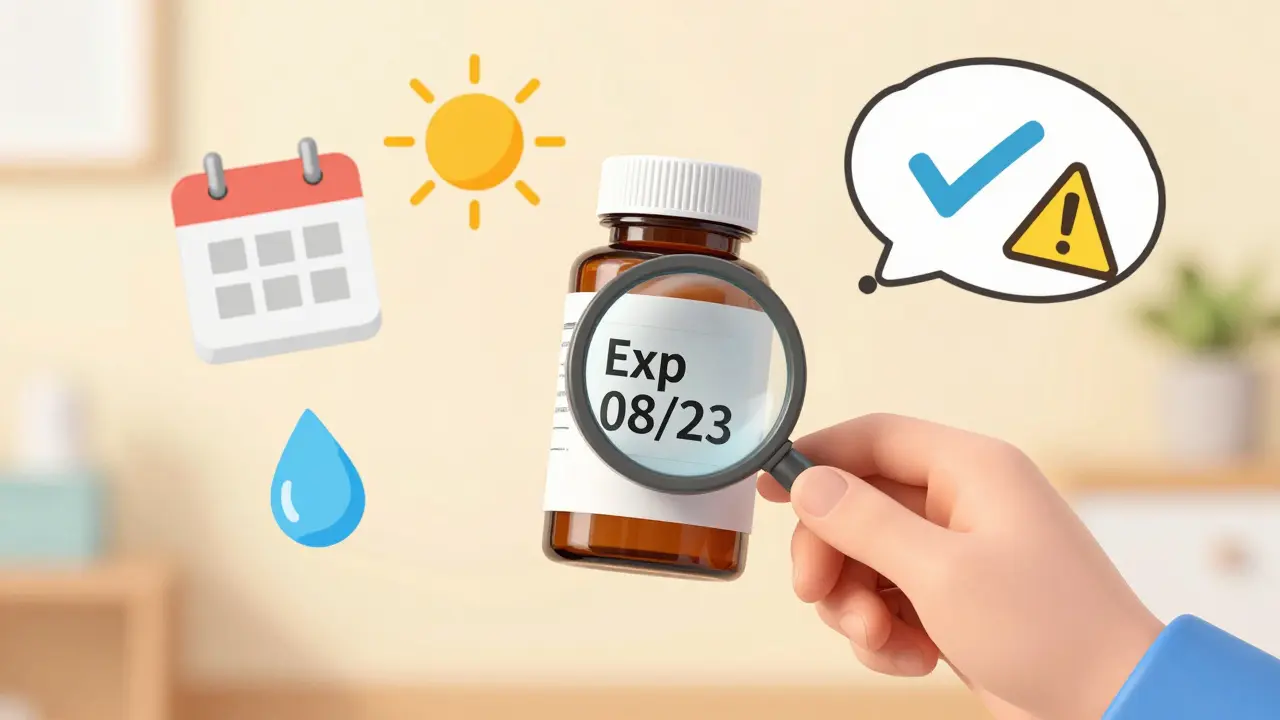
- "Exp 08/23"
- "Expiry Date: 2023-08-15"
- "Use by 15/08/2023"
- "Exp date: AUG 2023"
If the date is written as month/year (like 08/23), it means the medicine expires on the last day of that month. So 08/23 means August 31, 2023. No guessing needed.
If you see a full date like 2023-08-15, that’s straightforward-it expires on August 15, 2023. In the European Union, you’ll often see day/month/year (15/08/2023). In China, it’s year/month/day (2023-08-15). The format changes by country, but the meaning doesn’t.
Look for words like "Exp," "Expiry," "Expires," or "Use by." These all mean the same thing. If you’re unsure, check the original packaging or ask your pharmacist.
Pharmacy Labels vs. Manufacturer Dates
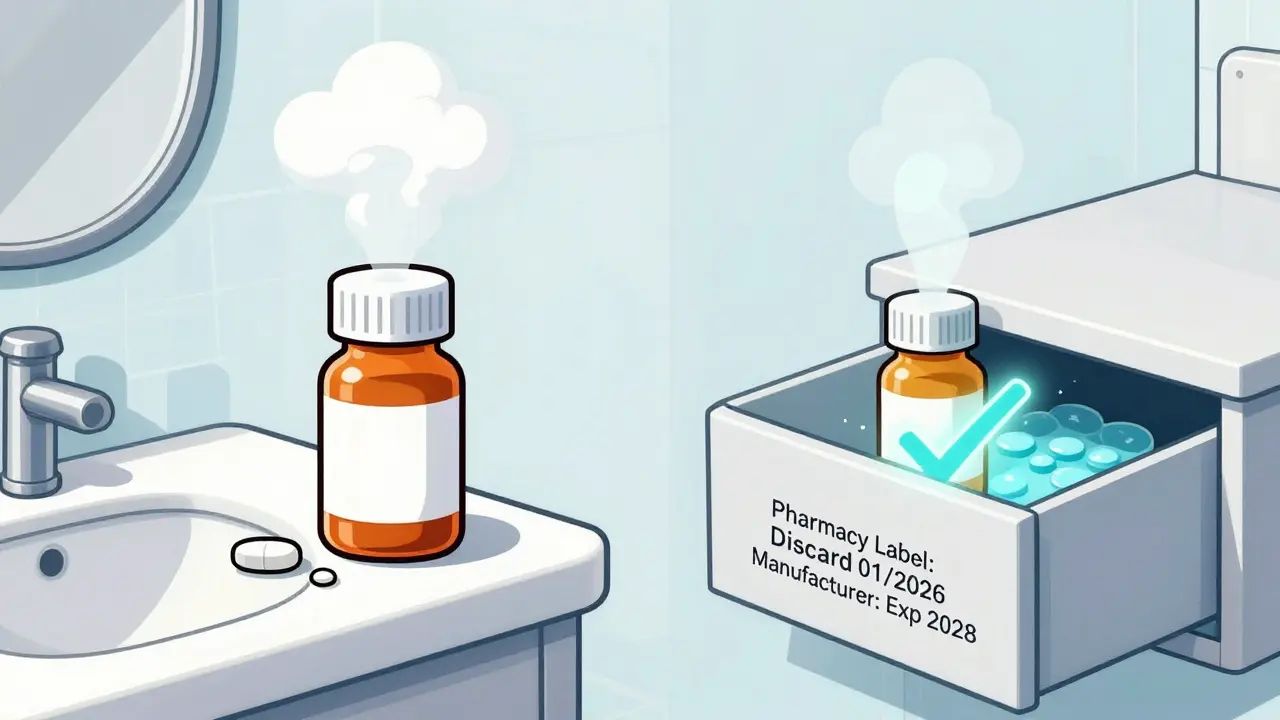
This is where most people get confused. When a pharmacy fills your prescription, they put their own label on the bottle. That label often says "Discard after: 01/2026" or "Do not use after: 1 year from dispensing."
That’s not the manufacturer’s expiration date. That’s the pharmacy’s "beyond-use date." It’s a safety buffer. For most pills, pharmacies set this date to one year from when you picked up the prescription-even if the original bottle says it expires in 2028. Why? Because once you open the bottle and start taking pills out, exposure to air, moisture, and handling can affect stability.
But here’s the important part: the manufacturer’s date is still valid. If your insulin bottle says it expires in 2027, but the pharmacy label says "discard after 2026," you can still use it until 2027-if it’s stored correctly. Always ask your pharmacist to write the manufacturer’s expiration date on the label, too. That way, you know the real cutoff.
Some medications have much shorter pharmacy expiration dates. Antibiotic liquids, for example, often expire just 14 days after being mixed. That’s because they’re not stable in liquid form for long. Don’t assume all prescriptions follow the same rule.
When Expired Medication Is Dangerous
Most expired pills won’t hurt you. But some can. The FDA and medical experts agree: certain medications should never be used past their expiration date.
- Insulin-If it’s expired, it won’t lower your blood sugar properly. That can lead to dangerous spikes.
- Birth control pills-Even a small drop in hormone levels can lead to unintended pregnancy.
- Thyroid medication-If it’s weaker, your metabolism can go out of balance, causing fatigue, weight gain, or heart problems.
- Anti-platelet drugs (like aspirin for heart health)-Losing potency could mean increased risk of clotting or stroke.
There’s also one rare but serious case: old tetracycline antibiotics. In the 1960s, expired tetracycline was linked to kidney damage. Modern versions don’t have that problem. But if you find an old bottle of tetracycline from decades ago-don’t take it.
Even if a drug isn’t dangerous, it might not work. An expired antibiotic could fail to kill bacteria, leading to worse infections or even antibiotic resistance. That’s not just bad for you-it’s bad for everyone.
How to Check If Your Medicine Is Still Good
Expiration dates aren’t the only clue. Look at the medicine itself.
- Does the pill look different? Discolored, cracked, or chalky? Toss it.
- Is the liquid cloudy, separated, or smelling odd? Don’t use it.
- Do patches or ointments feel sticky, dry, or crumbly? They’ve degraded.
- Are eye drops discolored or have particles in them? Discard immediately.
Many drugs lose potency without any visible change. That’s why you can’t rely on looks alone. But if you see something unusual, it’s a red flag.
Also, check for a Drug Identification Number (DIN) or General Product (GP) number on the label. In Canada and some other countries, this number confirms the product was approved for sale. If it’s missing, the medicine might be counterfeit or unregulated.
Storage Matters More Than You Think
Storing medicine correctly is just as important as checking the date. Heat, moisture, and light speed up degradation.
Don’t keep pills in the bathroom. The steam from showers ruins them. Don’t leave them in your car in summer. Temperatures inside a parked car can hit 50°C (122°F)-way beyond what most drugs can handle.
Most medicines should be kept in a cool, dry place-like a bedroom drawer. Some, like insulin or certain antibiotics, need refrigeration. Always read the storage instructions on the label. If it says "store below 25°C," don’t assume room temperature is fine.
The FDA’s Shelf Life Extension Program found that 90% of stockpiled drugs stayed effective for years past their expiration date-if they were sealed and stored in controlled conditions. That’s why emergency kits (like those used by the military) often have drugs that are 10+ years old and still work. But that doesn’t mean you should keep your personal meds in a basement or garage.
What to Do with Expired Medicine
Don’t flush pills down the toilet or throw them in the trash without precautions. Many places have drug take-back programs. Pharmacies, hospitals, or police stations often collect expired or unwanted medications.
If no take-back option is available, mix pills with something unappealing-used coffee grounds, cat litter, or dirt-then seal them in a container before tossing. This keeps kids and pets from getting into them.
For liquids, don’t pour them down the drain. Mix with water, seal in a plastic bag, and dispose of with regular trash. Never pour them into the sink.
Smart Tips to Avoid Confusion
- Write the expiration date on your pill organizer or phone calendar. Set a reminder 1 month before it expires.
- Keep original packaging. It has the manufacturer’s date and lot number, which matters for recalls.
- Use apps like MedSafe or MyTherapy to track multiple medications and get alerts.
- When refilling a prescription, ask your pharmacist: "Is this the manufacturer’s date or the pharmacy’s beyond-use date?"
- For critical meds (insulin, heart meds, seizure drugs), replace them before they expire-even if they look fine.
One common mistake? People throw out a $200 prescription because they saw a "discard after" date on the pharmacy label and assumed it was the real expiration. Always double-check the original bottle.
What’s Changing in the Future
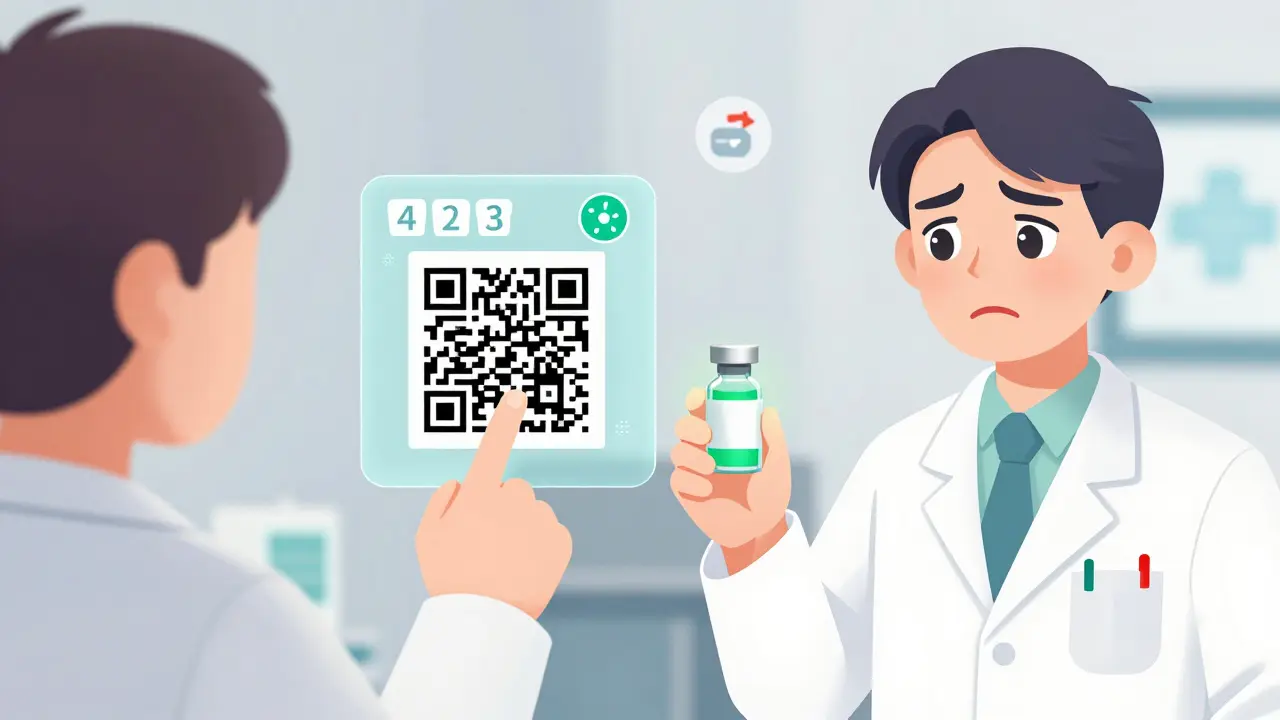
Pharmaceutical companies are starting to use smarter packaging. Some now have QR codes you can scan to see the real expiration date and storage info. Others use thermochromic ink that changes color if the medicine got too hot. Merck started using this for insulin in late 2022.
The World Health Organization is pushing for a global standard: YYYY-MM-DD format for all expiration dates. That means no more guessing whether 08/23 means August 2023 or March 2023.
But until then, you’re still the best line of defense. Know your labels. Ask questions. Don’t assume.
When in Doubt, Ask Your Pharmacist
Pharmacists are trained to decode these labels. They know which drugs are safe past expiration and which aren’t. They can tell you if your medicine is still good, even if the date has passed.
If you’re unsure about a pill, liquid, or patch-don’t guess. Walk into your pharmacy. Bring the bottle. Ask: "Is this still safe to take?" Most will check the manufacturer’s data and give you a clear answer.
It’s better to spend five minutes asking than risk your health because you assumed you knew what the date meant.
Josh josh
January 25, 2026 AT 23:25Man i just threw out my amoxicillin last week cause the bottle said 2022 and i thought it was bad
turns out i was dumb as hell
Uche Okoro
January 26, 2026 AT 15:20The pharmacokinetic stability profiles of solid oral dosage forms under accelerated aging conditions (40°C/75% RH) demonstrate negligible degradation beyond the labeled expiration date for 87% of analytes tested in FDA-mandated stability studies. The beyond-use date imposed by pharmacies is a risk-averse administrative construct, not a pharmacological imperative. The disconnect between regulatory compliance and clinical utility remains a systemic failure in pharmaceutical stewardship.
Joanna Domżalska
January 27, 2026 AT 10:27So you're telling me I can keep my Xanax from 2019 and it'll still work? Cool. So why does the government make us throw stuff out then? Because they want you to buy more. Always.
Mohammed Rizvi
January 27, 2026 AT 19:22Bro i once took a 10-year-old ibuprofen during a hiking trip. Felt like a superhero. No side effects. Just pure chill. The expiration date is just capitalism's way of selling you more painkillers.
Ashley Karanja
January 28, 2026 AT 15:18This is such an important topic. I've been working in community health for over a decade, and the number of people who panic over a pharmacy's beyond-use date versus the manufacturer's actual expiration is staggering. The lack of public education around this is a silent public health crisis. We need pharmacy staff to be trained to clearly communicate both dates on the label - and we need public service announcements that explain the difference in plain language. It's not just about safety, it's about equity. People who can't afford to replace meds every year are being punished by bureaucracy.
eric fert
January 29, 2026 AT 09:20Let me just say this - the entire pharmaceutical industry is built on fear. They want you to think your medicine turns into poison the second the date flips. But here's the truth: the FDA’s own Shelf Life Extension Program proves that 90% of drugs remain stable for years beyond expiration. And yet, they still force pharmacies to put those arbitrary one-year discard labels on everything. Why? Because if you knew your $300 insulin could last 7 years, they’d lose billions. It’s not about safety - it’s about profit. And don’t even get me started on how they scare people into throwing out antibiotics like they’re radioactive. The real danger isn’t expired meds - it’s the corporate lies that keep you buying new ones every time.
Ryan W
January 29, 2026 AT 20:55Why are we trusting some foreign lab to tell us how long our medicine lasts? We're Americans. We don't need some EU or Chinese date format to tell us when to stop taking pills. If it looks fine and the bottle says 2025, I'm using it. The FDA is just trying to control us.
Nicholas Miter
January 31, 2026 AT 00:03Just a heads up - if you're keeping meds in the bathroom, you're basically cooking them. Steam from showers breaks down tablets way faster than time. I used to do it till my aunt told me her blood pressure med stopped working after 6 months in the bathroom. Now I keep mine in a sealed container in my bedroom drawer. Simple fix. Also - if you're on insulin or thyroid meds, don't gamble. Replace them. But for ibuprofen or allergy pills? Chill. They're not gonna kill you if they're 2 years past.
George Rahn
January 31, 2026 AT 03:14It's fascinating how the global pharmaceutical complex imposes inconsistent labeling standards. The absence of a universal YYYY-MM-DD format is a geopolitical failure of standardization. While the WHO pushes for harmonization, national regulatory bodies cling to archaic conventions rooted in colonial-era bureaucratic inertia. The result? A fragmented, confusion-laden landscape where the average citizen becomes a de facto pharmacologist out of necessity. This isn't just poor labeling - it's institutional negligence disguised as tradition.
Betty Bomber
January 31, 2026 AT 10:43I used to be scared of expired meds. Now I just check if they smell weird or look like they’ve been through a war. If they don’t, I use them. My grandma took 15-year-old aspirin and lived to 98. Maybe we’re overthinking this.
TONY ADAMS
February 1, 2026 AT 19:29bro i just took a 7 year old zpack cause my throat hurt and i was too lazy to go to the store
it worked
now i feel like a genius
Rakesh Kakkad
February 2, 2026 AT 08:20It is imperative to recognize that the integrity of pharmaceutical substances is contingent upon the unbroken chain of storage conditions from manufacturing to consumption. Any deviation - even minor - renders the expiration date meaningless. Therefore, the onus is on the consumer to ensure absolute adherence to storage protocols. Failure to do so constitutes negligence, regardless of the manufacturer's stated shelf life.
Suresh Kumar Govindan
February 3, 2026 AT 10:11QR codes on meds? Thermochromic ink? This is how they track you. Every scan logs your location, your medication use, your health data. They’re not making packaging smarter - they’re building a surveillance system under the guise of safety.
Henry Jenkins
February 3, 2026 AT 12:05I’ve been thinking about this a lot lately. The fact that we treat medicine like milk - with rigid expiration dates - ignores the reality that most drugs degrade slowly, not suddenly. We don’t have good data on what happens after 5 years because manufacturers aren’t required to test beyond that. But the military’s stockpile studies show that with proper storage, many drugs last decades. So why are we throwing out perfectly good pills? Is it really about safety, or is it about profit and convenience? I think we need independent, long-term studies - not just corporate-funded ones. And we need transparency. If a drug is still safe and effective after 10 years, we should know that. Not guess. Not hope. Know.
Ashley Karanja
February 5, 2026 AT 05:49Henry, you just nailed it. I work with low-income seniors who refill insulin every month because they don’t know the original bottle expires in 2028. They’re told "discard after 1 year" and believe it. I’ve seen people skip doses because they think they’re out of medicine. We need pharmacists to write both dates on the label - manufacturer AND pharmacy - in big bold letters. And we need community health workers to do home visits and explain it. This isn’t just about science. It’s about dignity. People shouldn’t have to choose between rent and their meds because a label was confusing.