Medication-Induced Eye Sensitivity: Managing Halos and Photophobia
 May, 15 2026
Medication Eye Sensitivity Checker
Select the medications you are currently taking to check for potential visual side effects.
Potential Visual Side Effects
Recommended Safety Actions
Disclaimer: This tool provides information based on general medical data. It does not replace professional medical advice. If you experience sudden vision changes, eye pain, or severe light sensitivity, seek immediate medical attention.
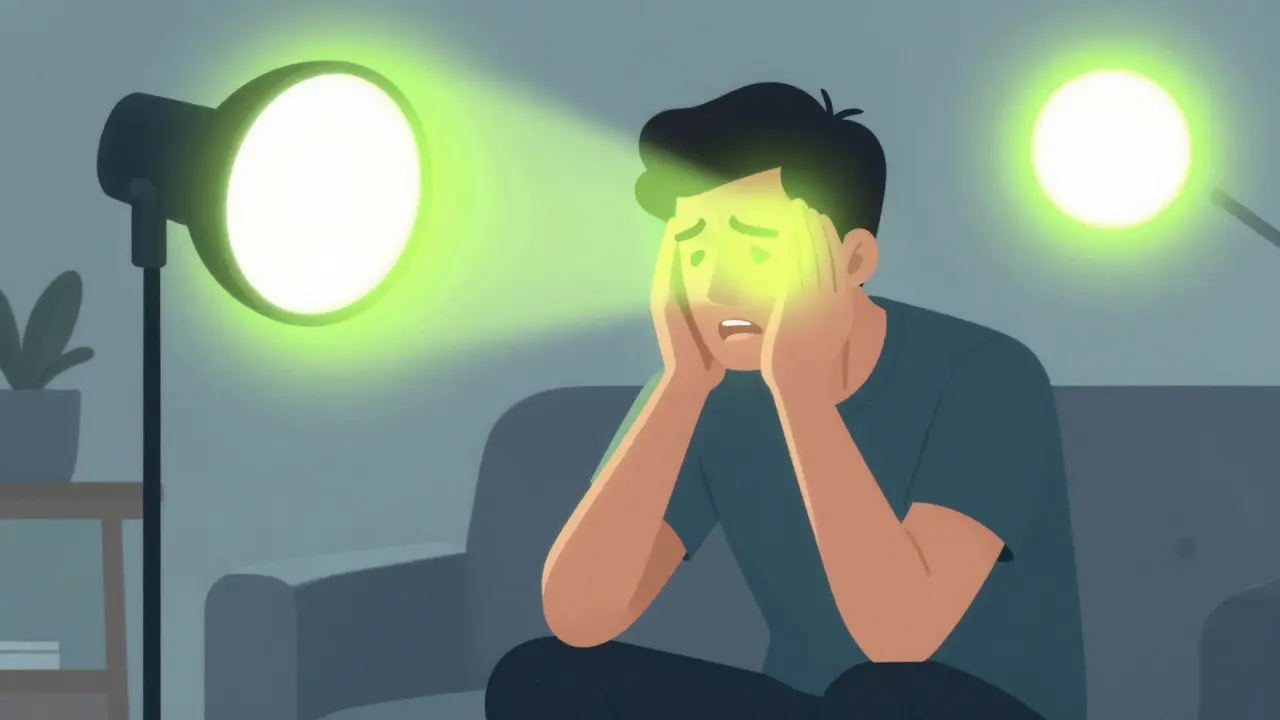
Did you know that the pills in your medicine cabinet could be changing how you see? For many people, taking common prescriptions for everything from heart rhythm to arthritis leads to a startling visual change: bright lights start to look like they have glowing rings around them, or even normal indoor lighting feels physically painful. These symptoms-known medically as halos and photophobia (light sensitivity)-are not just annoying quirks. They are documented side effects of numerous medications that can impact your daily life, driving ability, and long-term vision health.
If you’ve recently started a new medication and noticed these changes, you aren’t imagining things. Understanding which drugs cause these issues, why they happen, and how to protect your eyes is crucial for maintaining your quality of life while staying on necessary treatments.
Why Medications Affect Your Vision
Your eyes are complex organs connected directly to your brain’s sensory processing centers. When certain chemicals enter your bloodstream, they don’t just target one specific area; they circulate throughout your body, including the delicate tissues of your eyes. Research indicates that medication-induced visual disturbances often stem from biochemical interactions with the retina, cornea, or lens.
For instance, some drugs alter the way your brain processes light signals. Studies suggest this involves "thalamic hyperactivity," where the part of your brain responsible for relaying sensory information becomes hypersensitive to light stimuli. Other medications may cause physical changes, such as fluid buildup in the eye or deposits forming on the cornea. This divergence between the optic nerve and trigeminal nerve creates a direct link between light exposure and pain, turning a simple glance at a screen into a headache trigger.
Common Culprits: Which Medications Cause Halos?
Not all drugs affect vision equally, but several classes of medications are notorious for causing halos and light sensitivity. Knowing what you’re taking is the first step in managing these side effects.
| Medication Class | Specific Drugs | Primary Visual Side Effect | Risk Level |
|---|---|---|---|
| Antiarrhythmics | Amiodarone (Cordarone) | Halos around lights, blurred vision | Moderate (1-10% of patients) |
| Antimalarials | Hydroxychloroquine (Plaquenil) | Retinal damage, corneal clouding | High (with long-term use) |
| NSAIDs | Ibuprofen, Naproxen | Painful light sensitivity | Low (approx. 1%) |
| Erectile Dysfunction | Sildenafil (Viagra) | Color vision changes, light sensitivity | Moderate |
| Antipsychotics | Chlorpromazine (Thorazine) | Pigment changes, dry eye, blurry vision | Moderate to High |
| Antiseizure | Phenytoin (Dilantin) | Photophobia | Varies by patient |
Amiodarone, used for irregular heartbeats, is particularly famous for causing green-tinted halos around lights. While often temporary, it can make night driving dangerous. Similarly, Hydroxychloroquine, commonly prescribed for lupus and rheumatoid arthritis, carries a significant risk of retinal toxicity if not monitored closely. The American Academy of Ophthalmology warns that this damage can be irreversible, affecting up to 15% of patients after five years of standard dosing without proper screening.
The Hidden Danger of Retinal Toxicity
While halos might seem like a minor annoyance, they can sometimes signal deeper, more serious issues. With drugs like Hydroxychloroquine and Ethambutol (used for tuberculosis), the concern isn't just discomfort-it's permanent vision loss. These medications accumulate in the pigment epithelium of the retina over time.
The scary part? Early-stage retinal toxicity is often asymptomatic. You might feel fine, but damage is occurring silently. This is why regular monitoring isn't just a suggestion; it's a necessity. For Ethambutol users, optic nerve damage occurs in 1-2% of patients at standard doses but can rise to 50% at higher doses, manifesting as decreased peripheral vision and changes in color perception. If you are on these medications, skipping an eye exam is gambling with your sight.
Immediate Safety Tips for Light Sensitivity
If you are currently experiencing photophobia or halos, you don’t have to wait for your next scheduled appointment to find relief. There are practical steps you can take immediately to reduce discomfort and protect your eyes.
- Switch Your Lighting: Harsh white LED bulbs can exacerbate sensitivity. Switch to warm-toned LEDs (2700K-3000K) and keep brightness levels between 50-70%. Dimmable lamps allow you to adjust intensity based on your comfort level.
- Wear Specialized Tints: Standard sunglasses often block UV rays but still let in visible blue light, which can trigger pain. Look for lenses with FL-41 tinting. Clinical studies show these rose-colored filters can reduce light sensitivity symptoms by 40-60% for migraine and medication-induced photophobia.
- Practice the 20-20-20 Rule: Every 20 minutes, look at something 20 feet away for 20 seconds. Doing this in dimmed lighting helps reset your pupil size and reduces strain on sensitive ocular surfaces.
- Avoid Night Driving: If halos around streetlights or headlights are blinding you, stop driving at night immediately. This is a critical safety measure to prevent accidents until your vision stabilizes or you get specialized corrective lenses.

When to Seek Emergency Care
Most medication-induced light sensitivity is manageable, but sudden onset can indicate a medical emergency. If you experience sudden, severe light sensitivity accompanied by eye pain, nausea, or seeing rainbows around lights, you may be experiencing acute angle-closure glaucoma. Certain medications can trigger this condition, which requires treatment within 24-48 hours to prevent permanent blindness.
Contact an ophthalmologist immediately if:
- Symptoms appear suddenly rather than gradually.
- You notice a significant drop in visual acuity.
- You experience persistent eye redness or swelling alongside the light sensitivity.
Long-Term Monitoring Protocols
Prevention is better than cure, especially when it comes to drug-induced eye damage. The National Eye Institute reports that strict adherence to monitoring guidelines prevents 89% of permanent vision loss cases from high-risk medications. Here is what you should expect from your care team:
- Baseline Exam: Before starting drugs like Hydroxychloroquine or Tamoxifen, you need a comprehensive eye exam including visual fields and spectral-domain OCT (Optical Coherence Tomography).
- Annual Screenings: After five years of use, annual exams become mandatory for most high-risk patients. If you have additional risk factors (like kidney disease or high doses), screening may start earlier.
- Monthly Checks: Patients on Ethambutol typically require monthly vision testing during active treatment to catch optic neuropathy early.
Don’t hesitate to ask your doctor about these protocols. Many patients are unaware that their prescription requires specific ocular surveillance. Informed patients are safer patients.
Will the halos go away if I stop the medication?
In many cases, yes. For medications like Amiodarone or antipsychotics, halos and light sensitivity often resolve within 7-14 days after discontinuation under physician supervision. However, if the medication has caused structural damage to the retina or cornea (such as with long-term Hydroxychloroquine use), the visual changes may be permanent. Always consult your doctor before stopping any prescription.
Can over-the-counter painkillers cause light sensitivity?
Yes. Non-steroidal anti-inflammatory drugs (NSAIDs) like ibuprofen and naproxen can cause painful light sensitivity in approximately 1-3% of users. This is often linked to inflammatory pathways affecting the ocular surface. If you frequently use NSAIDs for migraines, note that migraines themselves cause photophobia, making it difficult to distinguish the source without professional evaluation.
What are FL-41 glasses, and do they really help?
FL-41 lenses are specialized tinted glasses that filter out specific wavelengths of blue-green light. Clinical studies have shown they can reduce light sensitivity symptoms by 50-70% in patients with migraine and medication-induced photophobia. They are particularly effective for those who cannot tolerate standard dark sunglasses due to glare issues.
How soon after starting a new medication should I get my eyes checked?
If you are starting a high-risk medication like Hydroxychloroquine, Ethambutol, or Chlorpromazine, you should receive a baseline eye exam before beginning treatment or within the first month. For lower-risk medications, report any new visual symptoms to your eye doctor immediately, but routine annual exams are generally sufficient unless advised otherwise.
Is there a link between chemotherapy and eye problems?
Yes. Certain chemotherapy agents, such as vemurafenib and tamoxifen, can cause severe photosensitivity and retinal deposits. Vemurafenib can lead to blistering sunburns under UVA radiation, while tamoxifen may cause corneal clouding in about 1.5% of patients. Cancer survivors undergoing these treatments require diligent UV protection and regular ophthalmological monitoring.