Monoclonal Antibody Biosimilars: Examples and Clinical Uses
 Feb, 26 2026
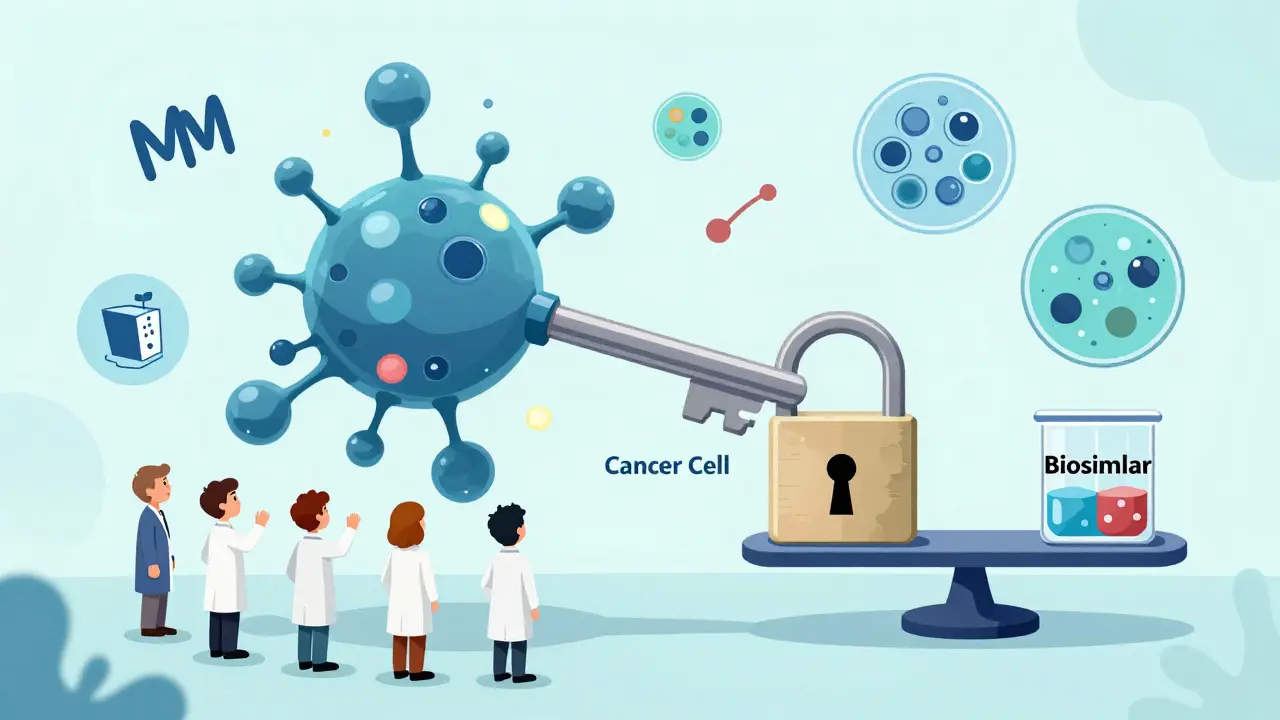
When you hear the word biosimilar, you might think it’s just a cheaper version of a brand-name drug - like a generic pill. But monoclonal antibody biosimilars aren’t like that at all. They’re not chemically identical. They’re not simple copies. They’re complex, living molecules - proteins the size of a small virus - made by living cells. And getting them right takes years of science, hundreds of tests, and millions of dollars. Yet, they’re changing how cancer and autoimmune diseases are treated across the world.
What Makes Monoclonal Antibody Biosimilars Different
Think of a small-molecule drug like aspirin. It’s made in a lab with precise chemical reactions. Every tablet is the same. That’s why generics work so well - they’re exact duplicates. But monoclonal antibodies? They’re produced in living cell cultures - Chinese hamster ovary cells, usually. These cells tweak the protein in tiny ways: adding sugar groups (glycosylation), folding the chain just right, or attaching a molecule here or there. No two batches are perfectly identical. Even the original brand-name drug varies slightly from one production run to the next.
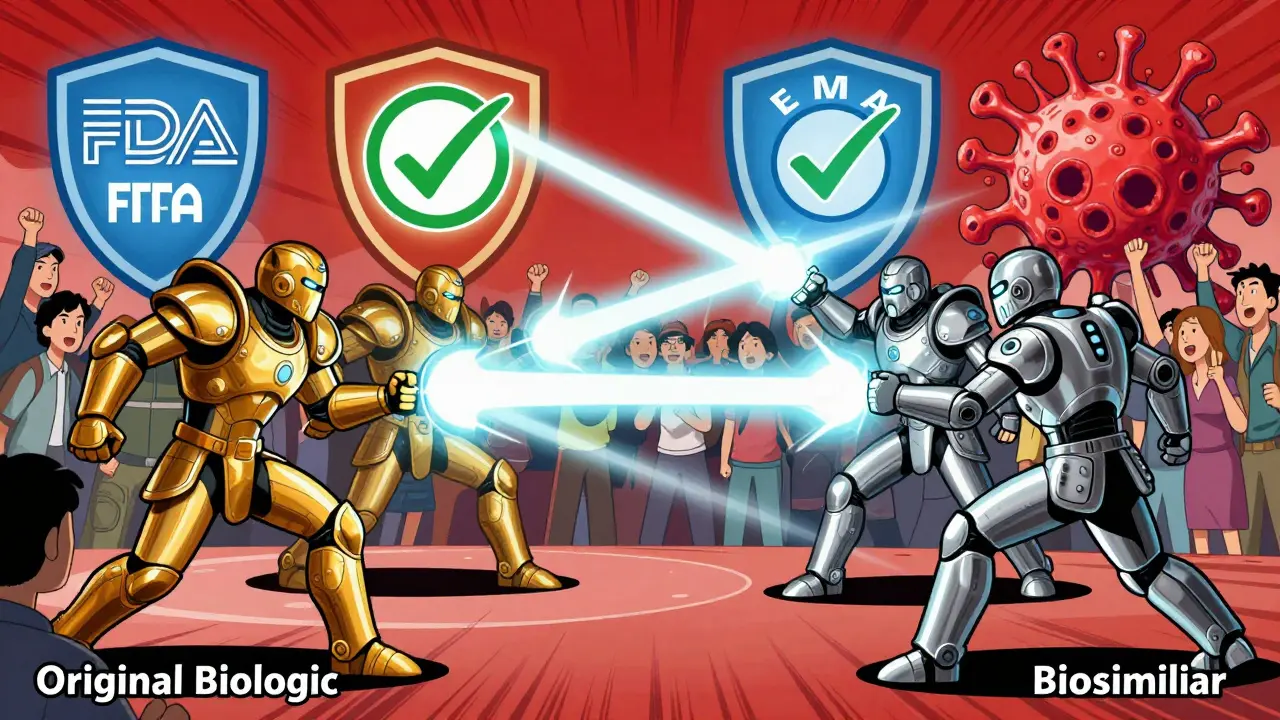
The FDA and EMA don’t require biosimilars to be exact copies. They only require that they’re highly similar - with no clinically meaningful differences in safety, purity, or potency. That means: if a patient switches from the brand to the biosimilar, their body should react the same way. No extra side effects. No drop in effectiveness. The science behind this isn’t guesswork. It’s a 50-step analytical process. Think mass spectrometry, NMR, cell-based assays, and immune response tests. The FDA’s 2023 draft guidance recommends 127 specific tests just to compare structure.
Key Examples and Their Uses
Let’s look at real-world biosimilars and what they treat.
Bevacizumab biosimilars (originally Avastin) are used in advanced cancers - colorectal, lung, brain, and cervical. As of 2023, the FDA has approved six: Mvasi, Zirabev, Alymsys, Vegzelma, Avzivi, and Jobevne. These drugs block VEGF, a protein tumors need to grow blood vessels. Without that blood supply, tumors starve. The biosimilars work just like the original. A 2022 study in JAMA Oncology tracked over 1,200 patients switching to a bevacizumab biosimilar. No increase in side effects. No drop in tumor response.
Rituximab biosimilars (originally Rituxan) target CD20, a protein on B-cells. Used for non-Hodgkin’s lymphoma, chronic lymphocytic leukemia, and rheumatoid arthritis. Three biosimilars are approved in the U.S.: Truxima, Ruxience, and Riabni. A real-world study at 15 U.S. cancer centers found switching to Truxima cut costs by 28% per cycle with no loss in safety. That’s huge when a single treatment can cost over $10,000.
Trastuzumab biosimilars (originally Herceptin) fight HER2-positive breast and stomach cancers. Six biosimilars are approved: Ogivri, Herzuma, Ontruzant, Trazimera, Kanjinti, and Hercessi. HER2 is a receptor that tells cancer cells to multiply. These drugs block it. In clinical trials, biosimilar trastuzumab matched the original in tumor shrinkage rates - sometimes within 1%. That’s why oncologists now feel comfortable using them as first-line treatment.
And then there’s infliximab biosimilars (originally Remicade), used for Crohn’s, ulcerative colitis, and rheumatoid arthritis. The first ever monoclonal antibody biosimilar approved - in the EU in 2013. In 2023, the FDA gave one version - Remsima - the status of “interchangeable.” That means pharmacists can swap it for the brand without asking the doctor. Only one other biosimilar has this status so far.
Why They Matter: Cost and Access
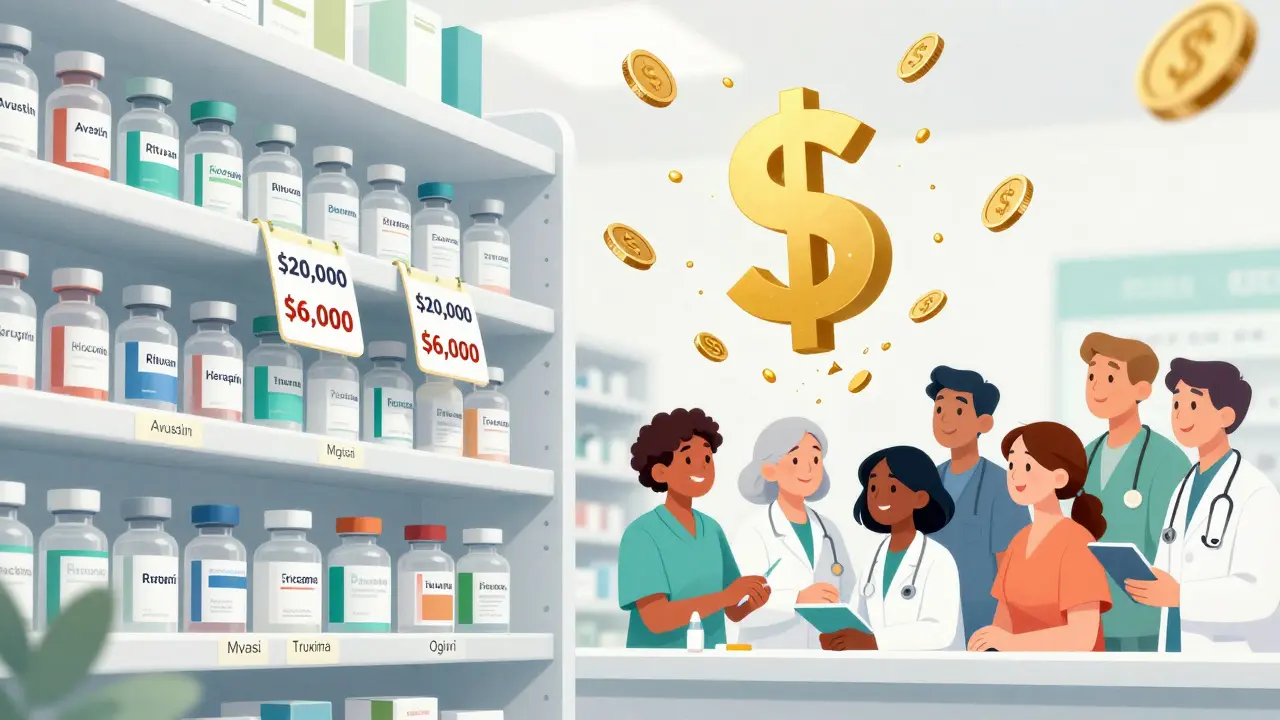
These drugs used to cost $15,000 to $20,000 per year. For a patient on long-term therapy, that’s out of reach. Biosimilars bring prices down - often by 30% to 50%. In some cases, even 70% after market competition kicks in.
Evaluate Pharma predicts biosimilar monoclonal antibodies will save the U.S. healthcare system $250 billion between 2023 and 2028. Bevacizumab, trastuzumab, and rituximab biosimilars will account for 78% of those savings. That’s billions freed up for other patients - for early screenings, new treatments, or even mental health support.
But savings don’t happen automatically. Pharmacy benefit managers still lock out biosimilars from formularies. Some insurers won’t cover them unless the patient tries the brand first. And doctors? A 2022 ASCO survey found only 58% of oncologists felt “very confident” prescribing them. Education gaps are real. Many still think biosimilars are like generics - and worry they’re less safe. They’re not.
What’s Next: The Pipeline
The next wave is coming fast. There are 37 monoclonal antibody biosimilars in FDA review as of late 2023. The biggest focus? Adalimumab (Humira) - the world’s best-selling drug for years. With 14 biosimilar candidates, it’s about to explode. The first U.S. version, Hyrimoz, was approved in September 2023. More will follow.
Then there’s pembrolizumab (Keytruda), the immunotherapy that changed melanoma and lung cancer care. Six biosimilars are in late-stage trials. If approved, they could cut the cost of checkpoint inhibitors - often over $150,000 per year - by half. That’s life-changing for patients without full insurance.
The EMA is preparing new guidelines for even more complex products: bispecific antibodies (targeting two proteins at once) and antibody-drug conjugates (antibodies carrying chemo directly to cancer cells). These are next-gen biologics. Making biosimilars of them? That’s the new frontier.
Challenges That Remain
It’s not all smooth sailing. Patent lawsuits delay market entry. One monoclonal antibody biosimilar faces an average of 14.7 patent challenges before it can launch. That’s not science - that’s legal warfare.
Immunogenicity is another concern. Could the body react to a tiny difference in sugar structure? Yes - but rarely. The EMA’s 2021 safety report found only 12 unexpected immune reactions across 1.2 million patient-years of exposure. That’s 0.001%. Same rate as the original products. So far, no biosimilar has shown higher risk.
And then there’s the perception gap. Some patients and providers still think “biosimilar” means “lower quality.” But the data doesn’t lie. In head-to-head trials, biosimilars match the reference product in response rates, side effects, and survival outcomes. In real-world use, they’re just as safe.
What This Means for Patients
If you’re on a monoclonal antibody for cancer, rheumatoid arthritis, or another chronic condition, you’re likely to be offered a biosimilar soon. It’s not a gamble. It’s science-backed, regulated, and proven. Switching doesn’t mean downgrading. It means getting the same treatment at a price your insurance can cover.
Ask your doctor: “Is there a biosimilar option for my drug?” If they’re unsure, ask for a referral to a pharmacy specialist. Many hospitals now have biosimilar transition programs. Some even offer patient support - like co-pay assistance or education sessions.
And if you’re worried about switching? Look at the data. Look at the studies. Look at the regulators. The FDA, EMA, and global health agencies don’t approve these lightly. They’ve spent over a decade building the science. You’re not a test subject. You’re a patient who deserves access to life-saving medicine - no matter the price tag.
Are monoclonal antibody biosimilars the same as generics?
No. Generics are chemically identical copies of small-molecule drugs - like aspirin or metformin. Biosimilars are highly similar, but not identical, copies of complex biological drugs - like trastuzumab or rituximab. They’re made from living cells, not chemicals, and have natural variations. That’s why they require far more testing to prove they work the same way.
Can I switch from the brand-name drug to a biosimilar?
Yes - and it’s safe. The FDA and EMA require biosimilars to show no clinically meaningful differences in safety or effectiveness. Many patients switch without issue. Some biosimilars, like Remsima (infliximab), are even approved as “interchangeable,” meaning a pharmacist can swap them without asking your doctor. Clinical studies show no increase in side effects or drop in response after switching.
Do biosimilars cause more side effects than the original drugs?
No. Large-scale studies and real-world data show side effect rates are nearly identical. The EMA tracked 1.2 million patient-years of exposure to monoclonal antibody biosimilars and found only 12 unexpected immune reactions - a rate of 0.001%, matching the original products. The FDA requires biosimilar manufacturers to prove safety is equivalent before approval.
Why are biosimilars cheaper if they’re so complex to make?
Because they don’t need to repeat the original clinical trials. Biosimilar makers use the original drug’s safety and efficacy data. They only run smaller studies to prove similarity. That cuts development costs by 70-80%. Plus, once multiple biosimilars enter the market, competition drives prices down further - often to 30-50% less than the brand.
Which biosimilars are approved in the U.S. for cancer treatment?
For cancer, approved monoclonal antibody biosimilars include: six for bevacizumab (Avastin), three for rituximab (Rituxan), and six for trastuzumab (Herceptin). Each treats specific cancers - colorectal, lung, breast, and lymphoma. Examples: Mvasi, Zirabev, Truxima, Ogivri, and Kanjinti. All have been approved by the FDA after rigorous testing.
Will biosimilars replace the original drugs completely?
Not completely - but they’ll dominate. Market analysts predict monoclonal antibody biosimilars will make up 35% of all biologic prescriptions in the U.S. by 2027, up from 18% in 2022. In cancer care, they’ll represent 62% of that volume. The original drugs will still be used - especially for patients who’ve been on them for years - but new patients are increasingly starting on biosimilars because they’re equally effective and far more affordable.
Eimear Gilroy
February 27, 2026 AT 01:44Interesting breakdown, but I’m still surprised how few people realize biosimilars aren’t just ‘cheap generics’ - they’re like cloning a snowflake. Every batch has micro-variations, and yet we’re told they’re interchangeable? That’s wild when you think about it. I’d love to see the raw data on glycosylation patterns across batches.
David McKie
February 28, 2026 AT 12:20Let’s be real - this whole biosimilar push is Big Pharma’s sneaky way to extend monopolies under a new name. The ‘127 tests’? That’s just theater. The real goal is to lock doctors into using only their approved versions. And don’t get me started on ‘interchangeable’ - that’s a pharmacist’s nightmare waiting to happen. I’ve seen patients crash after switching. They just don’t report it.
Martin Halpin
March 1, 2026 AT 02:23You know what’s funny? Everyone acts like biosimilars are this revolutionary breakthrough, but honestly, it’s just capitalism doing what it does best - cannibalizing innovation for profit. I’ve been on rituximab for six years. My oncologist told me they switched me to Truxima ‘for cost savings.’ No consent. No discussion. Just a letter in the mail. And now? I get migraines every time I get infused. Coincidence? Maybe. But I’ve got a folder full of lab reports that say otherwise. And don’t tell me ‘no clinically meaningful difference’ - my body doesn’t care about FDA jargon. It just knows something’s off.
Meanwhile, the companies making these biosimilars? They’re raking in billions. The original drug? Still sold at full price. The biosimilar? Discounted 40%. But the savings? Go straight to the insurance company’s offshore account. Patients? We’re the ones stuck with the side effects and the paperwork. This isn’t healthcare. It’s a financial engineering project wrapped in a lab coat.
And let’s not pretend the science is flawless. I read the EMA report - 12 immune reactions out of 1.2 million patient-years. That’s 0.001%. But what if you’re in that 0.001%? Does the FDA send you a sorry note? No. They send you a bill. And if you’re uninsured? Good luck.
It’s not that I’m against savings. I’m against being treated like a test subject while executives cash in. Where’s the transparency? Where’s the long-term follow-up? Why aren’t we tracking every single patient who switches? Because if we did, we’d find out this whole system is built on a lie wrapped in a study.
lela izzani
March 1, 2026 AT 17:06As a pharmacist who’s counseled over 200 patients on biosimilar switches, I can say with confidence: the fear is way out of proportion. The data is solid. I’ve had patients panic about switching from Herceptin to Ogivri - ended up feeling better because they weren’t stressed about cost anymore. The key is education. Most side effects are from anxiety, not the drug.
Also, if your doctor’s hesitant, ask for the biosimilar transition program at your hospital. Many have dedicated nurses who walk you through it. It’s not a gamble - it’s science.
Joanna Reyes
March 3, 2026 AT 05:44I’ve been working in biologics supply chain logistics for 12 years, and I can tell you - the manufacturing complexity behind these biosimilars is staggering. We’re not talking about pills. We’re talking about cell lines that have to be maintained under microgravity-like conditions, with temperature fluctuations of ±0.5°C that can alter glycosylation. One batch I saw had a 3% difference in sialic acid content - completely normal, but it required 14 additional validation tests. And yet, the FDA approved it because the clinical outcome was identical.
The real bottleneck isn’t science - it’s market access. PBMs still push branded drugs because they get kickbacks. Insurance companies require prior authorizations that take weeks. Meanwhile, patients in rural areas can’t even get the original drug because it’s too expensive. Biosimilars are the only thing keeping treatment accessible.
Yes, there are patent lawsuits. Yes, there are delays. But look at Europe - they’ve been using biosimilars for a decade. Cancer survival rates didn’t drop. They improved. Because more people got treated. That’s the real win here.
The fear-mongering? It’s not just wrong - it’s dangerous. People are dying because they skip treatment due to cost. Biosimilars aren’t perfect. But they’re the best thing we’ve got right now.
Southern Indiana Paleontology Institute
March 3, 2026 AT 12:41Y’all are overthinkin’ this. Biosimilars = cheaper drugs. That’s it. If it works, use it. If it don’t, switch back. Simple. No need for 127 tests or ‘glycosylation patterns.’ My cousin took the biosimilar for RA and saved $8K a year. No issues. End of story.
Anil bhardwaj
March 4, 2026 AT 00:03From India, where we’ve been using biosimilars for over 10 years. In our public hospitals, biosimilars are the only option - and patients live just as long as those on originals. No drama. No panic. Just medicine. The fear in the US? It’s a luxury. We don’t have the luxury of choice.
Stephen Archbold
March 5, 2026 AT 22:05Man, I just read this whole thing and my head is spinning. But hey - big thanks for laying it out so clear. I’ve got a buddy on trastuzumab and they switched last year. Said the only difference was the price tag. And the nurse who gave him the shot? She said, ‘It’s the same stuff, just cheaper.’ And honestly? That’s all I needed to hear. Thanks for the clarity.
Vanessa Drummond
March 6, 2026 AT 19:12They’re not ‘saving’ money - they’re rationing care under the guise of savings. I work in oncology billing. I’ve seen patients denied the original because their insurer says ‘biosimilar first.’ Then they get a reaction. Then they get billed for the ER visit. Then they get a letter saying ‘your plan doesn’t cover complications from off-label switching.’
This isn’t healthcare. It’s cost-shifting with a PowerPoint.
Nick Hamby
March 8, 2026 AT 19:10There’s a deeper philosophical layer here that often gets missed. Biosimilars force us to confront a fundamental question: What does it mean for two biological entities to be ‘the same’? In chemistry, identity is binary - either it’s the same molecule or it isn’t. But in biology, identity is probabilistic. A protein isn’t a static object - it’s a dynamic, evolving structure shaped by living cells, environmental noise, and stochastic folding. The FDA’s ‘no clinically meaningful difference’ standard is, in fact, a profound acknowledgment of this biological reality.
We don’t demand that two human faces be identical to be considered ‘the same person.’ We accept variation. Why should we demand perfection from a molecule produced by a hamster ovary cell? The answer, I suspect, is not science - it’s psychology. We fear what we can’t perfectly control.
And yet, the data shows: when we stop demanding perfection, and start demanding outcomes, we unlock access for millions. That’s not just medical progress. It’s moral progress.
Nerina Devi
March 10, 2026 AT 18:41As someone who’s seen cancer treatment costs destroy families in India, I can say with absolute certainty: biosimilars are a lifeline. Not perfect, not flawless - but the only reason my sister could afford treatment. The science may be complex, but the impact? Simple. More people live. That’s what matters.
Joseph Cantu
March 10, 2026 AT 22:11Who’s really behind this? Big Pharma? The FDA? The WHO? Or is it the same shadowy group that pushed the mRNA vaccines? I’ve dug into the patent filings - the same law firms, the same investors, the same offshore shell companies. This isn’t about access. It’s about control. They want you dependent on their system - just cheaper.
Dinesh Dawn
March 12, 2026 AT 16:12Just wanted to say thanks for the detailed post. My dad’s on a biosimilar for Crohn’s now - switched last year. He says he feels the same, and the copay dropped from $400 to $90. No drama. Just… relief. Maybe the system’s not perfect, but sometimes good enough is enough.