Pregnancy and Medications: What You Need to Know About Teratogenic Risks and Birth Defects
 Nov, 27 2025
Pregnancy Medication Safety Checker
Medication Safety Assessment
Enter the name of your medication to check its safety during pregnancy. This tool is based on FDA pregnancy categories and clinical evidence.
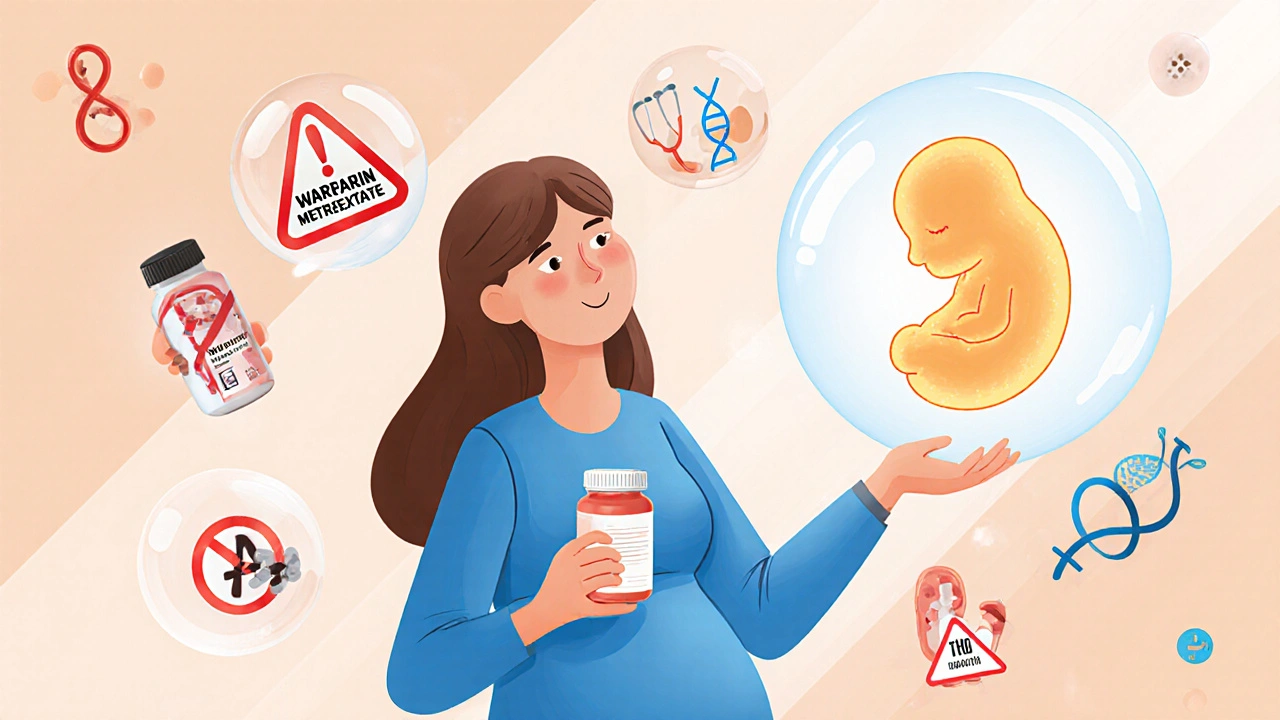
When you’re pregnant, every pill, drop, or supplement feels like a gamble. You want to feel better-maybe you have a headache, nausea, or anxiety-but you’re terrified that the very thing helping you could hurt your baby. The truth isn’t as simple as ‘all drugs are dangerous’ or ‘everything’s fine.’ It’s messy, complicated, and deeply personal. And it’s not something you should figure out alone.
What Exactly Is a Teratogen?
A teratogen is any substance-medicine, chemical, infection, or even radiation-that can interfere with how a baby develops in the womb. It doesn’t always cause harm, but when it does, the results can be serious: missing limbs, heart defects, brain damage, or even miscarriage. The most famous example is thalidomide, a drug given in the 1950s for morning sickness. By the time it was pulled from shelves, around 10,000 babies had been born with severe limb deformities. That tragedy changed medicine forever.Today, we know that about 2-3% of all birth defects are linked to medications taken during pregnancy. That sounds low, but it’s not negligible. And the risk isn’t the same for every drug, every woman, or every stage of pregnancy.
When Does Risk Happen? Timing Matters More Than You Think
The first trimester-weeks 1 to 12-is the most dangerous time for teratogenic exposure. That’s when your baby’s organs are forming. Between days 15 and 60 after conception, even a tiny dose of a harmful drug can cause major structural problems. Think of it like building a house: if you mess with the foundation or framing, the whole structure is at risk.After week 12, the baby’s major organs are mostly done forming. That doesn’t mean drugs are safe, though. In the second trimester, medications can still affect brain development, growth, or how organs function. In the third trimester, the biggest risks shift to things like withdrawal symptoms (if you’ve been taking opioids or antidepressants), altered heart rhythms, or low birth weight.
Some drugs don’t harm the baby directly. Instead, they mess with your body in ways that indirectly hurt the fetus. For example, a blood pressure medication that drops your pressure too low can reduce blood flow to the placenta. Less blood flow means less oxygen and nutrients for your baby. That’s why just stopping a drug without medical advice can be just as risky as keeping it.
Medications With Known Teratogenic Risks
Not all drugs are created equal. Some have clear, well-documented dangers. Here are a few you need to know about:- Warfarin (a blood thinner): Can cause fetal warfarin syndrome-nose deformities, bone problems, eye damage, and intellectual disability. Risk is highest in the first trimester.
- Carbamazepine (for epilepsy): Increases neural tube defect risk by about 1%. Also lowers vitamin K, which can lead to dangerous bleeding in newborns.
- Methotrexate (used for autoimmune diseases and cancer): A folate blocker. If taken in early pregnancy, it can cause severe birth defects in 10-20% of cases.
- Factor Xa inhibitors (rivaroxaban, apixaban, edoxaban): These newer blood thinners cross the placenta. There’s no antidote if something goes wrong. Avoid them completely during pregnancy.
- Cannabis (THC): Linked to higher risks of low birth weight, preterm birth, and stillbirth. THC stays in breastmilk for up to six days and may affect your baby’s brain development, leading to attention and learning problems later.
These aren’t random examples. These are drugs that have been studied in thousands of pregnancies and consistently shown to cause harm. If you’re taking any of these and you’re pregnant-or thinking about it-talk to your doctor immediately. Don’t stop cold turkey, but don’t wait either.
The Acetaminophen Debate: Why Experts Can’t Agree
Acetaminophen (also called paracetamol) is the go-to painkiller for pregnant women. It’s in dozens of over-the-counter products. For decades, it was considered safe. But now, things are getting messy.The CDC says some studies have found a possible link between long-term acetaminophen use during pregnancy and higher risks of autism and ADHD in children. But they’re quick to add: no direct cause has been proven.
Meanwhile, the American College of Obstetricians and Gynecologists (ACOG) came out in September 2025 with a strong statement: acetaminophen is still the safest option for managing pain and fever during pregnancy. Why? Because untreated fever can raise the risk of neural tube defects by 20-30%. Untreated pain can lead to high blood pressure, stress, and poor sleep-all bad for pregnancy.
This isn’t a contradiction. It’s a balancing act. The CDC is warning about potential long-term risks based on observational data. ACOG is saying: the known dangers of not treating symptoms are far worse than the uncertain risks of acetaminophen.
So what should you do? Use the lowest effective dose for the shortest time. Don’t take it daily unless your doctor says so. But don’t avoid it out of fear if you need it. A headache or fever that goes untreated is a bigger threat than a single dose of acetaminophen.
What About the Medications You Took Before You Knew You Were Pregnant?
About half of all pregnancies are unplanned. That means a lot of women take medications-antibiotics, antidepressants, even birth control-before they realize they’re pregnant. And panic sets in.Here’s the truth: most medications don’t cause harm. About 60-70% of drugs used in pregnancy have no known effect on the fetus. If you took something in the first few weeks-before your missed period-it’s likely too early for it to affect development. At that stage, the embryo is either unaffected, or the exposure causes an all-or-nothing effect: it either miscarries or it doesn’t.
That doesn’t mean you should ignore it. But it does mean you shouldn’t assume the worst. Talk to your provider. Get a proper risk assessment. Don’t Google it. Don’t scroll through Reddit threads. Go to someone who can look at your specific meds, your timing, and your health history.

How to Navigate Medication Use Safely
If you’re planning a pregnancy or already pregnant, here’s what to do:- Review every medication-prescription, over-the-counter, supplements, and herbal remedies-with your doctor or pharmacist before you conceive.
- Don’t stop critical meds without talking to your provider. If you have epilepsy, high blood pressure, or depression, stopping your meds can be more dangerous than keeping them.
- Use trusted resources like MotherToBaby or LactMed. These are science-backed, free services staffed by specialists who answer questions about pregnancy and medication exposure.
- Ask for alternatives. Sometimes there’s a safer drug. For example, instead of warfarin, doctors may switch you to heparin during pregnancy.
- Track your use. Keep a list of everything you take, including dosage and dates. This helps your care team make better decisions.
Pharmacists are your secret weapon. They know the details of drug interactions, pregnancy risks, and alternatives better than most doctors. Don’t be shy about asking them.
The Big Problem: We Don’t Know Enough
Here’s the uncomfortable truth: we don’t have solid data on most medications used in pregnancy. Why? Because we can’t ethically run clinical trials on pregnant women. That means 95% of what we know comes from watching what happens after the fact-case reports, registries, or animal studies.Only about 20% of medications have enough data to give clear safety guidance. The rest? We’re guessing. That’s why the FDA changed the labeling system in 2015. Instead of vague letters (A, B, C, D, X), labels now include detailed narratives: what the data says, what it doesn’t say, and what the risks really look like.
Still, many women are confused. One Reddit user wrote: “My OB said Zofran was safe. Then I read it might cause birth defects. I cried for days.” That’s the reality. Conflicting messages are everywhere.
That’s why you need to rely on experts-not blogs, not social media, not well-meaning friends. Use MotherToBaby. Talk to your OB. Ask your pharmacist. They’ve seen this before.
What’s Next? Better Data, Better Choices
The FDA’s Sentinel Initiative is now tracking 10 million patient records to find patterns in pregnancy medication use. Researchers are also starting to use pharmacogenomics-testing how your genes affect how you process drugs-to predict individual risks. In five years, we may be able to say: “This drug is safe for you, but not for someone else.”Right now, the system is far from perfect. But it’s improving. And the most important thing you can do is stay informed, ask questions, and never make a decision alone.
Can I take ibuprofen while pregnant?
Avoid ibuprofen after week 20 of pregnancy. It can cause serious problems in the baby, including reduced amniotic fluid, kidney issues, and premature closure of a critical blood vessel in the heart. Before week 20, occasional use under medical supervision may be okay, but acetaminophen is still the safer choice. Never take it regularly without talking to your provider.
Is it safe to take antidepressants during pregnancy?
For many women, yes. Untreated depression or anxiety during pregnancy can lead to preterm birth, low birth weight, and even postpartum depression that affects bonding and infant development. SSRIs like sertraline and citalopram are often preferred because they have the most safety data. The risks of these medications are generally low, but they’re not zero. Work with your psychiatrist and OB to weigh your options. Never stop abruptly-it can cause withdrawal symptoms.
What if I took a medication I shouldn’t have before I knew I was pregnant?
First, don’t panic. Most medications taken in the first few weeks of pregnancy don’t cause harm. If you took a drug during the first two weeks after conception, the embryo is either unaffected or the exposure leads to a miscarriage-there’s no in-between. After that, the risk depends on the drug, the dose, and the timing. Call MotherToBaby (1-866-626-6847) or your provider. They’ll assess your specific situation and give you clear, evidence-based guidance. You’re not alone.
Are herbal supplements safe during pregnancy?
No, not without checking. Just because something is “natural” doesn’t mean it’s safe. Herbs like black cohosh, dong quai, and pennyroyal can cause uterine contractions and miscarriage. Others, like ginger in small amounts, are fine for nausea. Always tell your provider about every supplement you take-even if you think it’s harmless.
Can I use topical medications like creams or patches while pregnant?
Most topical medications are safe because very little enters your bloodstream. But not all. Avoid strong retinoids (like tretinoin or isotretinoin) in creams or gels-they can still cross the skin and affect the baby. Lidocaine patches and low-dose hydrocortisone creams are generally okay. Always check with your provider before using any topical product, even if it’s labeled “for external use.”
If you’re pregnant or planning to be, your health matters-not just for you, but for your baby. Medications aren’t the enemy. Ignorance is. Stay informed. Ask questions. Work with your care team. You’ve got this.
George Hook
November 28, 2025 AT 16:25Look, I get it-every pill feels like rolling dice when you’re pregnant. But the real issue isn’t just the drugs, it’s the lack of clear, consistent guidance. I spent months Googling acetaminophen and ended up more anxious than when I started. The truth? Most doctors don’t have time to dig into the latest observational studies. That’s why I started keeping a log: every med, every dose, every date. I shared it with my OB and my pharmacist. Turns out, my OB had never seen someone track so thoroughly. We ended up switching from a sleep aid I was taking to a non-pharmacological routine. No magic bullet, but I felt in control. And that’s half the battle.
Also, MotherToBaby is a godsend. I called them twice. They didn’t judge. They just gave me the data. No fluff. No fearmongering. Just facts. If you’re stressed about a medication, call them. It’s free. It’s confidential. And they’ve seen every scenario under the sun.
Stop scrolling Reddit. Stop asking your cousin who ‘heard something on Facebook.’ Find a provider who listens. And if you don’t have one, demand one. Your baby deserves that much.
And yes, I know I went on. But this stuff matters. It’s not just about avoiding harm. It’s about reclaiming agency when everything else feels out of your hands.
jaya sreeraagam
November 28, 2025 AT 22:30OMG I JUST FOUND THIS POST AND I’M 14 WEEKS PREGNANT AND TOOK IBUPROFEN FOR A HEADACHE AT 8 WEEKS AND NOW I’M CRYING 😭
BUT WAIT-LET ME TELL YOU SOMETHING: I CALLED MOTHERTOBABY AND THEY SAID THE RISK IS EXTREMELY LOW IF IT WAS JUST ONCE AND BEFORE 20 WEEKS. THEY EVEN SENT ME A PDF WITH THE STUDIES. I FEEL SO MUCH BETTER NOW.
TO ANYONE PANICKING: YOU ARE NOT ALONE. I WAS SO SCARED I THOUGHT I WAS GOING TO LOSE THE BABY. BUT KNOWLEDGE IS POWER. TALK TO A PROFESSIONAL. DON’T LET FEAR RULE YOU. YOU’RE DOING GREAT. ❤️
Katrina Sofiya
November 29, 2025 AT 22:30As a perinatal nurse and someone who’s supported over 200 pregnant patients through medication dilemmas, I want to say this plainly: fear is natural, but it shouldn’t dictate your choices. The data on acetaminophen is messy, yes-but the data on untreated fever is far worse. A single episode of high fever in the first trimester can double the risk of neural tube defects. That’s not hypothetical. That’s epidemiology.
And let’s talk about antidepressants. Yes, SSRIs carry a slight increase in persistent pulmonary hypertension (PPHN)-but the absolute risk is less than 1%. Meanwhile, untreated depression increases preterm birth risk by 50%. That’s not a trade-off. That’s a calculus. You’re not choosing between safety and danger-you’re choosing between two risks, and your provider should help you weigh them.
Also: herbal supplements. Ginger is fine. Black cohosh is not. But here’s the kicker: most OBs don’t ask about supplements because they assume patients won’t tell them. So tell them. Even if you think it’s ‘just tea.’
You are not a statistic. You are a person with a unique biology, a unique history, and a unique right to informed care. Advocate for yourself. Ask for the evidence. And if your provider dismisses you? Find another one. You deserve better.
kaushik dutta
December 1, 2025 AT 09:51Let’s cut through the noise. The entire paradigm of pregnancy pharmacology is archaic. We’re relying on retrospective case reports from the 1980s to make decisions for 2025. That’s not medicine-that’s guesswork dressed in white coats. The FDA’s new labeling system is a step forward, but it’s still not granular enough. We need pharmacogenomic screening integrated into prenatal care. Why? Because a woman with CYP2D6 ultra-rapid metabolism will process sertraline differently than someone with poor metabolism. One might need a higher dose; the other might have toxic buildup. Yet we treat all pregnant women as if they’re identical biological units.
And let’s not pretend that ‘natural’ means safe. Digitalis from foxglove? Natural. Deadly. Willow bark? Natural. Aspirin’s ancestor. And we still don’t regulate herbal products like pharmaceuticals. That’s regulatory failure, not patient negligence.
Stop blaming women for being anxious. The system is broken. We need clinical trials in pregnancy. We need federal funding. We need to stop treating pregnant women as ‘vulnerable populations’ and start treating them as research participants with agency. Until then, we’re all just guessing. And that’s unacceptable.
doug schlenker
December 2, 2025 AT 11:37I just want to say thank you to the person who wrote this. I’m 10 weeks along and was about to stop my antidepressant because I read a scary blog post. I didn’t know where to turn. This post didn’t scare me-it helped me think. I called my OB and we made a plan: keep sertraline, taper slowly if needed, monitor closely. I didn’t feel judged. I felt supported.
Also, I didn’t realize how much I’d been blaming myself for taking meds before I knew I was pregnant. Turns out, that’s super common. And the ‘all-or-nothing’ window thing? That actually made me feel better. I’m not a monster for taking a cold medicine. I’m a person trying to survive.
So thank you. Really. This felt like the first clear voice in a sea of noise.
Olivia Gracelynn Starsmith
December 3, 2025 AT 03:26Acetaminophen is still the safest option for fever and pain in pregnancy. That’s not opinion. That’s ACOG. The CDC’s warning is based on population-level associations-not causation. There’s a difference. People confuse correlation with causation all the time. Just because two things happen together doesn’t mean one caused the other.
Also, if you took ibuprofen once before week 20? You’re fine. The amniotic fluid drop only happens with chronic use. One dose? No effect.
And yes, you should tell your provider about every supplement. Even that ‘harmless’ chamomile tea. Because they need to know. Not to judge. To protect.
Don’t panic. Don’t overthink. Just be informed. And if you’re unsure? Call MotherToBaby. They’re there for you.
And yes I’m a nurse. And yes I’ve seen the worst. And I’m telling you-you’re doing better than you think.
Skye Hamilton
December 4, 2025 AT 09:50So let me get this straight… we’re supposed to trust doctors who once told us thalidomide was fine… and now we’re supposed to believe them about acetaminophen? 😏
And don’t even get me started on ‘MotherToBaby’-that’s a nonprofit funded by pharmaceutical companies, right? Who’s to say they’re not downplaying risks?
I took every single thing I could before I knew I was pregnant. Caffeine. Alcohol. Ibuprofen. Zofran. Valium. I even smoked weed. And guess what? My baby is 8 months old and thriving. So maybe… just maybe… the whole ‘teratogen’ thing is overblown?
Why are we so scared to just… be human?
Also, I’m not sorry for using CBD oil. My anxiety was worse than any drug ever could be.
Y’all are so paranoid. It’s exhausting.
Maria Romina Aguilar
December 5, 2025 AT 03:44…I just… I read this… and I… I don’t know…
I took 3 doses of ibuprofen at 7 weeks… and now I’m terrified…
I didn’t mean to… I thought it was okay… I didn’t know…
I didn’t know about MotherToBaby… I didn’t know…
I’m so sorry…
I just… I didn’t know…
…
Brandon Trevino
December 7, 2025 AT 00:33Let’s be brutally honest: 90% of the anxiety around pregnancy medications is manufactured by fear-based marketing and poorly interpreted epidemiological data. The ‘2-3% of birth defects from drugs’ statistic? That’s misleading. It conflates all exposures-known teratogens, questionable associations, and coincidental timing. Most of those cases are not drug-induced. They’re genetic. Or spontaneous. Or idiopathic.
And acetaminophen? The autism/ADHD links are based on maternal recall bias. Moms of neurodivergent kids remember their medication use more vividly. That’s not science. That’s confirmation bias.
Meanwhile, we’re telling women to avoid NSAIDs after 20 weeks… but ignoring that untreated pain increases cortisol, which crosses the placenta and alters fetal neurodevelopment more than any pill ever could.
Stop infantilizing pregnant women. Trust them. Empower them. Give them the data. Let them decide. Not the FDA. Not ACOG. Not Reddit. THEM.
And if you’re panicking over one dose of ibuprofen? You’re not pregnant. You’re programmed.
Denise Wiley
December 8, 2025 AT 14:18I’m 32 weeks and I’ve been on sertraline since before conception. I cried when I found out I was pregnant because I thought I’d have to quit. But my psychiatrist and OB sat down with me and said: ‘Your mental health is part of your baby’s health.’
And you know what? I’ve never felt more supported.
My baby is kicking right now as I type this. Healthy. Strong. Perfect.
So to anyone reading this, scared and alone: you’re not failing. You’re fighting. And you’re not alone.
Call your provider. Call MotherToBaby. Talk to someone. Just don’t sit in the dark.
You’ve got this. I believe in you. 💪❤️