Prescriber Education Resources: Guides for Doctors on Generics
 Nov, 29 2025
Most prescriptions filled in the U.S. today are for generic drugs-90% as of 2023. Yet many doctors still hesitate to prescribe them confidently. Why? Because patients ask questions. And too often, doctors don’t have quick, clear answers ready.
Why Doctors Need Better Generic Drug Guides
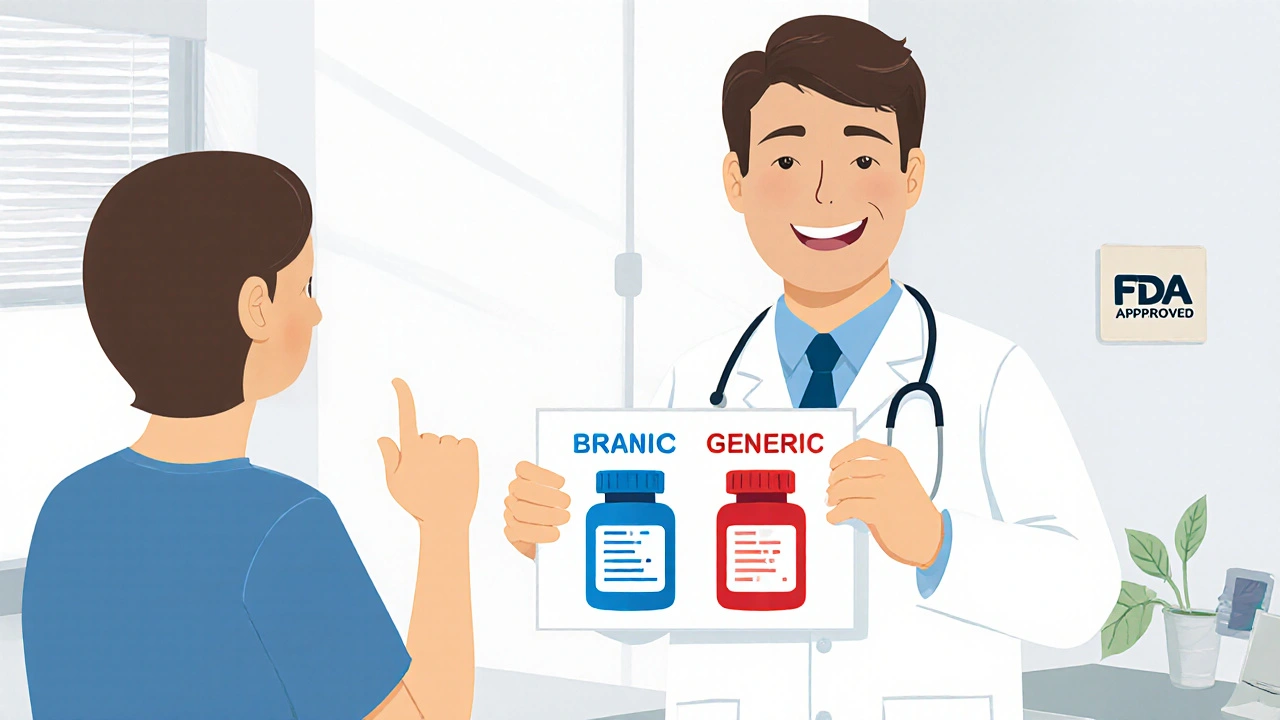
It’s not about trust in science. It’s about trust in communication. A patient walks in, says their insurance made them switch from Lipitor to atorvastatin, and asks: "Is this really the same?" If you’re unsure how to explain bioequivalence in plain language, you’ll default to the brand name-even if it costs $260 more per month. That’s what happened to Dr. Sarah Chen in rural Nebraska. She went from prescribing generics 62% of the time to 89% after using FDA’s visual guide comparing manufacturing standards. The infographic showed side-by-side images of brand and generic tablets being tested in the same labs, under the same rules. Her patients stopped asking. They started taking.What the FDA Actually Says About Generic Drugs
The FDA doesn’t just approve generics. It demands proof they work the same. Every generic must pass a bioequivalence test: its blood concentration must fall between 80% and 125% of the brand-name drug’s levels in 24 to 36 healthy volunteers. That’s not a guess. It’s a legal requirement under the Abbreviated New Drug Application (ANDA) process. And it’s not just one study-it’s repeated across different populations, doses, and conditions. The FDA’s 2022 Prescriber Flyer (Version 2) breaks this down in one page. No jargon. No fine print. It says: "Generics have the same active ingredient, strength, dosage form, and route of administration. They’re made in the same quality-controlled facilities. They’re held to the same standards." And here’s the kicker: in 2022, the FDA analyzed 12,467 adverse event reports for generics. For brand-name drugs? 11,832. No difference in safety. No hidden risks.Why Patients Doubt Generics-And How to Answer Them
Patients don’t doubt because they’re irrational. They doubt because they’ve heard stories. "My cousin took the generic and felt worse." "The pill looks different." "The brand worked better for me." The FDA’s Generic Drugs and Health Equity Handout gives you scripts. For example:- "The color change is just the inactive ingredient-like the dye in your cereal. It doesn’t affect how the medicine works."
- "The FDA requires the generic to release the same amount of medicine into your body, within a very tight range. That’s why it works the same."
- "If you switch and feel different, let’s check your levels. But 99.7% of people see no change at all."
What’s Missing from Most Education Materials
Here’s the problem: most doctors don’t use these resources. Why? Because they’re buried in PDFs. You have to print them. You have to remember to look them up. You have to find them between patients. A 2023 KLAS Research report found only 37% of major electronic health record systems (like Epic or Cerner) even show generic education pop-ups during prescribing. That’s like having a GPS that only works if you carry a paper map. The most successful fix? Integration. Kaiser Permanente embedded FDA’s generic facts directly into Epic’s prescribing screen. Within six months, brand-name prescribing dropped by 18.7%. No extra training. No extra time. Just a prompt that says: "This generic is bioequivalent. Savings: $262/month." That’s what works.Complex Generics Are the Blind Spot
Not all generics are created equal. Inhalers, topical creams, injectables, and biosimilars have more variables. A generic albuterol inhaler might look identical, but if the propellant or particle size is off by a fraction, the lung delivery changes. Same with topical steroids-absorption depends on the base, not just the active ingredient. The FDA’s current materials barely touch these. Only 42% of prescribers use existing biosimilar education tools, according to a 2023 FDA report. And a 2023 University of Arizona study found 61% of doctors don’t know what an "authorized generic" is-a brand-name drug sold under a generic label, same factory, same formula. This is where education gaps hurt. If you’re unsure about a complex generic, you’ll stick with the brand. And patients pay the price.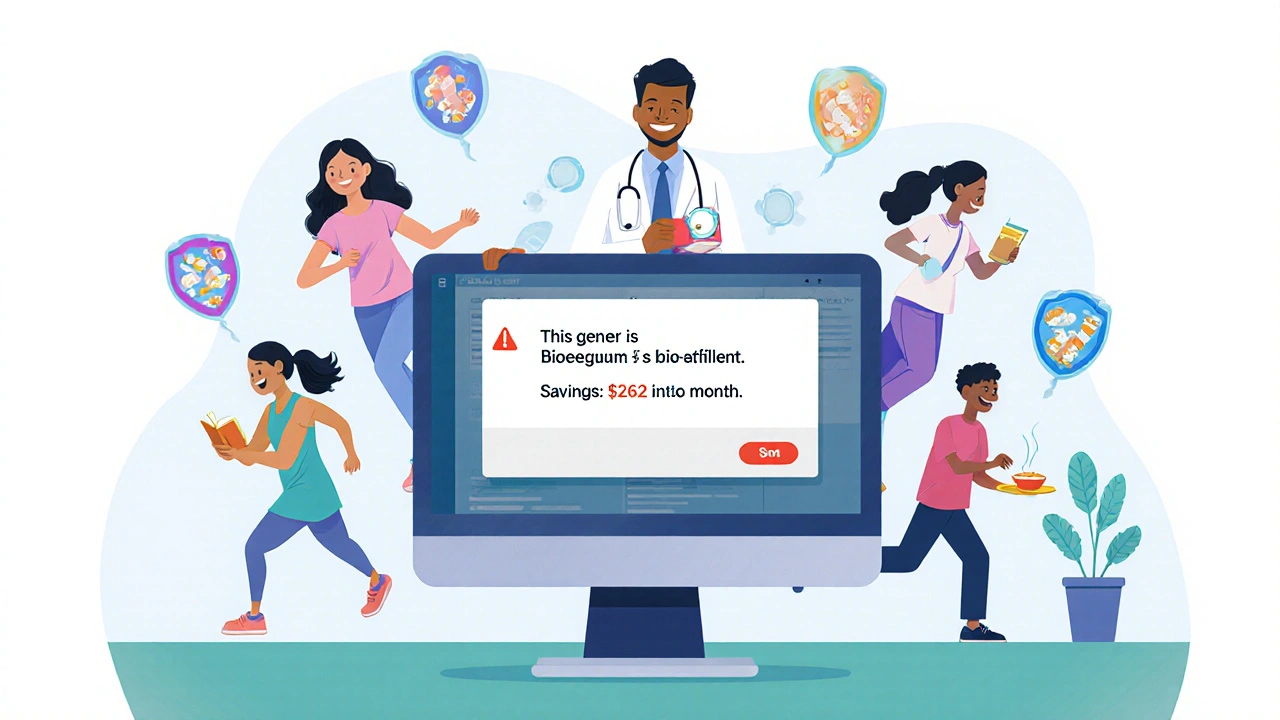
Real-World Impact: Cost, Adherence, and Outcomes
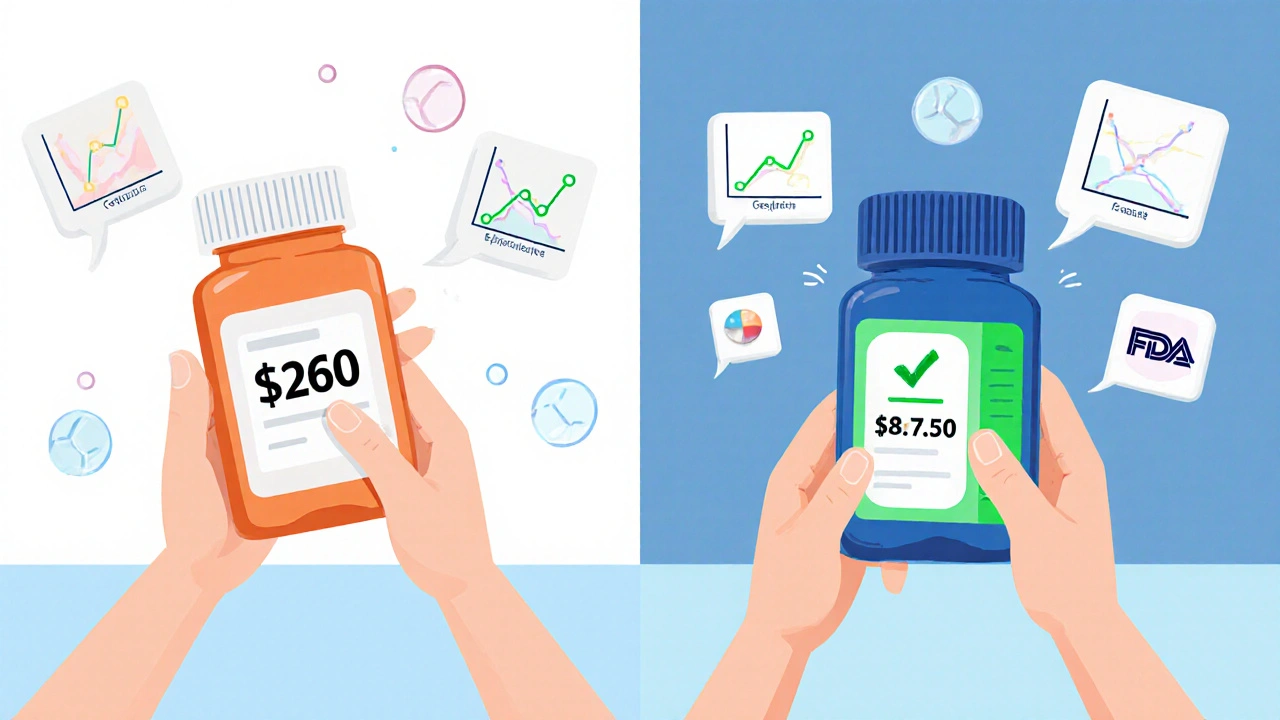
Cost isn’t just a number. It’s adherence. One in four patients skips doses because of price. The American College of Physicians found that 20-30% of new prescriptions are never filled because of cost. Generics cut that risk. Dr. Aaron Kesselheim’s research shows switching from a $300/month brand to a $37.50 generic saves patients $262.50 every month. That’s not a discount. That’s access to treatment. And the savings add up. From 2010 to 2020, generics saved the U.S. system $2.29 trillion. Projections say another $1.87 trillion will be saved by 2025. But only if doctors prescribe them.How to Use These Resources in Your Practice
You don’t need to become a pharmacologist. You need three things:- One quick reference-Print the FDA’s Prescriber Flyer (142 KB PDF) and keep it on your desk. It’s designed to fit in a standard brochure rack.
- One conversation starter-Use the script: "This generic is FDA-approved to work exactly like the brand. Most patients don’t notice a difference. But they save hundreds a year."
- One system fix-Ask your EHR vendor: "Can you add FDA generic equivalence alerts to my prescribing screen?" If they say no, push harder. It’s not a luxury. It’s a safety net.
The Future Is Personalized
AI is starting to help. IBM Watson Health tested a tool that analyzed patient records and generated custom messages: "Your blood pressure has been stable on this generic for 18 months. Switching back to brand won’t help. You’d save $2,200 a year." In a trial with 120 doctors, patient acceptance jumped 29 percentage points. This isn’t sci-fi. It’s coming. And when it does, the doctors who already know how to explain generics will be the ones patients trust.Generic drugs aren’t cheaper because they’re worse. They’re cheaper because they don’t need to pay for ads, celebrity endorsements, or fancy packaging. They’re the same medicine, stripped of the markup.
You’re not just prescribing a pill. You’re prescribing access. Stability. Dignity.
Are generic drugs really as effective as brand-name drugs?
Yes. The FDA requires every generic drug to have the same active ingredient, strength, dosage form, and route of administration as the brand-name version. It must also prove bioequivalence-meaning it delivers the same amount of medicine into the bloodstream within a tight range (80%-125%) compared to the brand. Over 90% of prescriptions in the U.S. are for generics, and studies show no meaningful difference in effectiveness or safety for the vast majority of patients.
Why do some patients feel different after switching to a generic?
Most patients feel no difference. But some report changes due to placebo effects, variations in inactive ingredients (like dyes or fillers), or underlying conditions. If a patient says they feel worse, check their adherence, dosage, and symptoms. Rarely, a patient may be sensitive to a specific filler-but that’s not a sign the generic is ineffective. Reassure them that the active ingredient is identical, and if needed, try a different generic manufacturer. The FDA tracks these reports and investigates any pattern of issues.
What’s the difference between a generic and an authorized generic?
An authorized generic is the exact same drug as the brand-name version, made by the same company, in the same factory, and sold under a generic label. The only difference is the packaging and price-it’s cheaper because it’s not marketed as a brand. Many doctors don’t realize this exists, but it’s a useful option when a patient insists on the brand but can’t afford it. Ask your pharmacist: "Is there an authorized generic for this?"
Do I need special training to prescribe generics confidently?
You don’t need a pharmacology degree. But you do need to understand three things: (1) bioequivalence means the drug works the same, (2) inactive ingredients don’t affect therapeutic effect, and (3) cost savings improve adherence. The FDA’s Prescriber Flyer and infographic take under 10 minutes to read. Most doctors who use them say they feel more confident in just one day. If your clinic offers a 15-minute training session on generics, take it-it’s the best investment in your prescribing practice.
Why aren’t generic education tools built into my EHR system?
Most EHR vendors haven’t prioritized it. Only 37% of major systems like Epic or Cerner include FDA generic education prompts. But it’s not impossible. Kaiser Permanente added FDA materials to their Epic system and reduced brand-name prescribing by nearly 20% in six months. Ask your IT team to request integration with the FDA’s new API pilot (launched in 2023), which now connects directly to EHRs. If they say no, ask why-because patients deserve to know they’re getting the same medicine at a fraction of the cost.
Peter Axelberg
November 30, 2025 AT 11:47Look, I get it - generics are scientifically identical, but let’s be real: patients aren’t robots. I had one guy switch from brand-name metoprolol to the generic and swear he felt like he was ‘floating through cotton.’ Turned out his blood pressure was fine, but he was convinced the generic was ‘weak.’ We showed him the FDA flyer, printed it out, put it on his fridge. He still called it ‘the white pill’ for six months. Sometimes the battle isn’t science - it’s perception. And perception? That’s the real prescription.
Sullivan Lauer
November 30, 2025 AT 12:58This is the most important thing I’ve read all year. I work in a rural ER where people skip meds because they can’t afford the brand. One woman came in with a hypertensive crisis - she’d been taking her generic lisinopril, but the pharmacy switched her to a different manufacturer and she panicked because the pill was blue instead of white. She thought it was a different drug. We pulled up the FDA infographic on my phone, showed her the side-by-side lab images, and she cried. Not from fear - from relief. That’s not just medicine. That’s dignity. If your EHR doesn’t have this built in, you’re failing your patients. Push harder. They’re counting on you.
Mary Kate Powers
November 30, 2025 AT 20:35Just a quick note: if you’re a clinician reading this and thinking ‘I don’t have time,’ start with one thing. Print the FDA flyer. Tape it to your monitor. Use the script: ‘This works the same, saves you $260/month.’ Do it for your next five patients. That’s it. No training. No extra meetings. Just five minutes of courage. You’d be shocked how many people just need to hear it from you - not a pharmacist, not a website - from their doctor. You’re the anchor. Be the one who says it clearly.
Sara Shumaker
December 1, 2025 AT 21:12There’s something deeply human here - we equate price with value. If something’s cheap, we assume it’s lesser. But medicine isn’t perfume. It’s not about packaging or scent or brand heritage. It’s about molecular structure. Bioequivalence isn’t a marketing term - it’s a mathematical certainty. And yet, we let patients carry the weight of that misconception. We let them feel guilty for wanting the brand. We let them believe they’re ‘cheating’ by taking the generic. This isn’t just about cost. It’s about trust. And trust? It’s built one quiet conversation at a time - when you, the doctor, look them in the eye and say, ‘This is just as good. I’m not saving money - I’m saving your life.’
Matthew Higgins
December 3, 2025 AT 02:11Man, I’ve seen this play out so many times. My mom’s on a generic statin. She’s 72. She asked me last week if the ‘blue pill’ was real. I showed her the FDA page. She said, ‘But the brand one made my legs feel better.’ I didn’t argue. I said, ‘Let’s check your cholesterol.’ It was perfect. She didn’t need to feel wrong - she needed to feel heard. That’s the trick. Don’t correct. Confirm. Then explain. And if you can, show them the picture of the labs. That’s the magic bullet. No jargon. Just proof. And yeah - if your EHR doesn’t have this? Demand it. Your patients deserve better than a PDF they’ll never find.
Latika Gupta
December 3, 2025 AT 10:27As someone from India where generics are the norm, I’m shocked how much drama this causes in the US. Here, generics are trusted because they’re all we’ve had for decades. No one asks if the medicine is ‘real.’ They just take it. Maybe the problem isn’t the science - it’s the marketing. Brand names are sold like luxury items. Generics? Treated like discount aisle leftovers. We need to reframe this. Not as ‘cheaper’ - but as ‘smart.’ Because it’s not about saving money. It’s about choosing wisdom over branding.
Sohini Majumder
December 5, 2025 AT 00:53OMG I can’t believe this is even a debate?? Like… the FDA literally tests these things?? I swear if someone says ‘my cousin felt worse’ I’m going to scream. It’s placebo. It’s the color. It’s the shape. It’s not the drug. And don’t even get me started on ‘authorized generics’ - that’s the same pill, same factory, same everything, just no fancy logo?? So… we’re paying $300 for a white pill with a logo?? I’m sorry but that’s not healthcare - that’s corporate extortion. Someone please tell Big Pharma to stop acting like they invented aspirin.
Brandy Johnson
December 6, 2025 AT 19:29While I appreciate the sentiment, this piece fundamentally misunderstands the nature of pharmaceutical regulation. The FDA’s bioequivalence thresholds are statistically arbitrary - 80–125% is a wide margin, and in complex formulations like inhalers or transdermals, even minor variations in excipients can alter pharmacokinetics in vulnerable populations. Moreover, the claim that adverse event reports are statistically identical ignores underreporting bias, particularly in low-income populations who discontinue generics due to perceived inefficacy. This is not a matter of education - it’s a matter of systemic neglect masked as convenience. The real solution isn’t a pop-up in Epic - it’s dismantling the monopoly-driven pricing model that incentivizes brand retention. Until then, this is performative reform.