Sarcopenia in COPD: How Nutrition and Resistance Training Can Improve Mobility and Survival
 Mar, 9 2026
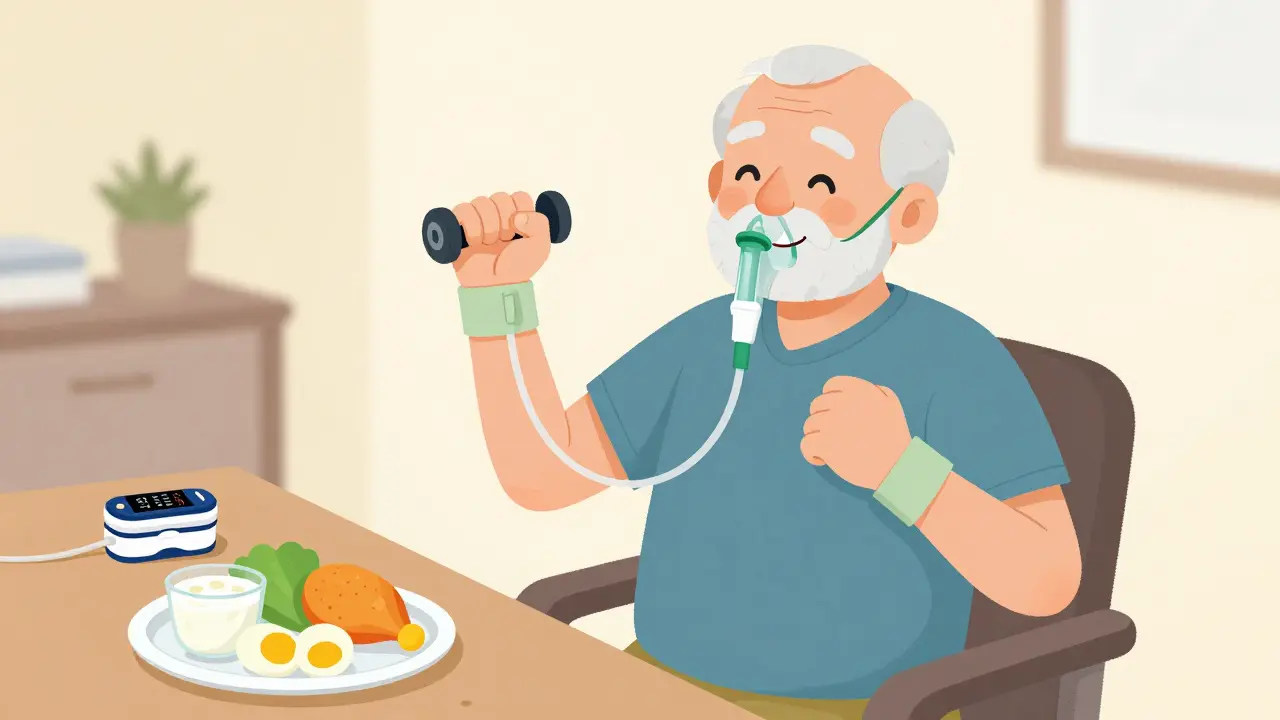
When you have COPD, your lungs aren't the only thing suffering. Many people don't realize that muscle loss-called sarcopenia-is a common and dangerous side effect. About 1 in 5 people with COPD lose muscle mass and strength faster than someone their age without lung disease. This isn't just about being weak. It's about losing the ability to walk, climb stairs, or even get out of bed without stopping to catch your breath. The good news? You can fight it. With the right nutrition and a smart approach to resistance training, many people with COPD regain strength, reduce hospital visits, and live longer.
Why Sarcopenia Hits Harder in COPD
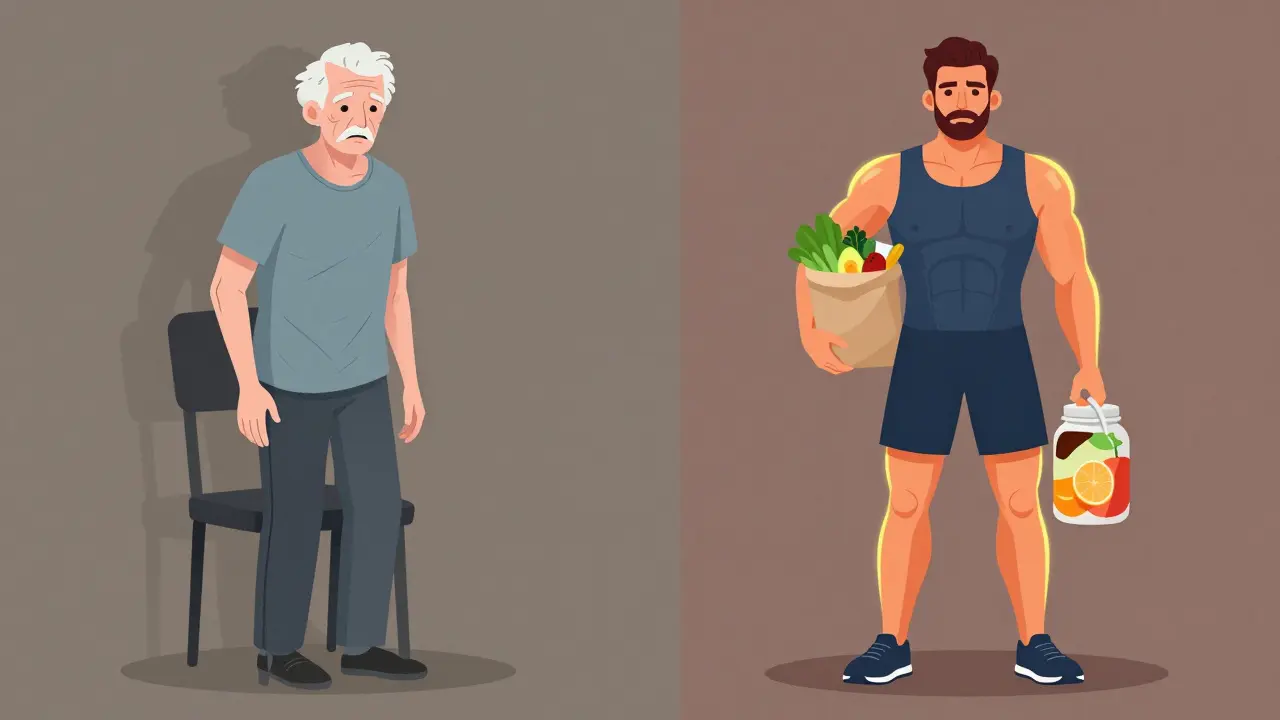
Sarcopenia isn't just aging. In COPD, it's worse. Your body is under constant stress from low oxygen, inflammation, and not moving enough. Studies show that COPD patients lose muscle at 3.2% per year-twice the rate of healthy older adults. That muscle loss isn't just in your legs. It hits your breathing muscles hardest. The pectoralis muscles in your chest, which help you inhale, can shrink by 68% in advanced COPD. This makes every breath harder, creating a vicious cycle: less breath → less movement → more muscle loss.
What makes it worse? Many people with COPD aren't eating enough protein. The average patient gets only 0.9 grams of protein per kilogram of body weight each day. But research shows you need 1.2 to 1.5 grams just to stop the loss, let alone rebuild. Combine that with low oxygen levels during sleep (below 88% for more than 30% of the night), and your body starts breaking down muscle just to survive.
The result? A 20-40% higher chance of dying within five years compared to COPD patients without muscle loss. And hospital stays? They jump by 32% when sarcopenia is present. This isn't a side note-it's a core part of COPD that needs direct attention.
How to Diagnose It (Before It's Too Late)
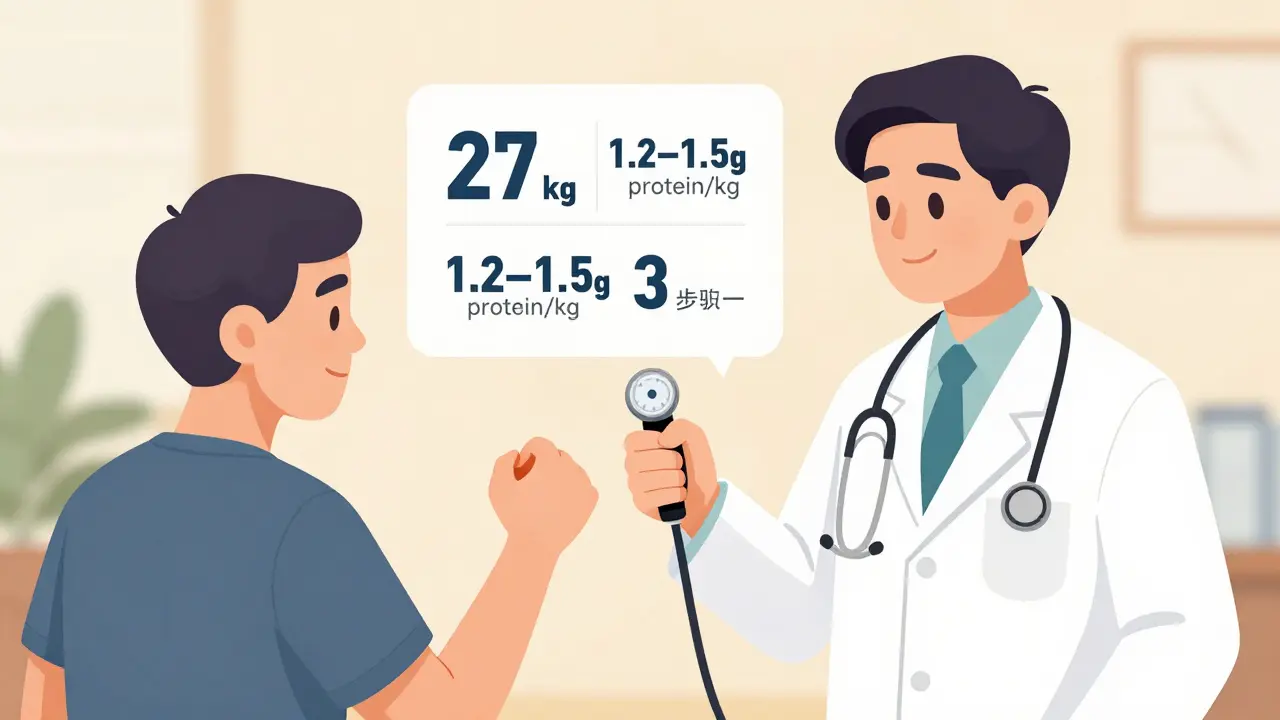
Doctors don't always check for sarcopenia in COPD. But if you're struggling to lift a grocery bag, rise from a chair without using your arms, or walk across a room without stopping, you should ask. The easiest way to screen is with a handgrip strength test. For men, under 27 kg (about 60 pounds) is a red flag. For women, under 16 kg (about 35 pounds) is concerning. That’s not about being weak-it’s about muscle quality.
More advanced testing uses a DEXA scan to measure muscle mass in your arms and legs. In COPD, the numbers are different than for healthy people. Men need more than 7.0 kg/m², women more than 5.5 kg/m². But even better is the pectoralis muscle index (PMI)-a CT scan that measures chest muscle size. A PMI below 1.06 cm²/BMI is a strong sign of sarcopenia in COPD patients.
There are three stages:
- Mild: Only muscle mass is low.
- Moderate: Muscle mass and strength are both down.
- Severe: You're also slow-walking less than 0.8 meters per second (about 1.8 mph), or scoring 8 or lower on the Short Physical Performance Battery.
Don't wait for symptoms to get bad. If you have COPD, ask your doctor for a simple grip test. It takes 30 seconds and could change your life.
Nutrition: Protein Isn't Optional
Most COPD patients think eating more calories is the answer. But it's not about calories-it's about protein. You need 1.2 to 1.5 grams of protein per kilogram of body weight every day. For a 70 kg (154 lb) person, that's 84 to 105 grams of protein daily.
Here’s the catch: eating it all at dinner won’t work. Your body can only use about 30-40 grams of protein at once to build muscle. So spread it out. Aim for 25-30 grams at each meal-breakfast, lunch, dinner, and even a snack.
What counts as 25 grams of protein?
- 3 eggs + 1 cup Greek yogurt
- 150g chicken breast + 1 scoop whey protein
- 1 can tuna + 1 cup cottage cheese
- 2 scoops of a protein supplement with 10g leucine
Leucine, an amino acid found in whey, eggs, and dairy, boosts muscle repair by 37% in COPD patients. Look for supplements that include at least 2.5g of leucine per serving. If you're not hungry, try liquid meals. Many patients with advanced COPD find it easier to drink a high-protein shake than eat a full meal.
Also, avoid eating too many carbs. High-carb diets can increase carbon dioxide production, making breathing harder. Focus on protein-rich foods: lean meats, fish, eggs, dairy, beans, and protein powders. Add a small amount of healthy fat-avocado, olive oil, nuts-to help with calorie needs without worsening breathing.
Resistance Training: Start Light, Move Smart
You don’t need heavy weights. In fact, starting with too much can make breathing worse. The goal is to build strength slowly, safely, and consistently.
Begin with 30-40% of your one-rep maximum (1-RM). For most people, that means:
- Light resistance bands (yellow or green)
- 1-2 pound dumbbells
- Bodyweight exercises like seated marches, wall push-ups, or standing calf raises
Do 2-3 sessions per week. Each session should target major muscle groups: legs, chest, back, shoulders. Start with 1-2 sets of 10-12 reps. Rest 2-3 minutes between sets. If you feel dizzy or your oxygen level drops below 88%, stop and rest. You might need supplemental oxygen during training-this is normal and not a sign you're doing too much.
Progress slowly. After 4-6 weeks, if you're not breathless, increase resistance by 10-15%. Most people see real gains in 8-12 weeks. One study showed a 23% improvement in walking distance after 16 weeks of supervised training with protein support.
Key tips:
- Always warm up for 5 minutes with slow arm circles or seated marching.
- Breathe out during the effort (lifting), breathe in when relaxing.
- Use a pulse oximeter during sessions if possible. If your SpO2 drops below 88%, pause and rest.
- Train with a partner or in a supervised pulmonary rehab program. It increases safety and motivation.
Many patients quit because they think they're failing. But if you're doing 2-3 sessions a week, even with light resistance, you're winning. Progress isn't about lifting heavy. It's about being able to stand up without help, carry your own laundry, or walk to the mailbox without stopping.
What Works in Real Life
Real patients aren’t just surviving-they’re thriving.
Mary Thompson, 68, had GOLD Stage 3 COPD. She could barely walk to her kitchen. After 12 weeks of light resistance bands and adding two protein shakes a day, she started carrying groceries again. "It didn’t happen overnight," she says. "But now I don’t need help to get dressed. That’s everything."
John Peterson, 72, tried resistance training at home. He stopped after three sessions because he couldn’t catch his breath. "No one told me I might need oxygen," he says. "I thought I was just out of shape."
That’s the gap. Most patients aren’t given clear instructions. The Cleveland Clinic’s program, which combines supervised training with protein supplements, saw 78 patients improve their 6-minute walk distance by 23%. The secret? Personalization. Oxygen use. Protein timing. And patience.
On the flip side, 32% of patients in surveys say they quit because exercise made breathing worse. That’s not failure-it’s poor guidance. The solution isn’t to stop. It’s to adjust.
What’s Changing Now
The Global Initiative for Chronic Obstructive Lung Disease (GOLD) just released its first sarcopenia management algorithm in early 2024. It now recommends checking nighttime oxygen levels and adjusting resistance training based on breathing tolerance. This isn’t theory-it’s practice.
European researchers are testing a new supplement called HMB (beta-hydroxy-beta-methylbutyrate), which helps preserve muscle during illness. Early results show 18% more muscle retention than placebo. Meanwhile, a drug called PTI-501, designed to block muscle breakdown, is in phase 2 trials and could be available by 2026.
But the biggest shift? Recognition. In 2020, only 22% of U.S. pulmonary rehab centers screened for sarcopenia. Today, it’s 38%. In academic hospitals, it’s 67%. The message is clear: muscle matters. And treating it isn’t optional-it’s essential.
What You Can Do Today
You don’t need a fancy program or expensive supplements. Start here:
- Ask your doctor for a handgrip strength test. If it’s below 27 kg (men) or 16 kg (women), sarcopenia is likely.
- Calculate your daily protein need: weight in kg × 1.2 to 1.5. Divide that into 4 meals.
- Start with 10 minutes of resistance training, 2-3 times a week. Use bands or light weights.
- Use supplemental oxygen during training if your oxygen drops below 88%.
- Track your progress: Can you stand up from a chair without arms? Walk across the room without stopping?
It takes time. But every gram of protein and every rep counts. You’re not just fighting muscle loss-you’re fighting for your independence. And that’s worth every effort.
Chris Bird
March 10, 2026 AT 00:55So basically COPD turns your body into a muscle-eating machine? That's wild. I thought it was just about lungs. Turns out your body's just like, 'lol see ya later' to your legs and chest. No wonder I can't lift my cat anymore.
Randall Walker
March 10, 2026 AT 03:56Wow. Just... wow. You mean... protein... matters? And... exercise... helps? I mean, who knew? Next you'll tell me water is hydrating or oxygen is breathable. This is groundbreaking science. I'm crying. Not really. But I should be.
LiV Beau
March 10, 2026 AT 15:51This gave me chills 😭 I had my dad on oxygen last year and he started doing those little band exercises with me. He couldn't even lift the yellow band at first. Now he carries his own groceries and laughs when he says 'I'm not weak, I'm just... reconditioning.' I'm so proud of him. Also, protein shakes at breakfast? Genius. We switched his toast to scrambled eggs + whey and he hasn't complained once. 🥚💪
Denise Jordan
March 11, 2026 AT 01:18Yeah right. Next they'll say eating vegetables prevents gravity. My uncle did all this 'protein and bands' stuff for 6 months. Ended up in the ER because he tried to do a squat with his oxygen tank. Don't be fooled. This is just Big Pharma selling supplements while pretending they care.
Gene Forte
March 11, 2026 AT 23:46Every human being deserves the chance to stand on their own two feet. This isn't about fitness. It's about dignity. When you can't rise from a chair without help, you're not just losing muscle-you're losing your autonomy. This article isn't just medical advice. It's a call to reclaim your humanity. Thank you for writing it.
Kenneth Zieden-Weber
March 12, 2026 AT 15:59So you're telling me the real villain isn't smoke or pollution-it's protein deficiency? And we've been treating lungs like they're the only thing that matters? Classic. We fix the symptom, not the system. I've seen this before. Asthma? 'Take an inhaler.' Diabetes? 'Take insulin.' Sarcopenia? 'Take protein.' The body's a whole system, folks. We're just patching holes while the roof burns.
David L. Thomas
March 12, 2026 AT 20:29Leucine-mediated mTOR activation is a key anabolic pathway in COPD-related muscle atrophy. The PMI threshold of 1.06 cm²/BMI correlates strongly with all-cause mortality (HR 2.1, CI 1.4–3.1). Also, the 30–40% 1-RM protocol aligns with the 2023 ERS guidelines on low-load, high-repetition resistance training in hypoxic populations. And yes, oxygen supplementation during exercise increases work capacity by 27% in Stage 2–3 patients. Just saying.
Bridgette Pulliam
March 13, 2026 AT 17:38It’s so easy to overlook muscle loss when you’re focused on breathing. But the truth is, if you can’t move, you can’t breathe well. It’s a loop. I work in rehab and see this every day. People think they’re failing because they’re out of breath. But they’re not failing-they’re just starting. I wish more doctors would say: ‘It’s okay to go slow.’
Mike Winter
March 13, 2026 AT 20:28Interesting piece. Though I must say, the assertion that 'protein isn't optional' feels almost tautological-of course it isn't. But perhaps what's more critical is the *distribution* of intake. The 30g-per-meal threshold is well-supported in geriatric literature. I'd love to see longitudinal data on protein timing versus total daily intake. Also, 'Breathe out during effort'-is that universally applicable? I've seen patients with severe airflow limitation who paradoxically inhale on exertion to stabilize their thorax. Context matters.
Miranda Varn-Harper
March 14, 2026 AT 04:33Let me be clear: this is dangerous misinformation. Muscle loss is natural. You're not supposed to be lifting weights at 70. Your body knows what it's doing. Why force it? And protein supplements? They're full of fillers and heavy metals. I know someone who got liver damage from 'clean' whey. Don't be fooled by this wellness cult. Let nature take its course.
Donnie DeMarco
March 14, 2026 AT 06:16bro i just started doing wall pushups with my oxygen tank next to me and i’m not gonna lie i felt like a god. also i’m eating 3 eggs + 2 scoops of that weird protein powder my cousin swears by. my pants are looser and i didn’t even realize i was so weak. also i cried when i carried my own laundry. that’s wild. also i’m gonna keep doing this until i can bench my cat. 🐱💪
Tom Bolt
March 14, 2026 AT 21:43They don’t want you to know the truth. The real reason sarcopenia is rampant? It’s because the government and pharmaceutical companies profit from you being weak. Weak people need more oxygen. More rehab. More pills. More visits. This whole 'protein and bands' thing? A distraction. They want you dependent. I’ve seen the documents. It’s all in the CDC’s hidden archives. Wake up.
Shourya Tanay
March 16, 2026 AT 17:01In India, we see this too-COPD patients with very low protein intake, often due to cultural dietary habits and cost. Many rely on rice and lentils, which are poor in leucine. A simple switch to milk-based protein or soy chunks (which are cheap and high in essential amino acids) can make a huge difference. Also, resistance training doesn’t need equipment-bodyweight squats against a wall, stair climbing, even carrying water pots can help. It’s about consistency, not intensity.
Adam Kleinberg
March 18, 2026 AT 03:42Who authorized this? Who gave these people the right to tell sick people what to eat and how to move? This is medical tyranny. My cousin tried this program. Lost his Medicaid. Got flagged for 'noncompliance' because he 'refused to use oxygen during exercise.' They took away his home care. This isn't health-it's control. And now he's in a nursing home because he 'failed' their protocol. I'm not buying it.
Alexander Erb
March 19, 2026 AT 09:40Just wanted to say-this is the kind of info we need more of. I’m a respiratory therapist and I’ve seen people turn their lives around with just 20 minutes of bands and a protein shake. No magic. Just consistency. If you’re reading this and thinking ‘I’m too old’ or ‘I’m too weak’-you’re not. You’re just at the beginning. Keep going. You’ve got this. 💙
Gene Forte
March 19, 2026 AT 21:06Thank you for sharing your story. It's not about the numbers-it's about the moments. The first time you stand up without help. The first time you walk to the mailbox alone. That's the victory. Keep going.