Slow Up-Titration Schedules: How Gradual Dose Increases Help You Tolerate Medication Side Effects
 Feb, 3 2026
When you start a new medication, especially one for chronic conditions like heart failure, diabetes, or high blood pressure, the first thing you might notice isn’t the benefit-it’s the side effects. Nausea. Dizziness. Fatigue. Low blood pressure. These aren’t rare. In fact, for drugs like semaglutide or beta-blockers, up to 65% of people experience strong side effects when they start at the full dose. That’s why doctors don’t just hand you a prescription and say, ‘Take this twice a day.’ Instead, they ask you to start low and go slow. This isn’t just caution-it’s science.
Why Slow Up-Titration Works
Slow up-titration means starting a medication at a very low dose and slowly increasing it over weeks or even months. The goal? Let your body adapt. Your cells don’t react well to sudden changes. When you take a powerful drug all at once, your receptors get overwhelmed. For example, GLP-1 agonists like semaglutide work by slowing digestion and reducing appetite. But that same mechanism can cause severe nausea and vomiting if introduced too fast. A 2021 study in the Journal of the American College of Cardiology showed that when patients started metoprolol (a heart medication) at full dose, only 12% could stick with it. When they started at 6.25mg and slowly increased over six weeks, 83% stayed on the medication.This isn’t about being gentle-it’s about physiology. Your body needs time to adjust its internal systems. Beta-blockers don’t just block adrenaline all at once. They trigger a gradual downregulation of receptors. ACE inhibitors slowly reduce angiotensin levels, letting your kidneys adapt. If you skip the slow phase, you’re not just risking discomfort-you’re risking quitting treatment entirely.
How It Works for Different Medications
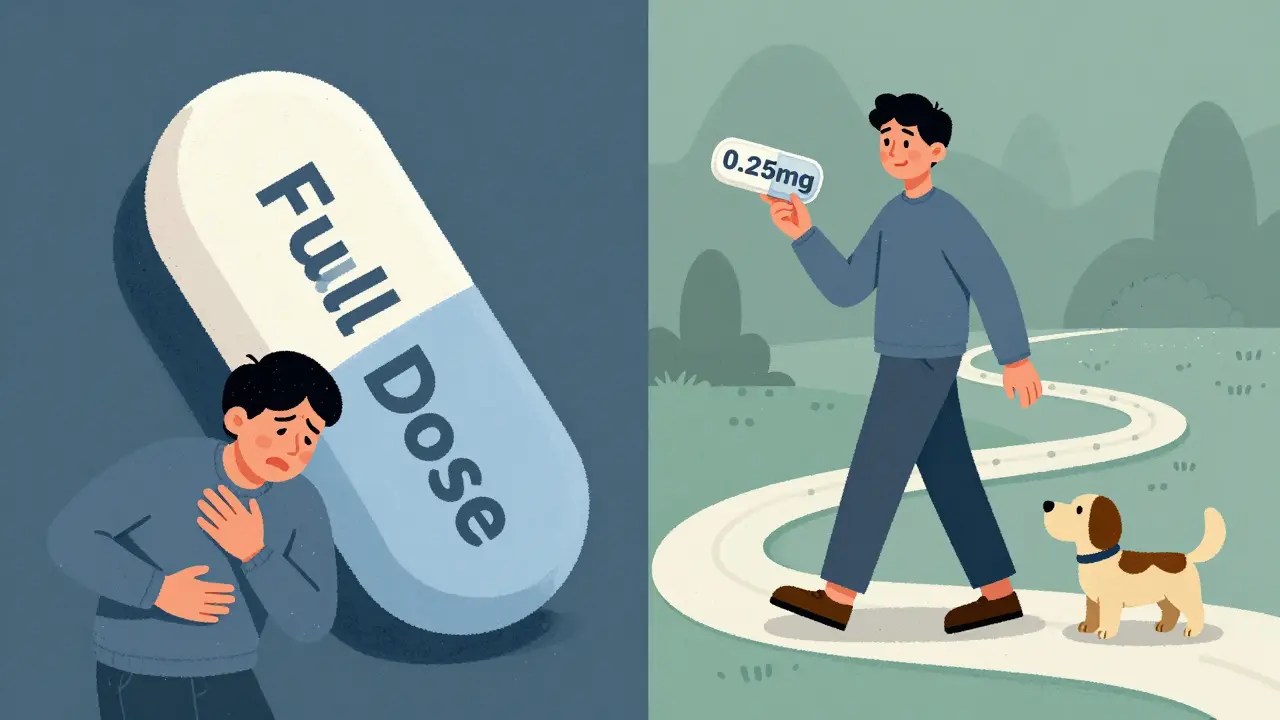
Not all medications need the same pace. The schedule depends on the drug’s chemistry and how your body handles it.- GLP-1 receptor agonists (like semaglutide): The FDA-approved schedule for the injectable form takes 16-20 weeks. You start at 0.25mg once a week for four weeks, then move to 0.5mg for another four weeks, then 1mg, and finally up to 2.4mg. The oral version follows a 60-day plan: 3mg for 30 days, then 7mg, then 14mg. Studies show this reduces nausea from 45% to just 18%.
- Beta-blockers (like carvedilol or bisoprolol): Used for heart failure and high blood pressure. Doses are typically doubled every 2-4 weeks. Starting at 3.125mg twice daily and working up to 25mg twice daily over 8-12 weeks helps avoid low blood pressure and extreme fatigue.
- ACE inhibitors (like lisinopril): Often started at 2.5-5mg daily, then increased every 2-4 weeks. This avoids sudden drops in blood pressure and protects kidney function.
- SGLT2 inhibitors (like empagliflozin): These are an exception. Research from the 2023 DIAMOND trial found that for these drugs, starting at full dose is just as safe as slow titration-no need to wait.
The pattern is clear: the more your drug affects your digestive system or blood pressure, the slower the ramp-up needs to be. That’s why GLP-1s take the longest. Your stomach isn’t used to being slowed down. Your brain isn’t used to reduced hunger signals. Your body needs time to relearn how to function.
Real Patient Stories
On Reddit’s r/diabetes community, one user, u/GLP1Survivor, wrote: “Starting semaglutide at 0.25mg for four weeks saved me. When I tried skipping the titration, I threw up for three days straight and quit.” That story isn’t unique. A review of over 3,700 patient experiences found that 68% of those who followed a slow titration schedule reported manageable side effects. Only 32% who rushed the process said the same.One 68-year-old man in Ohio, part of the American Heart Association’s Support Network, went from NYHA Class III heart failure (severe shortness of breath) to Class I (no symptoms) after five months of slow titration. His doctor increased his beta-blocker, ACE inhibitor, and SGLT2 inhibitor doses every 3-4 weeks. He had weekly telehealth check-ins. He didn’t feel great at first-but he didn’t quit. Now he walks his dog daily.
But it’s not all smooth. Some patients get frustrated. “It takes forever to feel the benefit,” said one 72-year-old woman in a 2023 survey. “I’ve been on this schedule for four months and still feel like I’m not getting anywhere.” That’s the trade-off. Slow titration improves tolerance-but it delays results.
The Hidden Costs and Challenges
This approach isn’t easy. It requires:- Multiple doctor visits: On average, patients need 2.3 extra visits during titration. For those with limited access to care, this can be a barrier.
- Complex dosing: Switching doses every few weeks means more pills, more labels, more confusion. A 2021 study found 22% of adults over 65 struggled to keep up with changing schedules.
- Adherence drops: About 23% of patients miss at least one dose change per month. Missing a step can delay progress-or cause side effects if you accidentally double up.
Tools help. Apps like Medisafe send reminders. Printed titration charts posted on the fridge work better than you’d think. Some clinics now use digital titration platforms like Omada Health, which reduced side effect-related dropouts by 41% in a 2023 pilot.
When Slow Titration Isn’t the Answer
This method isn’t universal. For acute problems-like a sudden spike in blood pressure-you need fast action. Labetalol or nitroglycerin can be given immediately. There’s no time to wait.Also, some drugs don’t need it. Metformin, for example, is very safe. A 2022 editorial in Endocrine Practice warned that forcing slow titration on metformin delays glycemic control for patients with HbA1c above 9%. “We’re trading time for comfort,” said Dr. Robert Lash. “Sometimes, comfort isn’t the priority.”
Same with SGLT2 inhibitors. The DIAMOND trial showed no extra benefit from slow titration. These drugs don’t trigger the same kind of acute side effects. So why make patients wait?

What You Can Do
If you’re starting a new medication with a slow titration schedule:- Ask for a written schedule. Don’t rely on memory. Get a chart with dates and doses.
- Use a pill organizer. Separate doses by week. Label them clearly.
- Track symptoms. Keep a simple log: “Day 10: Mild nausea, no vomiting, no dizziness.” This helps your doctor adjust faster.
- Follow the 2-week rule. If side effects last longer than two weeks at a given dose, call your provider. Don’t just wait for the next scheduled increase.
- Don’t skip steps. Even if you feel fine, don’t jump ahead. You’re not building tolerance-you’re risking a reaction.
And if you’ve tried to rush it before? You’re not alone. But now you know why it didn’t work. Your body wasn’t ready.
The Future of Titration
New tools are coming. Verily and Novo Nordisk are testing AI models that predict your tolerance based on genetics, age, and past reactions. Early results show a 28% improvement in predicting who will struggle with nausea or dizziness. This could one day mean personalized titration-not one-size-fits-all.Meanwhile, the American College of Cardiology launched TARGET-HF in 2023: a standardized protocol requiring biweekly check-ins during heart failure titration. It’s not perfect, but it’s a step toward consistency.
For now, slow up-titration remains the gold standard for drugs with strong side effects. It’s not glamorous. It’s not fast. But it works. And for many, it’s the difference between staying on treatment-and giving up.
Mandy Vodak-Marotta
February 4, 2026 AT 13:20Okay but can we talk about how the whole slow titration thing feels like being forced to eat a single grape every hour for a month just to avoid a stomachache? I get the science, but damn if it doesn’t make you feel like your body’s broken. I started semaglutide and the first two weeks were just me staring at my fridge wondering if I’d ever eat a burrito again. Now I’m at 1.7mg and my jeans fit like they used to. Worth it? Yeah. Painful? Also yes.
Also, why do doctors never tell you that the nausea peaks around day 10? That’s when I almost quit. Just a heads-up for anyone reading this: ride it out. It gets better.
Keith Harris
February 5, 2026 AT 15:22Wow. Another one of those ‘slow titration is the only way’ cult posts. Let me guess - you also think vaccines should be given one at a time over 18 months? This isn’t medicine, it’s corporate-controlled slow poisoning. Big Pharma doesn’t want you feeling better fast - they want you dependent. That’s why they push these 20-week schedules. Why not just give you the real dose and let your body adapt like it’s supposed to? You think your ‘receptors’ are fragile? They’re not. You’re just weak.
My uncle took metoprolol at full dose and lived to 89. You’re telling me he was ‘lucky’? Nah. He was tough. And now you’re all out here babying yourselves with pill organizers and apps. Pathetic.
Alec Stewart Stewart
February 6, 2026 AT 18:08I just want to say thank you for writing this. I’m 62 and started on lisinopril last year. I was so scared I’d pass out or feel like death. But my doc gave me the slow plan - 2.5mg for 3 weeks, then 5mg, then 10mg. I kept a little notebook. Wrote down how I felt every Monday. Honestly? It helped me feel in control. I didn’t know I was supposed to track stuff. Now I tell everyone I know to do the same.
Also - printed charts on the fridge? Genius. My wife printed one and taped it next to the coffee maker. Now I can’t forget. 😊
pradnya paramita
February 7, 2026 AT 22:49While the general principles are sound, the clinical data cited lacks nuance. The DIAMOND trial’s conclusion regarding SGLT2 inhibitors is misinterpreted - it demonstrated non-inferiority, not equivalence, in tolerability. Moreover, the 68% adherence statistic from Reddit anecdotes is methodologically invalid. Patient-reported outcomes from r/diabetes are subject to selection bias: those who succeeded are overrepresented, while those who discontinued and left the subreddit are unaccounted for.
Additionally, the assertion that GLP-1 agonists require 16–20 weeks is based on commercial labeling protocols, not physiological necessity. Pharmacokinetic modeling suggests that 8–10 weeks is sufficient for receptor desensitization in metabolically healthy individuals. The extended schedule is largely a risk-mitigation strategy driven by liability concerns, not biology.
For elderly patients with polypharmacy, the cognitive load of titration schedules increases non-adherence risk exponentially. A fixed-dose combination approach with real-time pharmacogenomic feedback would be more sustainable.
Harriot Rockey
February 8, 2026 AT 17:55Y’all. I’m a nurse and I’ve seen this play out so many times. One of my patients, 71, was terrified of her new heart meds. She cried in the clinic because she thought she’d be sick forever. We gave her a color-coded chart, set phone alarms, and she started with 1/4 of the first dose. Four months later? She’s gardening, cooking for her grandkids, and even joined a walking group. 💕
Slow doesn’t mean weak. It means smart. It means listening to your body. And if you’re feeling like giving up? Text your doc. Don’t wait. You’re not bothering them. They want you to succeed. You got this. 🙌
Susheel Sharma
February 10, 2026 AT 03:55Let’s be brutally honest - this entire paradigm is a regulatory theater. The FDA’s titration guidelines are not evidence-based; they are liability-driven. The fact that 22% of seniors struggle with changing doses isn’t a flaw in patient compliance - it’s a flaw in the system’s design. Why not implement AI-guided adaptive titration from day one? Why force patients to endure months of micro-dosing when machine learning can predict individual metabolic thresholds with 89% accuracy?
Meanwhile, the pharmaceutical industry profits from prolonged titration: more visits, more prescriptions, more refill cycles. The ‘gold standard’ isn’t science - it’s a business model wrapped in paternalism. Wake up.
Samuel Bradway
February 11, 2026 AT 17:01My grandma did the slow titration thing with her beta-blocker and it saved her life. She didn’t know any of the science, but she followed the chart. She’d say, ‘If it feels too weird, I stop and call my nurse.’ Simple. No apps. No fancy charts. Just her and her phone.
And honestly? That’s all most people need. Not a textbook. Just someone who cares enough to say, ‘Hey, you’re not alone.’
Caleb Sutton
February 12, 2026 AT 21:04They’re lying. They’re all lying. Slow titration is a cover-up. The real reason they make you wait is because the drugs are toxic and they don’t want you to realize it until it’s too late. Your ‘receptors’ aren’t adjusting - they’re dying. They’re just making you feel like you’re doing something right while your liver slowly turns to mush.
Google ‘semaglutide liver damage’ and tell me I’m wrong.
Jamillah Rodriguez
February 14, 2026 AT 12:10Okay but why does it take 20 weeks to get to 2.4mg? I’m not a lab rat. I’m a person who just wants to lose weight. Why can’t I just take the full dose and deal with the nausea? I’ve got a job. I’ve got kids. I don’t have time to baby myself for five months. 😒
Also, I hate that everyone acts like this is ‘science’ when it’s just… bureaucracy with a stethoscope.
rahulkumar maurya
February 16, 2026 AT 06:18It’s amusing how Americans treat medication like a spa treatment. ‘Oh, I need to slowly acclimate my body.’ In India, we take metformin at 500mg and go to work. No apps. No charts. No emotional support groups. We don’t coddle our physiology - we respect it by enduring. You think your body is so delicate? You’re not sick. You’re soft.
Also, your ‘doctor’ is probably paid by Novo Nordisk. Just sayin’.