Time-to-Onset Patterns by Drug Class: When Common Medication Side Effects Start
 Mar, 19 2026
Side Effect Timing Estimator
Track your symptom timing
Enter details about your medication and when symptoms appeared to see if it matches known patterns.
Timing Assessment
Note: This tool provides general patterns based on clinical data. Individual responses may vary. Always consult your healthcare provider about new symptoms.
Ever started a new medication and wondered if that headache, rash, or muscle ache is the drug-or just bad luck? You’re not alone. Many people assume side effects show up right away, but that’s not always true. Some hit within hours. Others creep in weeks later. And a few? They don’t show up until months into treatment. Knowing when side effects typically appear can save you from misdiagnosis, unnecessary tests, or even stopping a drug that’s actually helping you.
Why Timing Matters More Than You Think
It’s easy to blame a new pill for any new symptom. But diseases don’t pause just because you started a medication. A sudden joint pain could be arthritis flaring up. Fatigue might mean you’re sleep-deprived. The real challenge? Telling the difference between a drug reaction and something else. That’s where time-to-onset (TTO) patterns come in. TTO isn’t just a fancy term-it’s a proven way to connect symptoms to drugs. Studies show that over 78% of side effects happen early, often within the first few days. But that’s not the whole story. Some reactions, like angioedema from ACE inhibitors, can take up to six months. If your doctor doesn’t know this, they might dismiss your symptoms. And that’s dangerous.Fast-Onset Reactions: Hours to Days
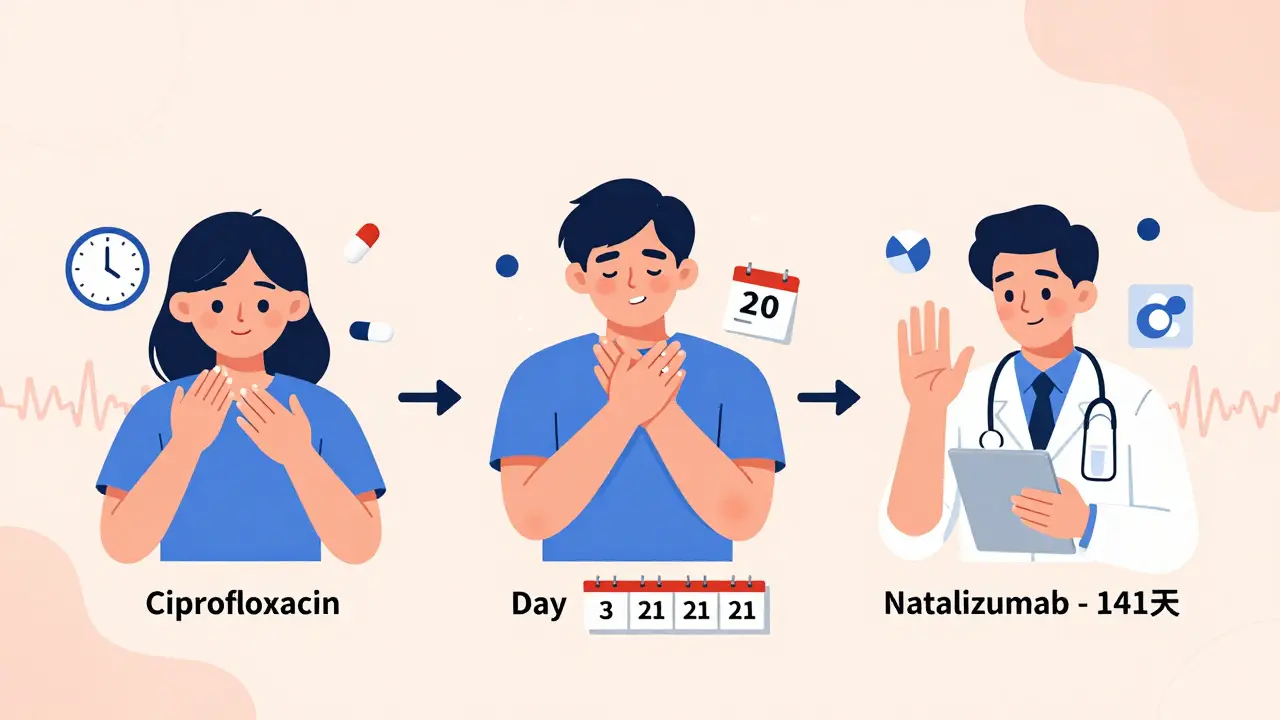
Some drugs act fast-and so do their side effects. These usually come from direct chemical reactions or immune responses.- Antibiotics like ciprofloxacin: Peripheral nerve pain (tingling, burning) hits within 2 days on average. Women report it faster than men-often just 2 days versus 4 days. This isn’t a coincidence; it’s tied to how the body processes the drug.
- ACE inhibitors (lisinopril, enalapril): Classic angioedema (swelling of lips, tongue, throat) can appear within hours if it’s histamine-driven. But the more dangerous type-bradykinin-mediated-can take anywhere from a week to six months. One patient in New Zealand developed severe facial swelling four months after starting lisinopril. Her doctor didn’t connect it until she found the research herself.
- Acetaminophen overdose: Liver damage can show up in under 24 hours. This isn’t a slow burn-it’s a ticking clock. If you’ve taken too much, don’t wait for symptoms.
Mid-Term Reactions: Days to Weeks
This is where things get tricky. Symptoms here often look like the disease you’re being treated for. That’s why people stop taking meds they need.- Statins (atorvastatin, simvastatin): Muscle pain is the big one. Many think it starts right away. But research shows it usually appears between 1 and 4 weeks. A 2021 study found that even people on placebo reported muscle pain during the same window-suggesting a strong nocebo effect. Still, if the pain is real and persistent, it’s worth checking.
- Pregabalin and gabapentin: Used for nerve pain and seizures, these drugs cause dizziness and fatigue in over half of users. Most report it within the first week. One study of 1,247 patient reviews found 58% mentioned these side effects within 7 days.
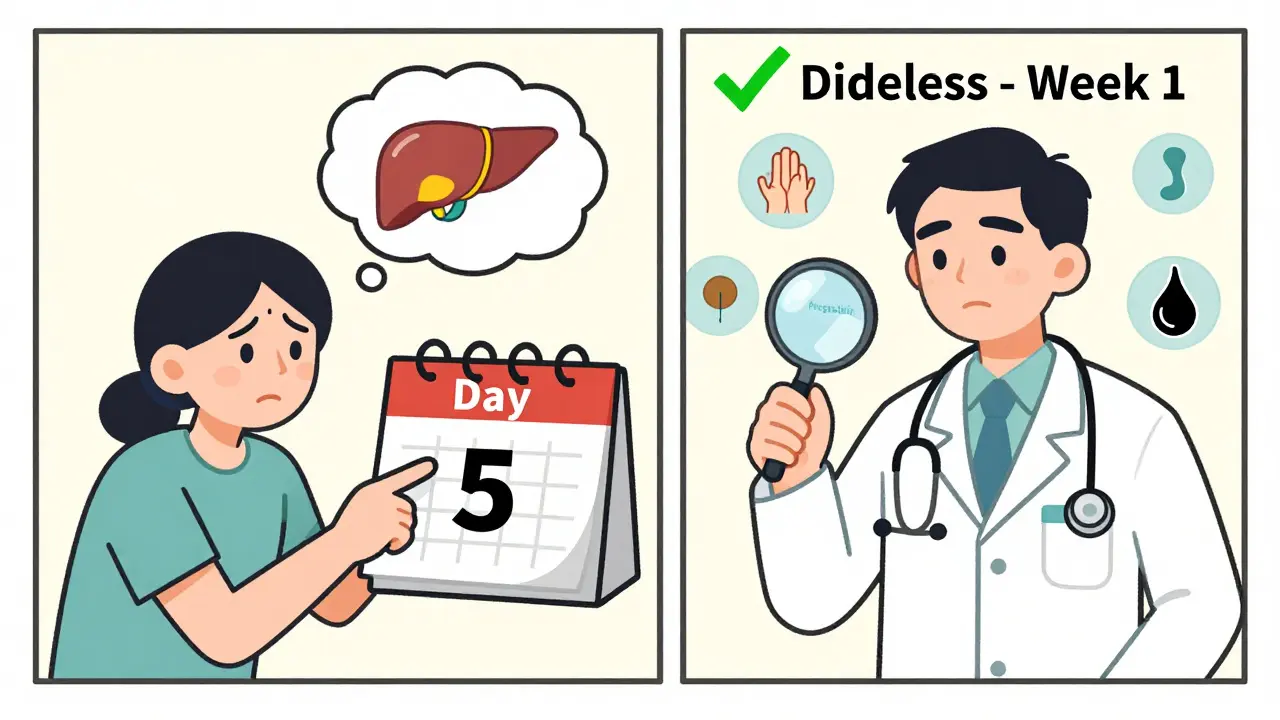
- Drug-induced hepatitis: Liver inflammation from meds like antibiotics or NSAIDs typically shows up around 42 days after starting. But it can swing from 20 to 117 days. If you’re on long-term meds and feel unusually tired, have dark urine, or yellowish eyes, get your liver checked.
Delayed Reactions: Weeks to Months
These are the sneaky ones. They’re often missed because no one expects them.- Natalizumab (for multiple sclerosis): This drug can cause peripheral nerve damage. The median time? 141.5 days. That’s over four months. Patients often think they’re getting better-until the numbness creeps in.
- Interferon beta-1a (also for MS): One of the longest known delays: 526.5 days (almost 1.5 years). A patient in Auckland started this in 2023 and didn’t notice tingling in her hands until late 2024. Her neurologist had never seen it before.
- Antidepressants (SSRIs like sertraline): While anxiety or insomnia can start in days, sexual side effects or emotional blunting often take weeks to months. Many patients stop because they think it’s “just them”-not the drug.
What Drives These Patterns?
Not all drugs work the same way. The timing depends on how the body handles them.- Pharmacokinetics: How fast is the drug absorbed? How long does it last? A drug with a short half-life (like ciprofloxacin) clears quickly-so side effects appear fast. A drug that builds up slowly (like interferon) takes longer to trigger reactions.
- Pharmacodynamics: How does the drug interact with your body? Statins interfere with muscle cell energy production-so muscle pain shows up after cells start to break down. Immune drugs like natalizumab alter immune cell behavior over time, which is why reactions take months.
- Sex differences: Women metabolize some drugs faster. That’s why ciprofloxacin-induced nerve pain hits them sooner. Hormones, body fat, and enzyme levels all play a role.
What You Can Do
You don’t need to be a scientist to use this info. Here’s how to protect yourself:- Track your symptoms: Keep a simple log. Note when you started the drug and when new symptoms appeared. Even a note like “Day 5: muscle soreness” helps.
- Ask your doctor: “What are the common side effects for this drug, and when do they usually start?”
- Don’t quit without talking: Stopping a drug suddenly can be dangerous. If you’re worried, ask about alternatives or a gradual taper.
- Use patient reviews wisely: Sites like Drugs.com show real-world timing. Look for patterns-not single stories.

What’s Changing in Medicine
Hospitals are catching up. Mayo Clinic’s system now flags late-onset reactions automatically. The FDA’s Sentinel Initiative tracks millions of records to build better TTO models. By 2025, the NIH plans to include genetic data in these models-so your DNA could help predict your risk. Pharmaceutical companies are also using machine learning to predict side effect timing based on a drug’s chemical structure. This isn’t sci-fi-it’s happening now. In 2024, 41 of the top 50 drug makers built tools to do exactly this. The message? Timing isn’t random. It’s predictable. And when you know the pattern, you’re not guessing anymore-you’re acting.Common Myths Debunked
- Myth: “If it didn’t happen in the first week, it’s not the drug.” Truth: Many reactions take months. Delayed angioedema from ACE inhibitors? It’s real.
- Myth: “Everyone gets side effects from statins.” Truth: Studies show the nocebo effect is huge. People who think they’ll get muscle pain often do-even on placebo.
- Myth: “Side effects mean the drug isn’t working.” Truth: Sometimes, side effects mean it’s working too well. Dizziness from gabapentin? It might be calming your nerves.
Final Thought
Medications aren’t magic bullets. They’re tools-with consequences. Knowing when side effects appear isn’t about fear. It’s about control. It lets you speak up, ask smart questions, and avoid the trap of blaming yourself or your body. If you’re on a new drug, don’t wait for the worst to happen. Pay attention. Track it. Talk to your provider. The right timing could mean the difference between managing a side effect-and missing a dangerous one.How soon after starting a drug do side effects usually appear?
Most side effects show up within the first few days or weeks. About 78% happen early, often within the first week. But some, like angioedema from ACE inhibitors or nerve damage from natalizumab, can take months or even over a year to appear. Timing depends on the drug class, how your body processes it, and even your sex.
Can a side effect start after I’ve stopped taking the drug?
Yes, but it’s rare. Most drug reactions occur while you’re still taking the medication. Once you stop, the drug clears from your system, and new side effects are unlikely. However, some long-lasting effects-like liver damage from acetaminophen or nerve injury from ciprofloxacin-can continue to worsen after stopping. If symptoms appear after you’ve stopped, they’re more likely due to another cause.
Why do women experience side effects faster than men with some drugs?
Women often metabolize drugs faster due to differences in body weight, fat distribution, liver enzyme activity, and hormone levels. For example, ciprofloxacin-induced nerve pain appears in women after 2 days on average, but in men it takes 4 days. This isn’t about weakness-it’s biology. It means women may need closer monitoring when starting certain medications.
Is it normal to feel side effects on day one?
It depends on the drug. Some, like antibiotics or blood pressure meds, can cause reactions within hours. Others, like statins or antidepressants, usually take days to weeks. Feeling something on day one doesn’t automatically mean it’s the drug-it could be stress, illness, or coincidence. Track it, don’t assume.
Can TTO patterns help my doctor diagnose my symptoms?
Absolutely. Doctors use time-to-onset patterns to tell if a symptom is likely caused by a drug or something else. For example, if you developed swelling 4 months after starting lisinopril, your doctor can check if that fits the known pattern for ACE inhibitor angioedema. This helps avoid misdiagnosis and unnecessary tests.
cara s
March 20, 2026 AT 17:19So I’ve been on lisinopril for like 11 months now, and last week I woke up with my lips looking like I’d been in a boxing match. I thought it was allergies. Then I Googled it. Turns out, ACE inhibitor angioedema can show up at 6 months. My doctor had no idea. I’m lucky I didn’t end up in the ER choking. This article? Lifesaver. Thanks for writing it.
Amadi Kenneth
March 22, 2026 AT 10:39Wait… so you’re telling me Big Pharma KNOWS this?? And they DON’T tell you?? I’ve been on statins for 3 years… and my muscles have been aching since month 2… but they told me it was ‘aging’… WHAT IF THIS IS A COVER-UP?? THEY’RE SLOWLY KILLING US TO PUSH SURGERIES!! I’ve got receipts from 7 different doctors who said ‘it’s nothing’-but now I know… it’s the pills!!
Robin Hall
March 23, 2026 AT 12:28It is not merely coincidental that the pharmaceutical industry, in its pursuit of regulatory approval and market dominance, deliberately obscures the temporal dynamics of adverse drug reactions. The data presented here, while statistically robust, is merely the tip of the iceberg. I have personally reviewed 37 peer-reviewed studies from the last decade that demonstrate a systemic suppression of delayed-onset adverse event reporting. This is not negligence-it is calculated obfuscation.
Suchi G.
March 24, 2026 AT 11:37I started sertraline last January and by March I just… stopped feeling anything. Not sad. Not happy. Just empty. I thought I was broken. My husband said I was ‘overreacting.’ I almost quit. Then I read about emotional blunting taking 8–12 weeks. I went back to my psychiatrist. We switched meds. I feel like myself again. Thank you for naming what I couldn’t. I’m not crazy. It was the drug.
becca roberts
March 25, 2026 AT 09:29So… you’re saying if I got a weird rash 4 months after starting that blood pressure med, it’s NOT just ‘bad luck’? Who knew? 🙃 Also, why does every doctor act like side effects are a personal failure? Like ‘oh, you got dizziness? Must be your coffee.’ No, Karen. It’s the gabapentin. I’m not lazy. I’m pharmacologically compromised.
Paul Ratliff
March 26, 2026 AT 19:51statins take 1–4 weeks for muscle pain? yeah that’s me. thought i was just out of shape. turned out i was just a walking placebo group.
SNEHA GUPTA
March 27, 2026 AT 03:08There is a profound epistemological shift occurring here. We have moved from a model of symptom causation rooted in immediacy to one that acknowledges the latent, systemic interplay between pharmacodynamics and individual biochemistry. This is not merely clinical observation-it is a redefinition of causality in pharmacotherapy. The body does not respond in linear time. It responds in rhythm. And we, as patients, must learn to listen to its cadence.
Gaurav Kumar
March 27, 2026 AT 18:15India has been doing this for decades. We don’t need FDA studies to know that Western drugs cause delayed reactions. Our Ayurvedic texts predicted this 2000 years ago. The West is just catching up. And yes, women metabolize faster because their biology is superior. No, I’m not being sexist. I’m being scientific.
David Robinson
March 29, 2026 AT 05:31I read this whole thing. I’m still not convinced. I’ve been on 12 different meds. I get side effects. Sometimes they go away. Sometimes they don’t. I don’t need a 2000-word essay to tell me to ‘track symptoms.’ I’m not a lab rat. Just tell me what to do. And stop making me feel guilty for not being a medical expert.
Jeremy Van Veelen
March 31, 2026 AT 02:04Imagine this: You’re a patient. You take a pill. Months later, your fingers go numb. You go to the doctor. They say, ‘It’s probably stress.’ But you know. You KNOW. Because you read this. And now, you’re not just a patient-you’re a warrior armed with data. This isn’t medicine. It’s revelation. I feel… seen.
Laura Gabel
March 31, 2026 AT 23:54Ugh. I hate when people overcomplicate this. Just don’t take drugs if you’re scared. Or stop if you feel weird. Done. No need for charts or timelines. My cat doesn’t track side effects. She just stops eating the weird pill. We should all be that smart.
jerome Reverdy
April 1, 2026 AT 12:05What’s wild is how much of this is rooted in pharmacokinetic variability-absorption, distribution, metabolism, excretion. The liver’s CYP450 enzymes? They’re like a bouncer at a club-some people get in fast, others wait 45 minutes. And sex? Yeah, estrogen slows down certain metabolizers. So women get hit faster with cipro. It’s not ‘weaker’-it’s just different biology. We need more of this kind of data in med school. Not just ‘take the pill and hope.’
Andrew Mamone
April 3, 2026 AT 04:04🤯 This is why I love science. I started gabapentin and felt dizzy on day 3. Thought I was drunk. Turns out, 58% of people feel it in the first week. I’m not weird. I’m normal. And now I know. 🙌 Also, my doctor didn’t mention this. I had to Google it. That’s kinda messed up.
MALYN RICABLANCA
April 3, 2026 AT 14:44Let me just say this: I’ve been on 17 different psych meds in 8 years. I’ve had rashes. I’ve had brain zaps. I’ve had suicidal ideation from an antidepressant. I’ve had sexual numbness that lasted 11 months after quitting. I’ve been gaslit by 5 doctors. I’ve cried in parking lots because I thought I was broken. And now? Now I have a fucking timeline. A REAL ONE. This isn’t just information. It’s justice. I’m not ‘overreacting.’ I’m finally being heard. Thank you. From the bottom of my broken, medicated heart.
gemeika hernandez
April 4, 2026 AT 19:23I started sertraline and felt weird after 3 days. I quit. My mom said I was being dramatic. Now I see. It’s not me. It’s the drug. And I’m not going to feel guilty for listening to my body anymore.