How to Overcome Swallowing Difficulties to Keep Taking Medicine
 Dec, 31 2025
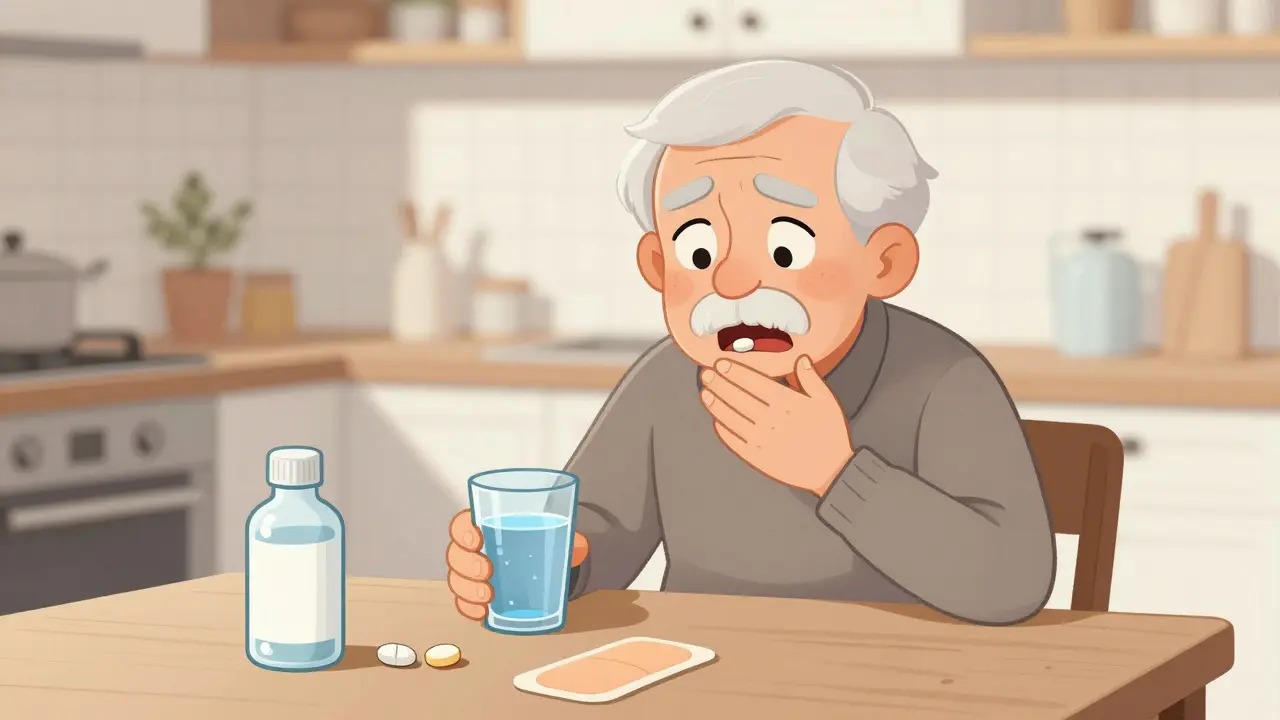
Imagine taking your daily pills and feeling like they’re stuck in your throat. You gag. You panic. You spit them out. Then you feel guilty. This isn’t just inconvenient-it’s dangerous. Around 15% of older adults living at home struggle with swallowing pills, and for those in care homes, that number jumps to nearly 70%. When swallowing becomes hard, people skip doses, stop meds altogether, or crush tablets without knowing the risks. The result? Hospital visits, worsening health, and even life-threatening mistakes.
Why Swallowing Pills Is Harder Than You Think
Swallowing isn’t just about throat muscles. It’s a complex process involving nerves, coordination, and timing. When something goes wrong-like after a stroke, Parkinson’s, dementia, or even just aging-it’s called dysphagia. You might not realize you have it until you can’t get a pill down. Some people think it’s just a matter of being "weak" or "not trying hard enough." But it’s not. It’s a medical issue.Many medications are designed to be swallowed whole. Crushing a slow-release tablet, opening a capsule, or mixing it with food can destroy how it works. A 2023 review found that nearly 50% of the time, when pills were altered to make them easier to swallow, the change made them unsafe. In 13% of cases, this led to overdose risks. In another 8%, the medicine stopped working properly.
Stop Crushing-Try These Safer Options First
Before you smash a pill into applesauce, pause. There are better ways.- Ask for liquid versions. Many blood pressure pills, antidepressants, and pain relievers come in liquid form. It’s often easier to swallow, and dosing is precise.
- Look for orodispersible tablets. These dissolve on the tongue without water. Brands like Zofran (for nausea) and some antifungals offer these.
- Try effervescent tablets. Dissolved in water, they turn into a drink. Great for painkillers like paracetamol or vitamin C.
- Ask about patches or suppositories. For pain, hormones, or nausea, these avoid the throat entirely. A skin patch for Parkinson’s or a rectal suppository for nausea can be life-changing.
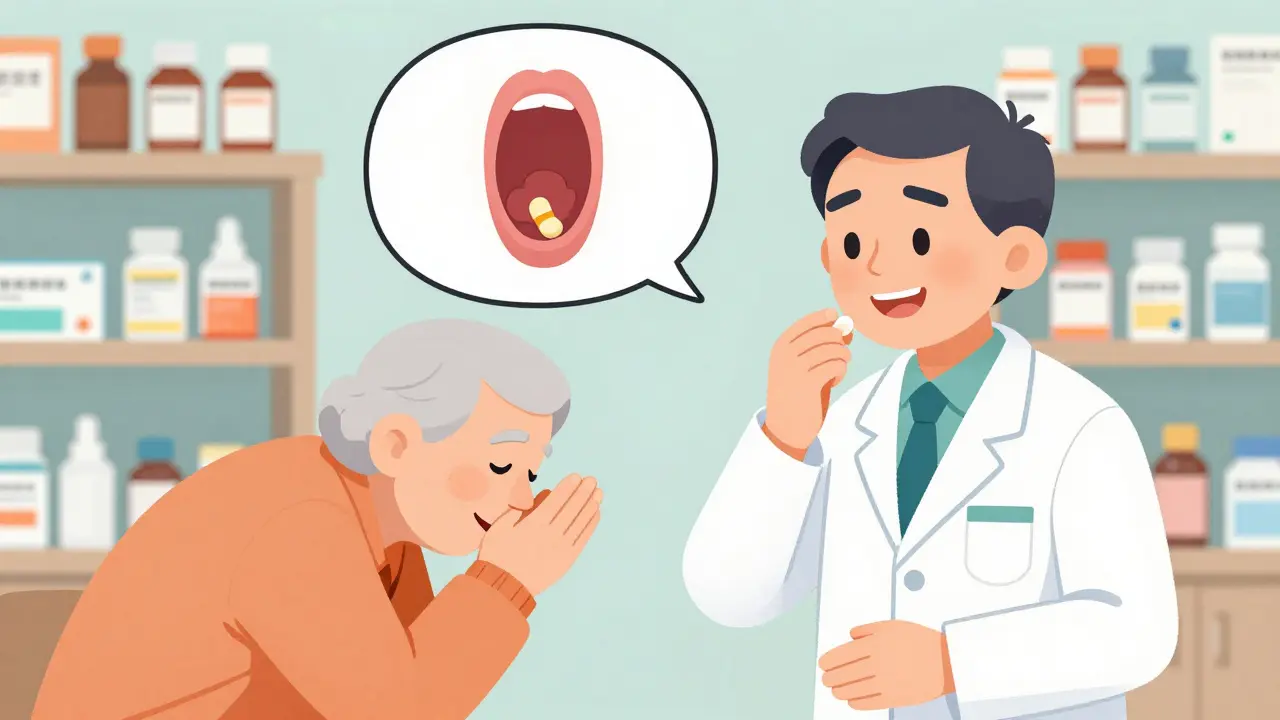
Not all medicines have alternatives-but you won’t know unless you ask. Talk to your pharmacist. They’re trained to spot these options. In fact, the American Society of Health-System Pharmacists says pharmacists should be the first line of defense in catching swallowing problems.
Swallowing Techniques That Actually Work
If you must swallow a pill whole, technique matters more than strength.The lean-forward method works for capsules. Place the capsule on your tongue. Take a medium sip of water. Then, lean your head forward slightly-like you’re looking at your toes-before swallowing. Studies show this boosts success rates by up to 75%. Why? It opens the throat wider and helps the pill slide down.
For tablets, try the pop-bottle method. Fill a plastic water bottle with water. Put the pill on your tongue. Seal your lips around the bottle’s opening. Take a big sip using suction-don’t just tilt your head back. The suction pulls the pill down with the water.
For kids or older adults with dry mouths, try this: take a small sip of milk or yogurt before the pill. It coats the throat and makes swallowing smoother. Ice chips before and after can also help clear the mouth and trigger the swallow reflex.
When You Absolutely Need to Crush or Open a Pill
Sometimes, there’s no alternative. But if you do, follow these rules:- Check the label. Look for "do not crush" or "enteric coated." If it’s there, don’t break it.
- Use a pill crusher. Don’t use a spoon or mortar. Crushers give even powder, reducing risk of uneven dosing.
- Mix with soft food. Applesauce, yogurt, or pudding work best. Avoid hot foods-they can break down medicine.
- Don’t mix multiple pills. Giving five crushed pills in one spoonful can cause chemical reactions or make the taste unbearable.
- Flush the container. After mixing, rinse the cup or spoon with water and drink it. You don’t want to lose part of the dose.
And never, ever open extended-release capsules. Those are designed to release medicine slowly over hours. Opening them can dump the full dose at once-dangerous, even deadly.
Feeding Tubes and Medication: What You Need to Know
If someone uses a feeding tube, giving pills isn’t as simple as flushing them through. Many pills can clog the tube or interact with the formula.- Use liquid or crushable meds only.
- Give one drug at a time.
- Flush with at least 10ml of water between each.
- Don’t mix meds with feedings-wait 30 minutes before and after.
- Ask your pharmacist to check for drug-feed interactions. Some antibiotics bind to formula and become useless.
Many care homes still don’t follow these rules. A 2020 UK study found that nursing staff often gave crushed meds without checking safety. That’s why clear communication between doctors, pharmacists, and caregivers is critical.

What the Industry Is Doing to Help
The problem is growing. With more people aging worldwide, the global market for dysphagia solutions is expected to hit $2.9 billion by 2029. Companies are responding.New technologies like dissolvable oral films-thin sheets that stick to the cheek and release medicine-are showing promise. One brand, VersaFilm, has an 85% success rate in patients with moderate swallowing trouble. The FDA and European Medicines Agency now require clearer labeling on whether a pill can be crushed or split.
Still, only 37% of essential medicines have safe alternatives for people with dysphagia. That’s a huge gap. And it’s why you can’t wait for the system to fix itself-you have to act now.
Who Should Be on Your Team?
This isn’t something you should handle alone. You need a team:- Your doctor: Ask: "Is this medicine still needed? Is there a better form?" Don’t assume all pills are necessary.
- Your pharmacist: They know what formulations exist. Ask them to review your full list every six months.
- A speech therapist: They can test your swallowing and teach you techniques. Many insurance plans cover this.
- Your caregiver: Whether it’s a family member or nurse, they need to know the rules-what can be crushed, what can’t, and how to spot trouble.
One woman in Auckland, 82, stopped taking her heart medication because she couldn’t swallow the pills. Her daughter brought her to a pharmacist. They switched her to a liquid version. Her blood pressure improved. She started eating again. Simple fix. But only because someone asked the right questions.
What to Do Today
You don’t need to wait for a crisis. Here’s your action plan:- Look at your pill bottle. Does it say "do not crush"? If yes, don’t break it.
- Call your pharmacist. Ask: "Are there liquid, dissolvable, or patch versions of these pills?"
- Try the lean-forward method with your next capsule. It takes 10 seconds.
- If you’re caring for someone, write down each pill, its form, and whether it can be altered. Share it with the doctor.
- Request a swallowing assessment if you’ve had trouble for more than a few weeks.
Medication adherence isn’t about willpower. It’s about smart choices. The right form, the right technique, the right team. You can take your medicine safely. You just need to know how.
Can I crush my pills if they’re too big to swallow?
Only if the label doesn’t say "do not crush" or "extended-release." Crushing can make slow-release pills dangerous by releasing the full dose at once. Some pills, like enteric-coated ones, are designed to dissolve in the intestine-not the stomach. Crushing them can cause stomach upset or reduce effectiveness. Always check with your pharmacist first.
Why do some pills feel stuck even when I drink water?
It’s often not about lack of water-it’s about technique. Pills can stick if you swallow them dry, lie back while swallowing, or don’t coordinate your throat muscles. Try the lean-forward method: place the pill on your tongue, take a sip of water, then bend your head forward slightly before swallowing. This opens your throat and helps the pill slide down. Many people see a 75% improvement with this trick.
Are liquid medicines as effective as pills?
Yes, if they’re the same active ingredient. Liquid versions are often just dissolved or suspended forms of the same drug. Some people even absorb them faster because they don’t need to break down in the stomach. The key is getting the right dose-pharmacists can help convert pill doses to liquid equivalents accurately.
What if my medicine doesn’t come in liquid or dissolvable form?
Ask your doctor if you can switch to a similar medicine that does. For example, some blood pressure pills have multiple brand names-some come in liquid. If switching isn’t possible, talk to your pharmacist about whether crushing is safe. Never guess. Also, consider alternatives like patches or suppositories. Many conditions can be treated without swallowing anything.
Can speech therapy help me swallow pills again?
Absolutely. Speech-language pathologists specialize in swallowing disorders. They can test your swallowing function and teach you exercises to strengthen your throat muscles. They also show you techniques like head positioning, swallowing maneuvers, and how to modify food and liquid textures. Many people regain the ability to swallow pills after just a few sessions.
Is it safe to mix crushed pills with baby food or yogurt?
It’s safer than taking them dry, but only if the pill can be crushed. Use cold, thick foods like applesauce, yogurt, or pudding. Avoid hot foods, acidic juices (like orange), or sticky foods like peanut butter-they can bind to the medicine and reduce absorption. Always flush the container with water after to get every bit of the dose. And never mix multiple crushed pills together.
What should I do if I’ve been skipping my meds because of swallowing trouble?
Don’t feel guilty-just act. Call your pharmacist today. Ask for alternatives. Request a swallowing assessment. Your health depends on taking your medicine, not on how you take it. There are safe, effective ways to manage this. You don’t have to choose between your health and your comfort.
sharad vyas
January 2, 2026 AT 05:19It’s not just about pills, you know? It’s about dignity. I’ve seen my uncle choke on a tablet like it was a snake. He cried. Not from pain-from shame. We think medicine is about science, but really, it’s about how we treat people when they’re vulnerable.
Swallowing isn’t just biology. It’s fear. It’s memory. It’s the sound of your own throat clicking like a broken door.
Why do we make people feel broken for needing help? Why not design medicine for humans, not just for convenience?
It’s not laziness. It’s not weakness. It’s just… life getting heavier.
And yet, we still blame the person who can’t swallow.
Maybe the problem isn’t the throat. Maybe it’s the system that forgot how to listen.
Bill Medley
January 3, 2026 AT 03:09Pharmacists are the unsung heroes of medication safety. Their expertise is routinely underutilized.
Always consult them before altering dosage forms.
Bobby Collins
January 3, 2026 AT 14:14Did you know the FDA is secretly pushing liquid meds to control the elderly? They want us dependent on big pharma’s syrupy formulas. Crushed pills are freedom. They’re just hiding the truth behind ‘safety’.
Also, why do all these ‘techniques’ come from universities? Who funded them? Who owns the patents on the lean-forward method?
Layla Anna
January 5, 2026 AT 06:17OMG this is so real 😭 I’ve been crushing my mom’s pills for years and felt awful about it…
But the pop-bottle trick? I tried it last week with her blood pressure pill and she swallowed it like a champ!!
Now I’m telling everyone. You’re a lifesaver 💙
Also-can someone link me to those dissolvable Zofran ones? My aunt needs them ASAP
Heather Josey
January 6, 2026 AT 14:14This is one of the most thoughtful, clinically accurate, and compassionately written pieces on medication adherence I’ve encountered in years.
Thank you for emphasizing the role of the pharmacist and the importance of swallowing assessments. Too many providers assume patients are noncompliant when the issue is physical, not behavioral.
These techniques and alternatives must be integrated into standard geriatric protocols. This should be mandatory reading for medical students.
Donna Peplinskie
January 7, 2026 AT 01:26Oh my goodness, I’m so glad someone finally wrote this…
My grandmother used to hide her pills under her tongue and spit them out later… I didn’t know why until I saw her struggle…
She tried the lean-forward method… and cried because it finally worked…
And then we found a liquid version of her antidepressant… and she started laughing again…
Please, please, please-don’t wait until someone is hospitalized to ask these questions…
Call your pharmacist today…
And if you’re a caregiver… don’t be afraid to ask for help…
You’re not failing… the system is…
But you can still fix it… one pill at a time…
Olukayode Oguntulu
January 8, 2026 AT 03:26Let’s be candid: the dysphagia industrial complex is a lucrative niche. Dissolvable films? Effervescent tablets? These are premium-tier products priced for the affluent. Meanwhile, the global south is left with crushed tablets and hope.
And let’s not pretend the ‘lean-forward method’ is some revolutionary breakthrough-it’s just a repackaged version of traditional swallowing rituals from Ayurvedic and Chinese medicine.
Western medicine loves to patent common sense and slap a 75% efficacy sticker on it.
Meanwhile, the real issue? Pharma doesn’t want to reformulate. It’s cheaper to sell 100mg tablets than 10mg liquids.
So we get ‘solutions’ that profit the system, not the patient.
Ask yourself: who benefits from this narrative?
jaspreet sandhu
January 8, 2026 AT 19:10Everyone is talking about techniques and liquids but nobody is talking about the root cause: people are just too weak now. In my village in Punjab, we swallowed whole tablets with a gulp of water at age 10. No problem. No tricks. No fancy bottles. No speech therapists. We didn’t have time to be fragile. Now everyone acts like swallowing is a yoga pose. It’s not hard. You just need discipline. Stop making excuses. Your body is not broken. Your will is weak. You just need to train your throat like you train your legs. One pill a day. No excuses. No liquids. No crushing. Just swallow. That’s how we survived. That’s how we should still live.
Alex Warden
January 10, 2026 AT 03:28Look, I get it. But if you can’t swallow a pill, maybe you shouldn’t be taking it. This country is full of people who think they’re too special for basic things. You think you’re sick? So is everyone else. But we don’t cry over a pill. We take it. End of story. Stop asking for special treatment. Just swallow it. You’re not a baby. You’re an American. Act like it.