How to Store Inhalers and Nebulizer Medications Safely: Temperature, Humidity, and Common Mistakes
 Jan, 1 2026
Why Storage Matters More Than You Think
Imagine this: You’re out running errands, your chest tightens, and you reach for your inhaler. You press it. Nothing happens. No puff. No relief. You panic. Later, you find out your inhaler was sitting in your car all morning-where it hit 110°F. That’s not just bad luck. That’s a preventable medical failure. Improperly stored inhalers and nebulizer meds lose potency fast. Studies show up to 40% less medication reaches your lungs when they’ve been exposed to heat or moisture. For someone with asthma or COPD, that’s not a minor issue-it’s life-threatening.
What Temperature Is Safe?
Most inhalers and nebulizer solutions need to stay between 68°F and 77°F (20°C to 25°C). That’s room temperature. Not hot. Not cold. Just right. But here’s the catch: different types have different needs.
Pressurized metered-dose inhalers (MDIs) like ProAir HFA or Ventolin can handle a wider range: 59°F to 86°F (15°C to 30°C). But don’t push it. If your car hits 95°F on a summer day, that’s not just warm-it’s dangerous. The FDA warns that inhalers left in cars can reach 158°F in under 30 minutes. At that point, the medicine breaks down. The propellant can even rupture the canister. Don’t risk it.
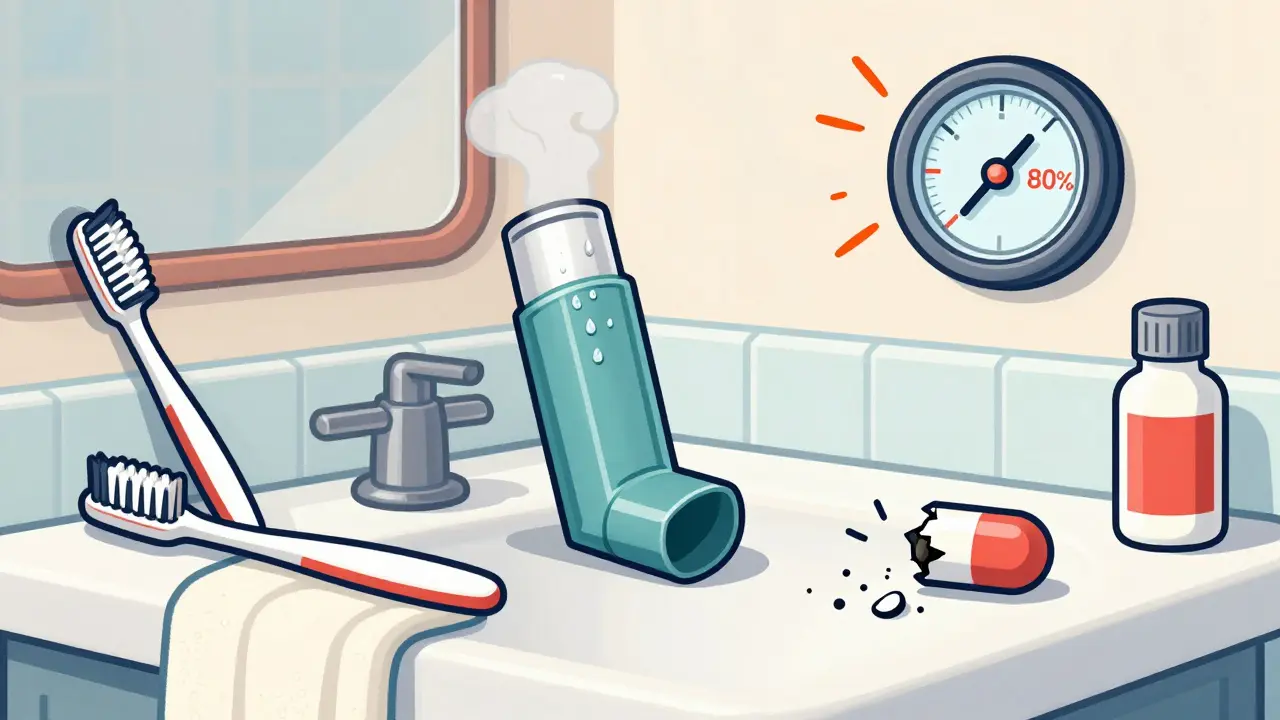
Dry powder inhalers (DPIs) like Spiriva or Advair Diskus are even more sensitive. They don’t use liquid or propellant, but they do use dry powder inside capsules. Moisture turns that powder clumpy. High humidity makes the capsules brittle. Once cracked, the dose is ruined. Keep them away from bathrooms, kitchens, or anywhere steam builds up.
Nebulizer liquids like albuterol or Pulmicort Respules have stricter rules. Most need to be refrigerated (36°F-46°F) before first use. Once opened, they’re good for only 7 days at room temperature. If you leave them on the counter in a sunny window, they degrade in hours. A 2022 study found that exposure to 104°F for just 30 minutes made albuterol completely ineffective.
Humidity Is the Silent Killer
It’s not just heat. Humidity is what most people ignore. If your bathroom has steam from showers, or your kitchen has a boiling pot, that’s the worst place to store your inhaler. Moisture doesn’t just make the device feel damp-it chemically alters the medication.
GlaxoSmithKline’s own testing showed that humidity above 60% causes DPI capsules to become brittle and crack. Boehringer Ingelheim’s data confirms that above 65% humidity, Spiriva capsules lose structural integrity. That means you might press the device and get no dose at all.
St. Jude Children’s Research Hospital found that storing albuterol inhalers in bathrooms reduced active drug concentration by 35% in just two weeks. That’s not a myth. That’s lab-tested fact. If you’re tempted to keep your inhaler next to the toothbrush, don’t. Get a drawer in your bedroom or a closet instead.
Storage Do’s and Don’ts
DO:
- Keep inhalers in their original packaging. The box blocks light and adds a layer of protection.
- Use an opaque container if you need to carry it. Sunlight can degrade medication over time.
- Store nebulizer solutions in the fridge until opened. Once opened, write the date on the ampule with a marker.
- Use a digital hygrometer to check humidity in your storage area. Aim for 40-50%.
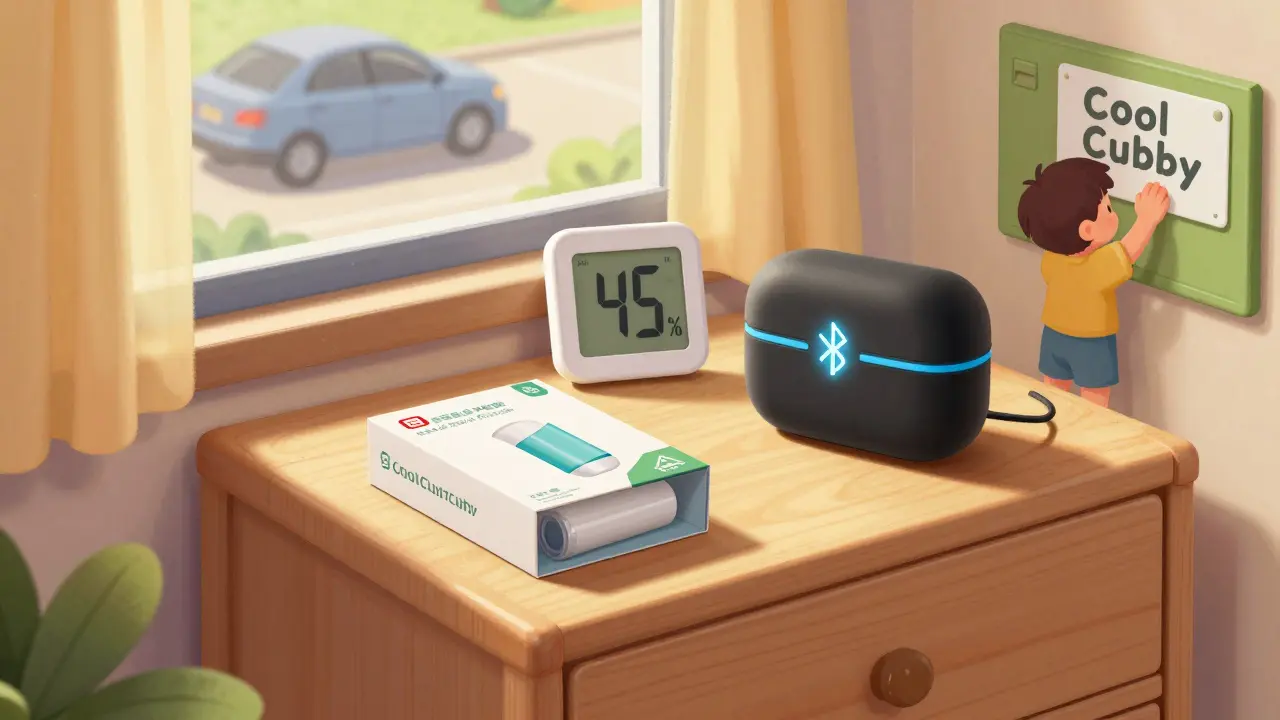
- For travel, use an insulated case like the MediSafe or SmartInhale. These keep meds at safe temps for up to 15 hours.
DON’T:
- Leave inhalers in your car, even for 10 minutes. Summer temps inside cars can hit 150°F.
- Store them near windows, radiators, or heating vents. Heat rises-so does the risk.
- Keep multiple inhalers together. A pMDI can leak moisture into a DPI. That’s how one bad habit ruins two devices.
- Refrigerate multi-dose inhalers like Symbicort unless you’re in extreme heat (above 95°F) and only for short periods. Some guidelines allow it; others don’t. When in doubt, stick to room temp.
- Assume your inhaler still works because it “sounds right.” The sound of the puff doesn’t mean the dose is full.
Traveling with Respiratory Medications
Traveling? The American College of Physicians has a simple rule: the Rule of 15. Don’t let your inhaler or nebulizer solution be outside a temperature-controlled environment for more than 15 minutes. That means no leaving it on the seat while you grab coffee. No tossing it in your backpack on a hot bus.
Use a small insulated case with a cold pack if you’re flying. TSA allows medication in carry-ons, even liquids over 3.4 oz, as long as you declare them. Keep them in your personal item, not checked luggage. Checked bags can drop to freezing temps or get stuck in hot cargo holds.
For school or work, talk to your nurse or HR department. A 2023 CDC report found that 63% of school asthma emergencies happened because the inhaler was stored in the nurse’s office-where it got too hot. Some schools now use “Cool Cubby” systems: small, temperature-monitored lockers in classrooms. If your child’s school doesn’t have one, ask them to consider it.
What About Expiration Dates?
Just because your inhaler says “expires 2027” doesn’t mean it’s good until then. If it’s been exposed to heat, humidity, or sunlight, it could be dead months before that date. In fact, 35% of complaints on Drugs.com about inhalers “not working before expiration” were traced back to improper storage.
Check the device. If the mouthpiece looks cloudy, if the canister feels lighter than usual, or if the spray feels weak, don’t wait for the expiration date. Replace it. Your lungs don’t negotiate.
New Tech Is Making Storage Easier
In 2023, two big innovations hit the market. GlaxoSmithKline rolled out humidity-indicating packaging for Ellipta inhalers. The label changes color if moisture levels go too high. SmartInhale, an FDA-cleared case, uses Bluetooth to track temperature and sends alerts to your phone if your inhaler gets too hot or cold.
The FDA is pushing for mandatory temperature tracking on all rescue inhalers by 2026. That’s coming. But until then, you can’t wait for technology to fix your habits. You have to be the one who checks, stores, and protects your meds.
Why So Many People Get It Wrong
A 2023 survey by the Asthma and Allergy Foundation of America found that 92% of patients thought they were storing their inhalers correctly. Only 38% actually were.
Why? Because the instructions are confusing. Teva’s ProAir HFA guide got a 4.7/5 from pharmacists for clarity. Generic albuterol instructions? 2.3/5. Too vague. Too small print. Too easy to ignore.
Reddit users say they keep inhalers in bathrooms because it’s convenient. Gym bags? Because they forget them there. Cars? Because they’re “just going to be right back.” But convenience kills. A single mistake can cost you your next breath.
What to Do If Your Inhaler Fails
If your inhaler doesn’t work during an attack:
- Use your backup inhaler if you have one.
- If you don’t, call 911 or go to the ER immediately.
- Afterward, replace the inhaler-even if it still has liquid in it.
- Write down what happened: where it was stored, how long, what the weather was like.
- Bring the used inhaler to your doctor. They can test it or report the issue to the manufacturer.
Don’t assume it’s just “bad luck.” It’s preventable. And if you’ve had this happen before, you owe it to yourself to fix your storage habits.
Final Rule: Treat Your Inhaler Like a Lifeline
Your inhaler isn’t just a device. It’s your emergency tool. Your insurance card. Your peace of mind. Store it like you’d store your phone charger-where it’s safe, dry, cool, and always where you can find it. Not in the glovebox. Not in the medicine cabinet above the sink. Not in your gym bag.
Find a drawer. A bedside table. A locked cabinet in your bedroom. Keep it away from heat, moisture, and light. Check it every month. If you’re unsure, replace it. Better to spend $50 on a new inhaler than risk a trip to the ER.
One in four asthma attacks is preventable with proper medication storage. Don’t be the statistic. Be the one who knows how to protect what keeps them breathing.
Can I store my inhaler in the fridge?
Only if the manufacturer says so. Nebulizer solutions like Pulmicort Respules must be refrigerated before opening. But most inhalers-especially metered-dose ones like albuterol or Symbicort-should NOT be refrigerated. Cold can change how the propellant works, and condensation can form inside the device. If you’re in extreme heat (over 95°F), some experts say brief refrigeration is okay, but it’s not recommended long-term. When in doubt, keep it at room temperature.
Is it safe to keep my inhaler in my purse or pocket?
Yes, if you’re careful. Your body heat won’t damage the inhaler. But if you’re in a hot car, on a sunny day, or in a crowded place where your bag gets left in direct sunlight, it’s risky. Always keep it in its original case or an insulated pouch. Avoid letting it sit on a hot car seat or in a pocket next to your phone, which can get warm. The safest spot is inside a bag that stays out of direct heat.
How do I know if my inhaler has gone bad?
Signs include: a weak or uneven spray, no mist at all, the inhaler feeling lighter than usual, or the mouthpiece looking cloudy or sticky. If you’ve stored it in heat or humidity, and it doesn’t work during an attack, assume it’s ruined. Even if it still has liquid, the medicine may have degraded. Don’t wait for the expiration date. Replace it.
Can I reuse nebulizer solution after it’s been opened?
Most nebulizer liquids, like albuterol or Pulmicort, are only good for 7 days after opening-even if there’s liquid left. After that, bacteria can grow, and the medicine loses strength. Always write the opening date on the ampule. Discard any unused solution after 7 days. Never refrigerate opened ampules to extend life. That doesn’t work.
What should I do with expired or unused inhalers?
Never throw inhalers in the trash or flush them. The propellant is pressurized and can explode in landfills. Many pharmacies, including those in New Zealand, have medication take-back programs. You can also contact your local waste authority for safe disposal options. If you’re unsure, ask your pharmacist. They’re required to help you dispose of them safely.
Next Steps
Check your inhaler storage right now. Where is it? Is it in the bathroom? The car? The kitchen? Move it today. Buy a small insulated case for $15 if you travel often. Get a $10 digital hygrometer to check humidity in your storage area. Write down the storage rules on a sticky note and put it on your fridge. Make this a habit-not an afterthought.
One in four asthma attacks is preventable. You don’t need to be a doctor to save your own life. Just be smart about where you keep your medicine.
LIZETH DE PACHECO
January 2, 2026 AT 22:31Just did a quick check: mine’s been in the same drawer since January. Still works like a charm.
jaspreet sandhu
January 3, 2026 AT 21:48Olukayode Oguntulu
January 4, 2026 AT 01:51Todd Nickel
January 4, 2026 AT 04:49Liam George
January 4, 2026 AT 20:01Austin Mac-Anabraba
January 5, 2026 AT 20:19Stephen Gikuma
January 7, 2026 AT 19:39Bobby Collins
January 7, 2026 AT 20:02Layla Anna
January 7, 2026 AT 22:11Heather Josey
January 9, 2026 AT 20:12Donna Peplinskie
January 10, 2026 AT 14:31Alex Warden
January 10, 2026 AT 19:44Lee M
January 12, 2026 AT 13:42Kristen Russell
January 13, 2026 AT 04:05