QR Codes on Drug Labels: Real-Time Safety Updates
 Dec, 15 2025
Drug Safety QR Code Checker
Check Your Medication Safety Information
Enter a drug name or QR code identifier to verify if real-time safety updates are available for your prescription.
Current Safety Information
No safety information available. This drug may not yet support real-time updates.
How This Works
QR codes on drug labels provide real-time safety updates when scanned. Your information is encrypted and secure.
Imagine you’re holding a bottle of your new prescription. The label is printed with tiny text you can barely read. You scan a QR code instead. In seconds, you see a video explaining how to take it, a pop-up alert about a recent black box warning, and a link to report side effects-all updated yesterday. This isn’t science fiction. It’s happening now.
Why QR Codes Are Changing How We Get Drug Info
For decades, drug labels were printed once and stuck on bottles forever. If a new safety warning came out, manufacturers had to reprint millions of boxes, ship them globally, and wait months before the updated info reached patients. That delay cost lives. In the last decade, over 225 black box warnings-the strongest safety alerts the FDA and global regulators issue-were issued. Many patients never saw them until it was too late. QR codes on drug labels fix that. They turn static paper into living documents. When a drug’s safety profile changes, the manufacturer updates the content behind the code. No new labels. No delays. Patients, pharmacists, and doctors get the latest info within hours or days, not months. Spain led the way in 2021, becoming the first country to legally allow QR codes linking directly to official prescribing information. By 2024, the UK followed, updating its pharmaceutical code to make it official. This isn’t optional anymore-it’s the new standard.How QR Codes Work on Medications
These aren’t just any QR codes. They’re dynamic, secure, and built for healthcare. Unlike a static code that points to one fixed webpage, dynamic QR codes connect to a secure cloud system. That system can be updated anytime without touching the physical label. If a new drug interaction is discovered, the manufacturer pushes the update to the server. Everyone who scans the code that day sees the new info. The old version? Gone. The system works like this: the code links to a secure page hosted by the drugmaker or a third-party platform like DosePacker’s CareCommunityOS. That page pulls real-time data from pharmacovigilance databases-systems that track side effects and safety signals. It can show:- Current prescribing guidelines
- Updated black box warnings
- Drug interactions with other medications you’re taking
- Step-by-step administration videos
- How to report an adverse reaction
- Lot number and expiration verification to fight counterfeits
Real Benefits: Less Errors, Faster Reporting
The results are clear. Hospitals and pharmacies that switched to QR codes saw drops in medication errors. One facility reported a 40% improvement in patient understanding of complex drug regimens after introducing QR codes on discharge meds. Why? Because patients don’t have to guess what the tiny print says. They get clear, updated instructions in their own language. Pharmacists love it too. Eighty-five percent prefer digital reporting systems over paper forms for adverse events. Why? It’s faster, more accurate, and integrates directly into electronic health records. One pharmacist on Reddit shared: “We used to spend 10 minutes explaining a drug to each patient. Now we scan the code together. They see the video. They get it.” Supply chain teams also benefit. QR codes help verify if a drug is real. Scanning a code can confirm the lot number, manufacturing date, and distribution path. This cuts down on fake meds-something that’s a growing problem worldwide.
The Downsides: Not Everyone Has a Smartphone
This isn’t a perfect solution. About 60% of elderly patients in rural clinics can’t scan QR codes. They don’t have smartphones. Their phones are too old. Their eyesight is bad. Or they just don’t trust tech. In one study, nearly half of patients over 70 said they’d rather have printed instructions-even if the print was small. That’s why smart companies don’t replace paper. They add QR codes to it. DosePacker and others include printed summaries alongside the code. Pharmacies train staff to scan codes on the spot for patients who need help. Some even offer free kiosks in waiting rooms. There’s also a real risk: if the system goes down, or the patient has no internet, the info disappears. Emergency responders can’t scan a code if the phone is dead. That’s why regulators insist on backup print versions. The goal isn’t to eliminate paper-it’s to make it smarter.Global Adoption: Who’s Leading?
Europe is ahead. Spain started first. The UK made it official in 2024. The European Federation of Pharmaceutical Industries and Associations (EFPIA) is working on a unified code that will make QR labeling mandatory across member countries. The U.S. is catching up. Military pharmacies began using QR codes on prescriptions in 2022. The FDA hasn’t mandated it yet, but it’s watching closely. In Asia and Africa, adoption is slower. Many regions lack reliable internet or smartphone access. But that’s changing fast. In India and Brazil, pilot programs are testing QR codes with offline caching-so once scanned, the info stays on the phone even without connection. Companies like sQR.me, Vodori, and Freyr Solutions have sprung up to help drugmakers build these systems. They handle the tech, the compliance, the multilingual content, and the audit logs. It’s not cheap-but it’s cheaper than lawsuits from patients who didn’t know about a life-threatening interaction.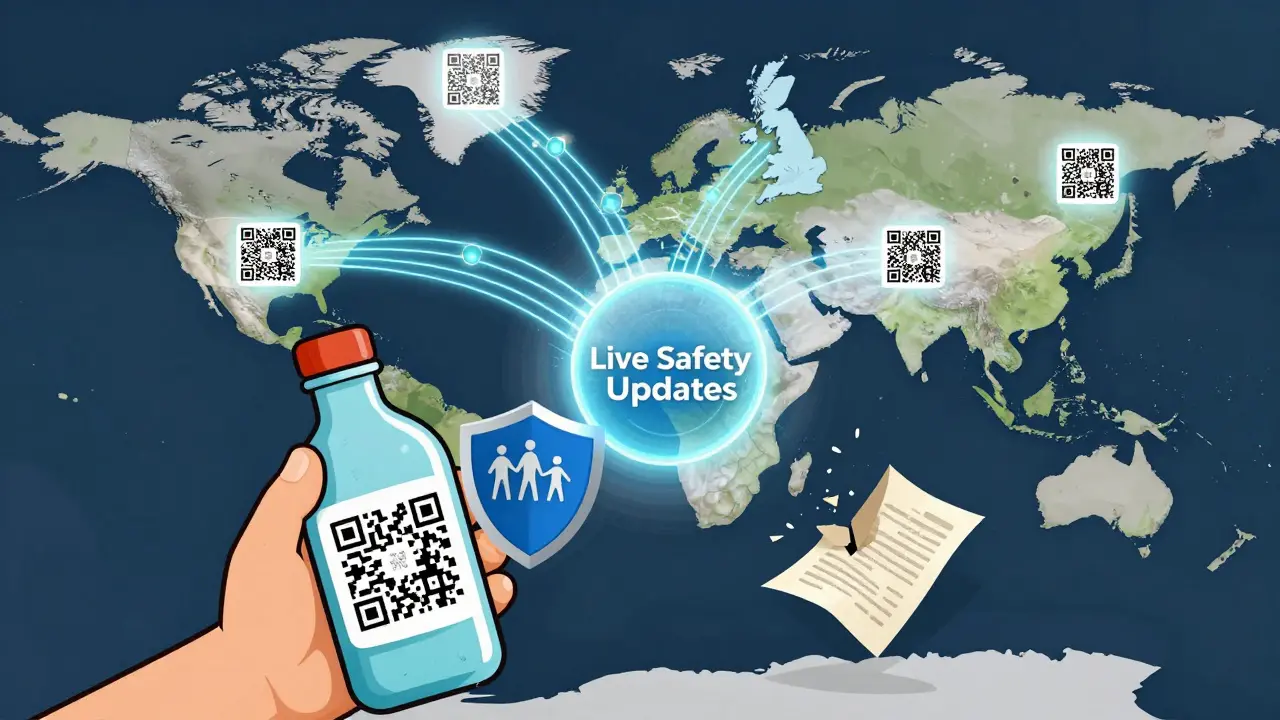
What’s Next? AI, Apps, and Global Sync
The next step? Integration. QR codes won’t just show info-they’ll connect to your health apps. DosePacker’s MyDoses app already lets you scan a code and auto-add the drug to your medication tracker. It sends reminders. Flags interactions with your other meds. Alerts you if a warning is issued. In the future, AI will analyze scan data to spot safety signals faster. If 500 people scan a code and report nausea within 24 hours, the system flags it automatically. That could cut the time to detect a new side effect from months to hours. By 2025, dynamic e-labeling with QR codes will be standard in most developed countries. The goal is global harmonization: one code, one update, one language option per user-no matter where you are.What You Should Do Now
If you’re a patient: scan the QR code on your new prescriptions. Don’t just ignore it. Watch the video. Read the warning. Report side effects if you see them. You’re not just getting info-you’re helping improve safety for everyone. If you’re a caregiver or family member: help older loved ones scan the code. Sit with them. Show them how it works. The tech is simple-it’s the fear of using it that’s the barrier. If you’re a pharmacist or clinician: push for QR codes in your facility. Train your team. Keep printed backups. Use the scan logs to see who’s accessing what info. That data helps improve care. If you’re in pharma: don’t wait for regulators to force your hand. Start now. Build your system. Test it with real users. The companies that adopt this early will lead the market-and save lives.FAQ
Are QR codes on drug labels safe?
Yes. The codes link to secure, encrypted websites hosted by the drug manufacturer or a trusted third party. They don’t collect personal data unless you choose to log in or report a side effect. Every scan is logged for audit purposes, and the content is verified to prevent tampering. Counterfeit drugs are harder to fake because each code ties to a real lot number and expiration date.
Can I still get printed information if I don’t have a smartphone?
Absolutely. Regulations require that printed patient information leaflets remain available alongside QR codes. Pharmacies must provide printed copies upon request. Many labels now include both: the QR code for the full, up-to-date version and a printed summary with key warnings and dosing instructions.
Do QR codes work in emergencies?
They can, but they’re not foolproof. If your phone is dead, out of battery, or you don’t have internet, you won’t be able to scan. That’s why emergency responders and hospitals still rely on printed labels and medical ID cards. QR codes are best used for routine care and follow-up. In emergencies, always have a printed list of your meds or use a physical pill organizer with labels.
How often are the updates made?
Updates happen as soon as regulators approve them. For serious safety issues-like a new black box warning-the update can be live within 24 to 72 hours. The industry aims for a 90-day global rollout window, down from the old 6-12 months. Minor updates, like dosage clarifications, can be pushed out even faster.
Are QR codes used in the U.S. yet?
Yes, but not universally. Military pharmacies started using them in 2022. Some major hospitals and pharmacies have adopted them voluntarily. The FDA hasn’t mandated them yet, but it’s actively reviewing evidence. Expect U.S. regulations to catch up by 2026, especially as more states pass laws requiring digital access to medication info.
Can I report side effects through the QR code?
Yes. Many QR code systems include a direct link to report adverse reactions. You can fill out a form, upload photos of symptoms, or even connect to your electronic health record. This data goes straight to the drugmaker’s pharmacovigilance team and regulators. It’s faster and more accurate than calling a hotline or mailing a form.
Dwayne hiers
December 15, 2025 AT 02:31The integration of dynamic QR-based e-labeling represents a paradigm shift in pharmacovigilance infrastructure. By leveraging secure, cloud-hosted endpoints tied to pharmacovigilance databases, manufacturers achieve real-time compliance with post-marketing safety obligations under ICH E2E and FDA 21 CFR Part 11. The audit trail functionality-timestamped scans with device identifiers-satisfies regulatory requirements for traceability and data integrity. This isn’t just convenience; it’s a necessary evolution to meet the demands of precision medicine and global supply chain transparency.
Jonny Moran
December 16, 2025 AT 03:04Man, this is huge for folks like my grandma who’s on six meds and can’t read the tiny print. I showed her how to scan the code on her blood thinner last week-she watched the video in Spanish and finally understood why she can’t have grapefruit. Now she does it every time she gets a new script. Tech ain’t scary when it’s made for people, not just engineers. 🙌
Sarthak Jain
December 17, 2025 AT 15:16bro in india we got like 3g and phones from 2018, scanning qr is like asking someone to run a marathon with broken legs. but the offline caching pilot in bangalore? genius. saved my uncle’s life-he scanned his insulin before the signal died and the video stayed on his phone. still, why no voice option? old people cant read either. maybe add audio narration? 🤔
Tim Bartik
December 18, 2025 AT 16:07USA is the only country that actually gives a damn about patient safety. Europe? They’re still printing labels in 1998. Spain? Cute. UK? LATE. Meanwhile, our military pharmacies rolled this out in 2022 and now even VA hospitals are using it. Why? Because we don’t wait for bureaucrats to get their act together. We fix shit. And if you can’t scan a QR code in 2025, maybe you shouldn’t be driving a car either. 🇺🇸
Sinéad Griffin
December 19, 2025 AT 20:28OMG I JUST SCANNED MY ANTIBIOTIC AND IT SHOWED ME A VIDEO OF HOW NOT TO MIX IT WITH MY BIRTH CONTROL 😱 I DIDN’T EVEN KNOW THAT WAS A THING. THANK YOU TECH. I’M TELLING EVERYONE. 📲❤️💊 #LifeSaver #QRCodeMagic
Daniel Thompson
December 20, 2025 AT 08:54While the technological infrastructure is commendable, one must consider the ethical implications of deprioritizing physical accessibility. The reliance on digital interfaces inherently excludes populations with cognitive, sensory, or socioeconomic barriers. A dual-mode system is not merely prudent-it is a moral imperative. The burden of adaptation must not fall upon the most vulnerable. Regulatory frameworks must enforce universal design principles, not merely technological novelty.
Wade Mercer
December 21, 2025 AT 15:19You people are celebrating this like it’s a miracle. But let’s be real-this is just another way for Big Pharma to avoid responsibility. They push out updates, but who’s actually checking? And if the server goes down? People die. This isn’t innovation-it’s negligence dressed up as progress. We should be mandating printed warnings in bold, 14-point font, not handing out tech solutions to a problem they created.
jeremy carroll
December 22, 2025 AT 14:37just scanned my new blood pressure med and it showed me a 30-sec vid in my language + told me which other meds to avoid. i’ve been on this stuff for 3 years and never knew half this stuff. seriously, this is the dumbest thing i’ve ever been skeptical about. if your pharmacy doesn’t have this yet, ask for it. it’s not hard. and if you’re old like me? just ask the pharmacist to scan it for you. they love helping. 😊