Prescription Insurance Coverage Questions to Ask Before You Enroll
 Dec, 28 2025
Most people don’t realize how much their prescription drug costs can jump between plans-until they show up at the pharmacy with a $500 bill for a medication they’ve taken for years. It’s not a glitch. It’s a gap in understanding. Prescription insurance coverage isn’t just about whether your drugs are covered-it’s about how much you’ll actually pay, when you’ll pay it, and where you can get it. With 66.7% of U.S. adults taking at least one prescription drug, skipping these questions could cost you thousands a year.
Is My Exact Medication on the Formulary?
The formulary is the list of drugs your plan covers. But it’s not just a yes-or-no list. It’s broken into tiers, and each tier has a different price. Tier 1 usually means generic drugs-often $10 or less per fill. Tier 2 is preferred brand-name drugs, maybe $40. Tier 3? Non-preferred brands, often $100 or more. And Tier 4? That’s specialty drugs-like insulin, cancer treatments, or rheumatoid arthritis meds. Those can cost hundreds or even thousands per month, and you might pay 25-33% coinsurance instead of a flat copay.Don’t assume your drug is covered just because it’s common. A 2023 CMS survey found that 63% of people didn’t check if their specific meds were covered until after they enrolled. One woman in Ohio thought her $4,200 monthly specialty drug was covered under Tier 4-until she got billed $3,700. Turns out, her Silver plan had a $500 copay cap, but only if the drug was on the preferred list. It wasn’t. She had to switch plans during open enrollment and lost three weeks of medication.
Always look up your exact drug name, dosage, and form (tablet, injection, etc.). Use your plan’s online formulary tool. If you can’t find it, call customer service and ask: “Is my exact medication on the formulary, and what tier is it?”
What’s My Out-of-Pocket Cost Before Coverage Starts?
Many plans have a deductible-meaning you pay 100% of your drug costs until you hit a certain amount. Bronze plans average a $6,000 deductible. That means if you take three maintenance meds at $150 each per month, you’re paying $540 a month out of pocket until you’ve spent $6,000. That’s over a year of full-price drugs.Gold and Platinum plans often have lower deductibles-sometimes as low as $150. If you’re on regular meds, paying a higher monthly premium might save you more in the long run. CMS modeling shows someone filling 12 prescriptions a year saves $1,842 by choosing a Gold plan over a Bronze one. That’s not just savings-it’s predictability.
Ask: “What’s my deductible for prescriptions? Does it stack with my medical deductible? Or is it separate?” Some plans combine them. Others don’t. That changes everything.
Are There Step Therapy or Prior Authorization Requirements?
Step therapy means your plan won’t cover your current drug unless you try cheaper ones first-even if those didn’t work for you before. For example, your doctor prescribes a newer arthritis drug, but your plan forces you to try three generics first. You might wait weeks, endure pain, and still get denied.Prior authorization is even trickier. Your doctor has to fill out paperwork proving your drug is medically necessary. If they don’t, the pharmacy won’t dispense it. In 2023, 28% of Medicare Part D prescriptions required prior authorization. For specialty drugs, that number jumps to over 60%.
Ask: “Does my medication need prior authorization? What’s the process? How long does it usually take?” And: “Has this drug ever been denied for your members? What’s the appeal rate?” If the answer is vague, that’s a red flag.
Which Pharmacies Are In-Network?
You can have perfect drug coverage-but if your local pharmacy isn’t in-network, you’ll pay 37% more. Seventy-eight percent of Marketplace plans restrict you to specific pharmacies. That includes big chains like CVS and Walgreens, but not always your neighborhood pharmacy.Some plans even have “mail-order only” rules for maintenance meds. If you’re on a 90-day supply of blood pressure or diabetes meds, you might be forced to order through their mail service. That’s fine if you’re organized. But if you’re traveling, sick, or forget to reorder, you’re stuck.
Ask: “Which pharmacies can I use without paying extra? Can I use my local pharmacy? Is there a mail-order option, and do I have to use it?”

What’s the Coverage Gap for Medicare Part D?
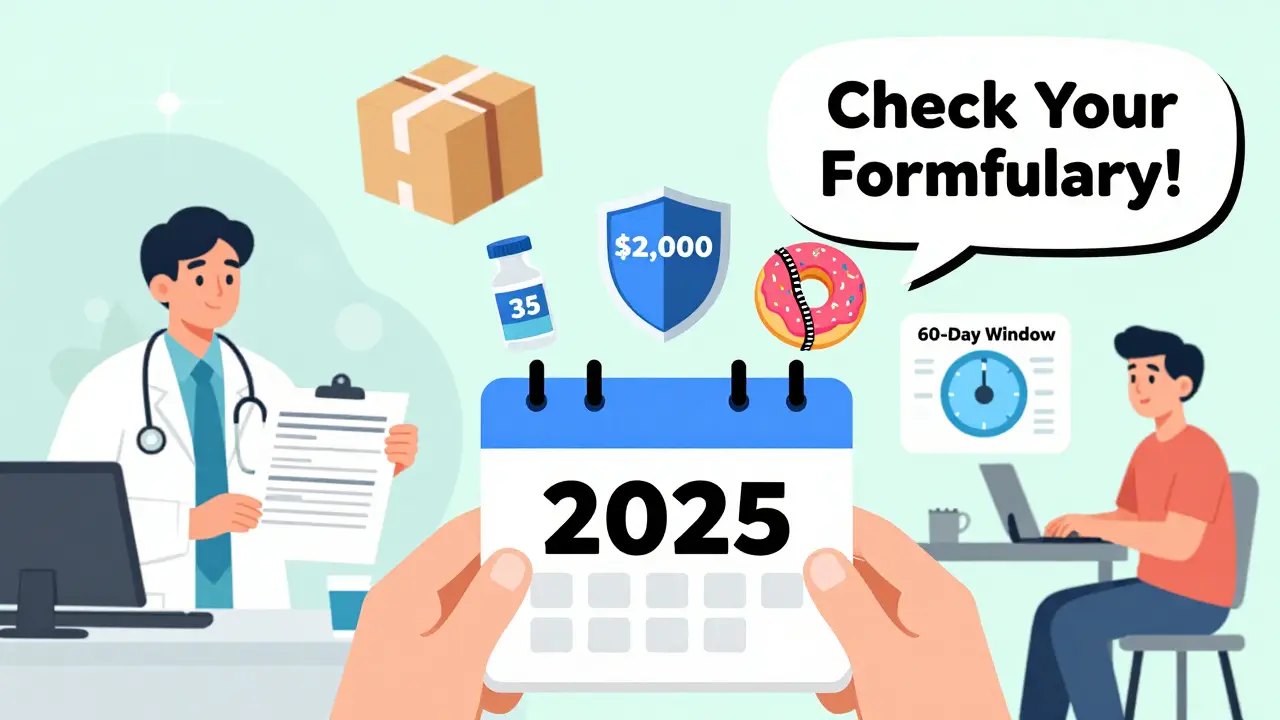
If you’re on Medicare, you need to know about the “donut hole.” In 2024, once your total drug costs hit $5,030, you enter the coverage gap. You pay 25% of the cost until you hit $8,000 in total spending. Then catastrophic coverage kicks in.But here’s the big change: Starting in 2025, the donut hole disappears. You’ll pay 25% all year, no matter how much you spend. Plus, insulin will be capped at $35 per month. That’s huge.
Even with these changes, you still need to track your spending. Ask: “How do I track my progress toward the out-of-pocket limit? Will I get a statement? Can I check it online?”
What’s the Monthly Premium vs. Annual Cost?
A low premium sounds great-until you realize you’re paying $1,200 a year in copays. Bronze plans have the lowest premiums ($452/year on average) but highest out-of-pocket maximums ($9,450). Platinum plans cost more upfront ($875/year) but cap your total spending at $3,050.If you take more than five prescriptions a year, go for Gold or Platinum. The math is simple: If your monthly drug cost is $200, you’re paying $2,400 a year in copays. A $200 higher premium saves you $2,200. That’s a net win.
Ask: “If I fill 12 prescriptions this year, how much will I pay total-premiums + copays?” Use the plan’s cost estimator tool. Enter your meds, your pharmacy, and your expected refills. Don’t guess.
Will My Drug Be Covered Next Year?
Formularies change every year. A drug you’re on now might get moved to a higher tier-or dropped entirely. That’s why open enrollment isn’t just a formality. It’s your annual checkup for your meds.In 2023, 32% of Medicare Part D beneficiaries switched plans because their drugs were no longer covered. One man in Florida had been on a $1,100 monthly medication for three years. In 2024, his plan removed it. He had to switch to a less effective alternative and ended up in the ER twice. He didn’t check his formulary until November.
Ask: “Has my medication been removed or changed tier in the last 12 months? What’s the plan’s history of removing drugs?” Look at past formularies online. If the plan won’t show them, walk away.
What’s the Maximum Out-of-Pocket Limit?
This is your safety net. It’s the most you’ll pay for covered drugs in a year. After that, the plan pays 100%. For Marketplace plans, it’s $9,450 for Bronze, $8,700 for Silver, $5,050 for Gold, and $3,050 for Platinum.For Medicare Part D, the 2025 cap will be $2,000. That’s a game-changer. But until then, you’re on the hook for everything above your plan’s limit.
Ask: “What’s my annual out-of-pocket maximum for prescriptions? Does it include what I pay toward the deductible? Is it separate from my medical out-of-pocket?”
How Do I Appeal a Denial?
If your drug is denied, you have rights. You can appeal. But you need to know how.Most plans have a three-step process: request a redetermination, then a reconsideration, then a hearing. You have 60 days to file each step. If you wait too long, you lose your chance.
Ask: “What’s your appeals process? Can I get a written copy? Do you have a form? How long does each step take?”
Also ask: “Can I get a temporary supply while my appeal is pending?” Many plans will give you 30 days of meds while you wait.
What’s Changing in 2025?
The Inflation Reduction Act is reshaping prescription coverage. By 2025, Medicare Part D will have no donut hole, insulin capped at $35/month, and a $2,000 annual out-of-pocket cap. The government will also start negotiating prices for 20 high-cost drugs-potentially lowering premiums by 10-15% by 2030.Even if you’re not on Medicare, these changes ripple through the market. Insurers are adjusting formularies now to prepare. Some are adding value-based designs-lower copays for high-value drugs like statins or diabetes meds.
Ask: “Are you updating your formulary for 2025? Will any of my drugs get better coverage?”
What if my drug isn’t covered at all?
If your drug isn’t on the formulary, you can ask for a formulary exception. Your doctor must submit a letter explaining why you need it-usually because alternatives failed, caused side effects, or aren’t suitable for your condition. Many plans approve these if the medical case is strong. Don’t assume it’s impossible. In 2023, over 60% of formulary exception requests for Medicare Part D were approved.
Can I switch plans outside of open enrollment?
Usually, no. But there are exceptions. If you move out of your plan’s service area, lose other coverage, qualify for extra help, or if your plan changes drastically (like dropping your drug), you can switch during a Special Enrollment Period. Always call your plan or Medicare to confirm eligibility before assuming you’re locked in.
Do all plans cover the same drugs?
No. Each insurer builds its own formulary. Two plans from the same company can cover completely different drugs. That’s why comparing plans using your exact medications is critical. A plan that covers your insulin might not cover your thyroid med. Always enter your full list into the plan comparison tool.
Is mail-order always cheaper?
Often, yes-especially for 90-day supplies. But not always. Some mail-order pharmacies charge higher shipping fees or don’t accept your preferred payment method. Check the total cost: drug price + shipping + handling. Sometimes your local pharmacy with a discount program beats it. Always compare.
What if I can’t afford my copay?
Many drugmakers offer patient assistance programs. Nonprofits like NeedyMeds and the Patient Access Network Foundation help with copays. Medicare Extra Help (Low-Income Subsidy) can reduce costs for those with limited income. Ask your pharmacist-they often know which programs are active for your drug.
Prescription coverage isn’t something you set and forget. It’s a living part of your health plan. Spend 20 minutes during open enrollment checking your meds. That’s all it takes to save over $1,100 a year. And if you’re on Medicare, those 2025 changes mean the next few months are your best chance to lock in the lowest possible cost for your drugs. Don’t wait until you’re at the counter with a $1,000 bill.
Emma Duquemin
December 30, 2025 AT 05:35Okay, I just got off the phone with my insurer and I’m crying-laughing because I thought my $1,200/month rheumatoid arthritis drug was Tier 3-turns out it’s Tier 4 AND they added a prior auth requirement last month. I’ve been paying $300 a fill for two years. Now it’s $900. I almost didn’t refill because I thought my card was declined. This article? Lifesaver. I’m switching plans tomorrow. No more guessing games.
Kevin Lopez
December 30, 2025 AT 09:19Formulary tiers are a tax on ignorance. If you don’t know your drug’s ACOP (adjusted cost of prescription) vs. PBM rebate structure, you’re getting fleeced. Prior auth delays = clinical risk. Mail-order mandates = logistical failure. Bronze plans are predatory. Period.
Nicole K.
December 31, 2025 AT 17:07People need to stop being lazy. If you don’t read the fine print, you deserve to pay $500 for a pill. I told my cousin this exact thing last week and she still didn’t check her formulary. Now she’s in debt. This isn’t rocket science. It’s basic responsibility.
Fabian Riewe
January 2, 2026 AT 14:07Just wanna say-this is the kind of stuff no one talks about until it’s too late. I used to think insurance was just about premiums. Then my mom needed insulin and we realized her plan had a $1,000 deductible on meds. We were paying $150 per vial until we switched to a Gold plan. Now it’s $35. The system’s broken, but knowing these questions? That’s your power move. Thanks for laying it out like this.
Amy Cannon
January 4, 2026 AT 09:03Dear fellow citizens of the great United States of America, I must say, after having navigated the labyrinthine, Byzantine, and frankly, Kafkaesque world of Medicare Part D formularies for my elderly mother, I am compelled to share that the notion of 'coverage' is often a cruel illusion. One must not only scrutinize the formulary, but also the pharmacy network, the mail-order policies, the step therapy protocols, the prior authorization timelines, the annual out-of-pocket maximums, and the ever-shifting tiers-each of which can change without notice, like a magician pulling a rabbit from a hat while you're blindfolded. And yet, despite all this, I still believe in the American dream… even if my copay doesn't.
Himanshu Singh
January 4, 2026 AT 17:05Bro this is so true! I just got back from pharmacy and my diabetes med cost me $200… i thought it was covered. I didnt check formulary because i thought my plan was good. Now i know. Next year i am going with gold. Thanks for the tips!
Greg Quinn
January 5, 2026 AT 11:33It’s funny how we treat health insurance like a subscription service. You don’t cancel Netflix if the show you want gets pulled-you just switch. But with prescriptions, people suffer silently for months because they’re afraid of ‘making a fuss.’ The real tragedy isn’t the cost-it’s the normalization of being financially vulnerable just because you’re sick.
Lisa Dore
January 6, 2026 AT 00:07Hey everyone-just wanted to add a quick tip: if you’re on Medicare, go to Medicare.gov and use their Plan Finder tool. Type in your exact meds, your pharmacy, and your zip code. It’ll show you the total annual cost, not just the premium. I saved $1,800 last year by switching just because of this. Seriously, 15 minutes can change your whole year. You’ve got this!
Sharleen Luciano
January 7, 2026 AT 18:14It’s pathetic how people expect insurance to be simple. If you can’t handle reading a 5-page formulary, maybe you shouldn’t be on prescription meds. My brother’s wife is on 7 drugs and she still didn’t check her tier. She’s lucky she didn’t end up in the ER. This isn’t a democracy-it’s a contract. Read it. Or pay.
Jim Rice
January 8, 2026 AT 12:35Actually, the real problem is that you’re all just accepting this. Why are we letting corporations decide what drugs we can afford? Why is insulin still a profit center? Why are we having this conversation at all? This isn’t about formularies-it’s about capitalism failing people who are sick. You’re all just rearranging deck chairs on the Titanic while the insurers laugh all the way to the bank.
Alex Ronald
January 9, 2026 AT 14:27For anyone wondering about formulary exceptions: I got my specialty drug approved last year after my doctor wrote a 3-page letter and I submitted lab results showing the alternatives caused severe neuropathy. Took 3 weeks, but it worked. Don’t give up. Call your plan’s pharmacy line and ask for the ‘exception request form’-they’ll send it. Most people don’t know it exists.
David Chase
January 9, 2026 AT 15:45OMG I CAN’T BELIEVE PEOPLE STILL DON’T KNOW THIS 😭😭😭 I had to fight my insurer for 6 months just to get my cancer med covered-THEY SAID IT WAS ‘NON-ESSENTIAL’ 🤡 I had to go on social media and post my receipts to get help. THIS IS A CRISIS. WE NEED TO BURN THE SYSTEM DOWN 🔥💸 #MedicareForAll #InsulinIsAHumanRight
Duncan Careless
January 10, 2026 AT 16:56Thank you for this thoughtful breakdown. I’ve worked in healthcare administration for over 15 years, and I can confirm: the complexity isn’t accidental. It’s designed to confuse. The good news? Knowledge is your shield. I’ve helped dozens of patients navigate these waters-always start with the formulary, then the pharmacy network, then the out-of-pocket max. And never, ever assume. Even if it’s been the same drug for five years. Change is coming.